Need a Canada Apostille in Valencia? Learn how to apostille your RCMP criminal record check and key documents for Spain, a step-by-step guide for Canadians living in Valencia.
Before January 2024, getting Canadian documents accepted in Spain meant mailing paperwork back to Canada, waiting weeks for Global Affairs Canada authentication, then sending everything to the Spanish embassy. This was a slow and expensive process. That all changed when Canada joined the Hague Apostille Convention on 11 January 2024. Now, a single apostille certificate is enough for Canadian documents to be recognized in Spain.
If you need a Canada apostille in Valencia, there is no need to travel back to Canada. Whether you need an RCMP Criminal Record Check for immigration, a birth certificate for registration, or another Canadian document for use in Spain, Globeia can help coordinate the apostille process from Valencia.
In this blog, you'll learn which Canadian documents can be apostilled, how the process works, when certified translations may be required, and how to obtain a Canada apostille for use in Valencia and throughout Spain.

Valencia is Spain's third-largest city and one of the fastest-growing destinations for Canadian expats. The appeal is clear with a lower cost of living than Barcelona or Madrid, a Mediterranean climate, reliable infrastructure, and a well-established English-speaking community.
Canadians come here for the Non-Lucrative Visa, for retirement, for remote work on the Digital Nomad Visa, and increasingly to put down permanent roots.
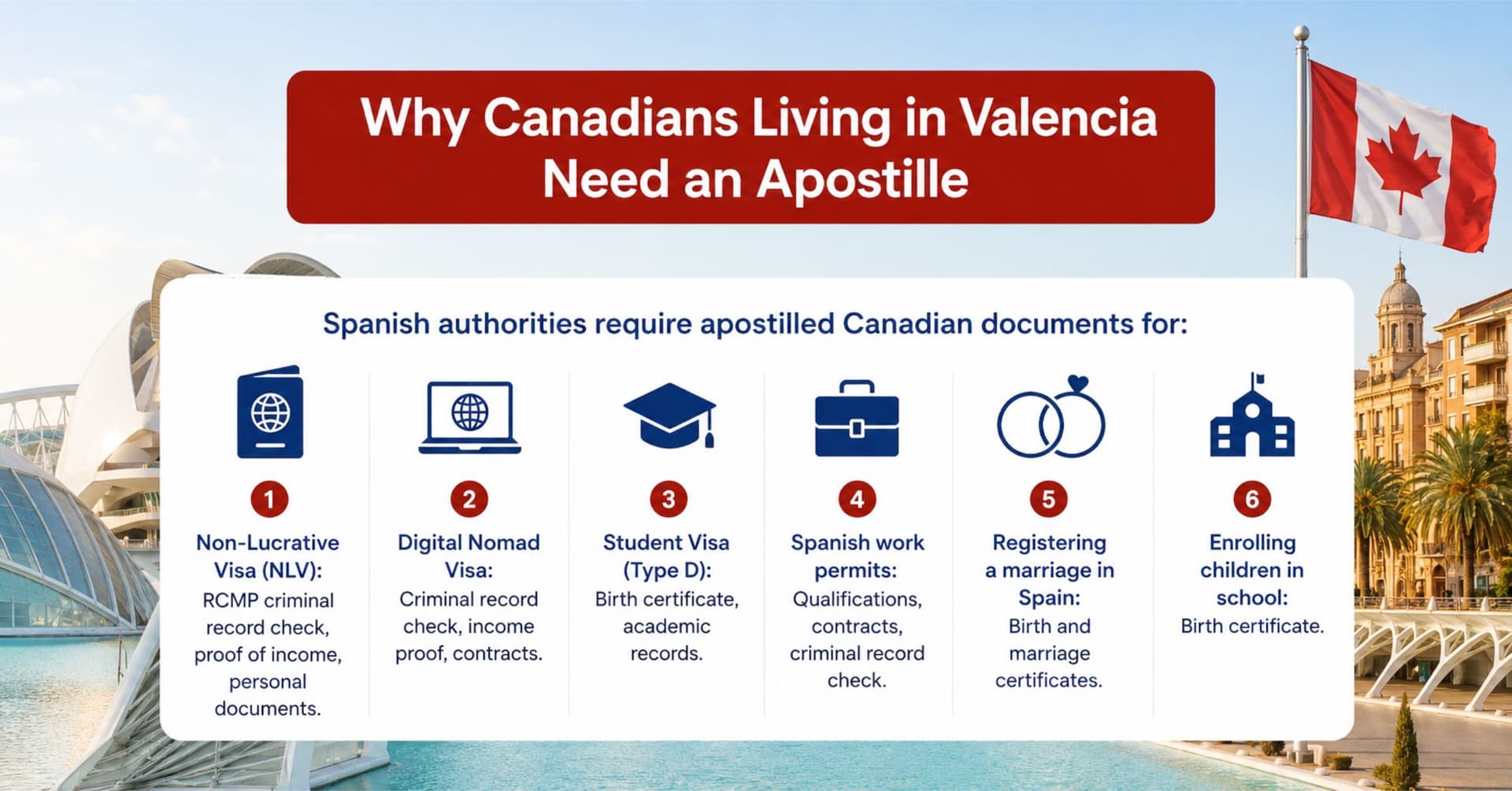
Once you are here, your Canadian documents do not stop needing official recognition. Spanish authorities require apostilled Canadian documents for:
One point that often confuses is where the apostille is issued. If you have a Canadian document, the apostille must be issued in Canada, not in Spain. The document is apostilled by the appropriate Canadian authority and then used in Spain.
Whether you live in Valencia, Madrid, Barcelona, or anywhere else in the world, the same national rules apply. Your location in Spain does not change the apostille requirements for Canadian documents.
If you need a Canada apostille in Valencia sorted without travelling home, Globeia's apostille services in Valencia can handle the full document coordination process from where you already are.
Not every Canadian document follows the same apostille route for Canada apostille Spain purposes; the process depends entirely on whether your document is federal or provincial. Getting this wrong is the most common reason applications get delayed.
Federal documents: Apostilled by Global Affairs Canada only
These are issued by the Government of Canada and can only be apostilled through the Global Affairs Canada apostille process:
Provincial documents: Apostilled by the issuing or notarising province
Private documents: Notarisation required first
Documents not issued by a government body, like contracts, employer letters, and certified copies, cannot be apostilled directly. A notary public must first sign and seal them. It is the notary's signature that gets apostilled, and the apostille comes from whichever province the notarisation took place in.
Other documents that need an apostille for Spain
The apostille requirements for supporting documents can vary depending on the Spanish authority, visa category, or purpose of the application. Requirements can differ between consulates and government offices, so always confirm the current document requirements with the authority requesting the documents before beginning the apostille process.
Not sure which category your document falls into? Globeia's team handles this question daily for Canadians in Valencia; they can confirm the correct authority before you submit anything. Just get in touch with us through email or call.
Why Spain Specifically Requires Your RCMP Criminal Record Check
Spain requires a criminal background check covering the past five years from every country an applicant has lived in, for anyone aged 18 and over. For Canadians, this means one specific document, which is the fingerprint-based RCMP criminal record check. A provincial Criminal Record Check, a name-based criminal record check, or a local police record check obtained in Valencia is typically not accepted when an RCMP criminal record check is specifically requested.
The reason Spanish consulates are strict about this, including the regional immigration offices serving the Valencian Community, is that the RCMP criminal record check searches Canada's National Repository of Criminal Records through RCMP CCRTIS- only a fingerprint-based federal check provides a definitive result tied to your biometric identity. For many Spanish long-stay visa applications, Canadian applicants must first obtain a RCMP Criminal Record Check. Once issued, the document may then need to be apostilled before it can be submitted to the relevant Spanish authority.
You will need it for:
How to Get Your RCMP Criminal Record Check from Valencia
This is where being based in Spain changes things significantly, and where most guides written for people still in Canada become unhelpful.
Electronic fingerprint submissions to the RCMP are not accepted from outside Canada. If you are living in Valencia, you cannot walk into any fingerprinting centre and expect your prints to go directly to the RCMP. The process for an RCMP criminal record check outside Canada works like this:
If no criminal record match is found, the most common outcome, the RCMP typically processes within 3 to 120 days. This is entirely the RCMP's timeline; no service provider can expedite it.
How to Apostille the RCMP Criminal Record Check from Valencia?
Once you have your RCMP criminal record check in hand, the next step is the apostille. This is where another common mistake happens, like the RCMP criminal record check is a federal document and can only be apostilled by Global Affairs Canada in Ottawa. Submitting it to any provincial apostille authority, Ontario, BC, or Alberta, will result in rejection. Provincial offices do not handle federal documents.
For an RCMP criminal record check apostille in Valencia, you have three routes:
Route A: Mail to Global Affairs Canada
Send the original RCMP criminal record check to Global Affairs Canada in Ottawa. Global Affairs Canada apostille processing takes approximately 20 business days from receipt, not including mailing time in either direction. Always check current processing times at the Global Affairs Canada website before submitting. This route works well if your original check is already being sent to Canada, but for Canadians living in Valencia, it means coordinating a cross-country mail chain from abroad.
Route B: Via the Canadian Embassy in Madrid
If you are already in Spain, this route is significantly quicker. Submit a scanned copy of your Canadian criminal record check by email to the Canadian Embassy in Madrid. The Embassy can issue apostilles on federally issued documents, including RCMP criminal record checks. For most Canadians based in Valencia, this is considered a practical choice.
Route C: Through a Professional Apostille Service Provider
If you would rather not manage the Global Affairs Canada or Embassy submission yourself, a professional service provider can handle the submission on your behalf. Globeia coordinates the apostille submission to the designated government authority, Global Affairs Canada or the Canadian Embassy in Madrid, directly from Valencia. This means your RCMP criminal record check moves through the process without you needing to navigate government portals or international mail logistics alone.
Please note that Globeia does not directly apostille official government documents and does not perform apostille services on behalf of any government authority. All apostille requests are submitted by Globeia to the designated competent government authority on your behalf. The apostille itself is issued by that authority, Global Affairs Canada.
For Canadians living in Valencia who want the process managed end-to-end, from fingerprinting, submission to the RCMP, apostille coordination, and certified translation, choosing a professional service provider like Globeia removes the coordination burden entirely.
Do Not Let Your RCMP Apostille Expire Before You Apply
Spanish consulates require that both the RCMP criminal record check and its apostille be issued within 3 to 6 months of your visa application date. The exact window varies by consulate. Some require the documents to be no older than 3 months; others allow up to 6 months. Before you start the process, confirm the specific validity window with the consulate handling your application.
If you apostille your RCMP criminal record check too early, and your visa preparation runs longer than expected, you may find the documents are out of date by the time you submit. At that point, you have to restart the entire chain from fingerprinting. To avoid this, treat apostilling your RCMP criminal record check as the last document you obtain, not the first.
For Canadians living in Valencia, Globeia coordinates the full chain from one place. Fingerprint collection in Valencia, submission to the RCMP through Globeia Incorporated in Toronto, and Global Affairs Canada apostille coordination are all handled together. You are not managing separate providers across two countries or chasing government offices from abroad.
Understanding how to apostille a document in Spain starts with one important correction that is the apostille does not come from Spain. It comes from Canada. Here is the full Canada apostille from Valencia process, step by step.
Step 1: Identify whether your document is federal or provincial
Federal documents (RCMP criminal record check, CRA letters, citizenship certificates, IRCC documents) go to Global Affairs Canada. Provincial documents go to the province that issued or notarised them, not to Global Affairs Canada.
Step 2: Obtain original certified copies for vital records
For birth certificates, marriage certificates, and other vital statistics documents, you need an original certified copy issued directly by the provincial registry, not a notarised photocopy. The apostille authority authenticates the official's signature, so the document goes straight to the provincial authority.
Step 3: Notarise private documents first
Private documents such as powers of attorney, certified true copies, employer letters, and declarations cannot be apostilled directly. They must first be signed and sealed by a notary public (or commissioner of oaths) in the province where the signing takes place. It is the notary public's signature and seal that gets apostilled, not the document itself.
Step 4: Submit to the correct authority
| Document Type | Apostille Authority |
| Federal (RCMP, CRA, citizenship, IRCC) | Global Affairs Canada apostille, Ottawa. |
| Ontario | Ministry of Public and Business Service Delivery. |
| Quebec | Quebec Ministry of Justice. |
| British Columbia | Ministry of the Attorney General. |
| Alberta | Ministry of Justice and Attorney General. |
| Saskatchewan | Ministry of Justice and Attorney General (Authentication Services). |
| Manitoba, NB, NS, NL, NWT, Nunavut, PEI, Yukon | Global Affairs Canada. |
Ways to submit a Canada Apostille:
Step 5: Get a sworn certified translation
After the document has been apostilled, it may need to be translated into Spanish for use with immigration, residency, education, or other official applications. Spanish authorities generally require translations to be completed by a Traductor Jurado (sworn translator) recognized in Spain. Standard certified translations are often not accepted for official Spanish government procedures.
If a certified Spanish translation is required after apostille, Globeia can coordinate this through a MAEC-registered Traductor Jurado as an additional service.

When preparing your documents for a Canadian apostille in Valencia, these are the six mistakes that cause the most rejections, delays, and missed visa windows.
Sending the RCMP criminal record check to a provincial authority
The RCMP criminal record check is a federal document. If you send it to Ontario's Ministry of Public and Business Service Delivery, BC's Ministry of the Attorney General, or any other provincial office, it will be rejected. Only Global Affairs Canada can apostille a criminal record check Canada document issued by the RCMP.
Using a local police check instead of the RCMP criminal record check
A local police information check is not the same as an RCMP criminal record check. Spanish consulates specifically require the fingerprint-based version, including for applicants completing an RCMP criminal record check outside Canada who are living in Valencia. Local or provincial checks will not be accepted.
Underestimating the timeline
The Global Affairs Canada apostille processing time alone is 20 business days by mail, not counting mailing time in either direction. If you add RCMP processing and sworn translation, the full process can take several weeks. Starting too late is the most common reason applicants miss their visa submission window.
Using a general translator instead of a Traductor Jurado
Spain's immigration authorities require translations by a Traductor Jurado, a sworn translator registered with Spain's Ministry of Foreign Affairs. General certified translations, even from professional agencies, will not be accepted. The Traductor Jurado's official seal must accompany every translation.
Apostilling too early and letting the document expire
Spanish consulates typically require the RCMP criminal record check and its apostille to fall within 3 to 6 months of the application date. Documents apostilled months before you plan to apply may already be out of date when you submit, requiring you to restart the whole process.
Applying to the wrong province for notarized documents
If a power of attorney was issued and notarized by an Ontario notary public, the apostille will generally be issued by Ontario because the apostille authenticates the notary's signature and seal.
Coordinating an apostille while planning an international move is genuinely a lot to manage. Between identifying the right authority, timing your RCMP check, and arranging a certified translation, there are several points where a wrong step means starting over.
Globeia is a fingerprinting and global mobility services company with RCMP accreditation through Globeia Incorporated in Toronto. Canadians already living in Spain, they also have trained associates in Valencia through Globeia, which means fingerprinting and document coordination can happen locally rather than requiring you to arrange everything remotely from abroad.
Globeia's services for Canadians heading to Spain include:
Whether you are applying from Valencia or preparing your documents before you move, Globeia's team can coordinate from fingerprinting to the apostille process, so nothing gets rejected and nothing runs out of time.
Canada's accession to the Hague Apostille Convention in January 2024 made a real difference for Canadians moving to Spain. What once required authentication through Global Affairs Canada and a separate legalization step at the Spanish embassy now takes a single apostille. For most people heading to Valencia, the fingerprint-based RCMP criminal record check remains the most time-sensitive document in the process; it needs to be apostilled, sworn-translated by a Traductor Jurado, and submitted before its validity window closes.
Valencia continues to draw more Canadians each year, and getting your Canadian documents apostilled in Valencia right from the start means your application moves without delays or rejections.
If you need support at any point in the process, Globeia's apostille services in Valencia are there to help.
“Curated insights and top reads handpicked for the Globeia community.”


Have questions or need support? Our team is here to guide you through secure, reliable background checks—anywhere in the world.
Canada
1185 Victoria Park Avenue, Toronto, ON, M4B 2K5
USA
1901 Pennsylvania Ave NW, Unit 801, Washington, DC, 20006-3405

Need help with your application or background check?
Contact us now and speak with a dedicated Globeia expert today.