Most Canadian applicants preparing for a Spain long-stay visa assume the difficult parts will be financial proof, accommodation, or securing a consulate appointment. In reality, one of the most time-sensitive and frequently misunderstood documents is the certified RCMP background check for Spain Visa.
Most Canadian applicants preparing for a Spain long-stay visa assume the difficult parts will be financial proof, accommodation, or securing a consulate appointment. In reality, one of the most time-sensitive and frequently misunderstood documents is the certified RCMP background check for Spain Visa. It is not just about requesting a police certificate. Spain requires a very specific version of the RCMP background check, followed by an apostille and a certified Spanish translation- all within a strict validity window. You miss a step, choose the wrong document type, or mistime the process, and you risk delays that can push your entire visa timeline back by weeks or even months.
This guide breaks down exactly what Canadians need to know in 2026, which RCMP criminal record check Spain accepts, how the apostille process works in Canada, realistic timelines, and how to plan this document correctly so it does not become a blockage in your visa application.
Spain requires a criminal background check from your country of origin as part of every long-stay visa application. This applies to the Non-Lucrative Visa, the Digital Nomad Visa, the Self-Employment Visa, the Job Search Visa, and most other long-stay categories. The reasoning is direct- Spain is granting you the right to live on its territory for an extended period, and the consulate needs to verify that you have no serious criminal history.
For Canadians, it's a federal-level criminal record check from the Royal Canadian Mounted Police. This is not a local police check or a Vulnerable Sector check. A specific document called the Certified Criminal Record Check, issued by the RCMP's Canadian Criminal Real Time Identification Services (CCRTIS) and issued in a form that can be apostilled for international use.
Many applicants often get this wrong at the very first step. A standard police certificate issued by a local police service, or a check run for employment purposes, does not meet the Spanish consulate's requirements. Spain wants the federal record. It wants it certified. And it wants it authenticated for international use before you submit it.
A detail many applicants miss until it delays their application is the RCMP criminal record check and your provincial criminal record check are two entirely separate documents. Spanish consulates require both, for every long-stay visa category.
The RCMP background check covers your federal criminal record- offences recorded at the national level across Canada. The provincial check captures records held at the provincial level that may not appear federally, including certain local charges and offences. These are not duplicates of each other, and one cannot substitute for the other.
You may also be required to provide additional police certificates covering places you’ve lived in Canada in the past five years. This can include provincial or local checks depending on the consulate handling your application.
The apostille process adds another layer. Your RCMP criminal record check is a federal document and must be apostilled through Global Affairs Canada. Your provincial checks are apostilled through each province's own designated authority. If you have checks from multiple provinces, each one goes through a different authority.
Start both processes together, not one after the other. If you wait for your RCMP background check before beginning your provincial checks, you’re adding avoidable weeks to your timeline.
The RCMP offers multiple types of criminal record checks, but for a Spanish long-stay visa, you need the Certified Criminal Record Check issued by the RCMP’s CCRTIS (Canadian Criminal Real Time Identification Services).
This is the official federal-level certificate accepted by Spanish consulates. It is not the same as other commonly requested checks in Canada.
RCMP criminal record check certificate is different from:
Fingerprint vs Name-Based: What Actually Works
While the RCMP does offer name-based searches, Spanish consulates expect a fingerprint-based Certified Criminal Record Check for visa applications. A fingerprint-based check:
Where as , name-based checks:

For a Spanish visa, the RCMP Certified Criminal Record Check is a fingerprint-based process. What matters is not just applying for this check but also ensuring on how your fingerprints are captured and submitted.
How the process works
An RCMP criminal record check cannot be completed entirely on your own or processed outside Canada.
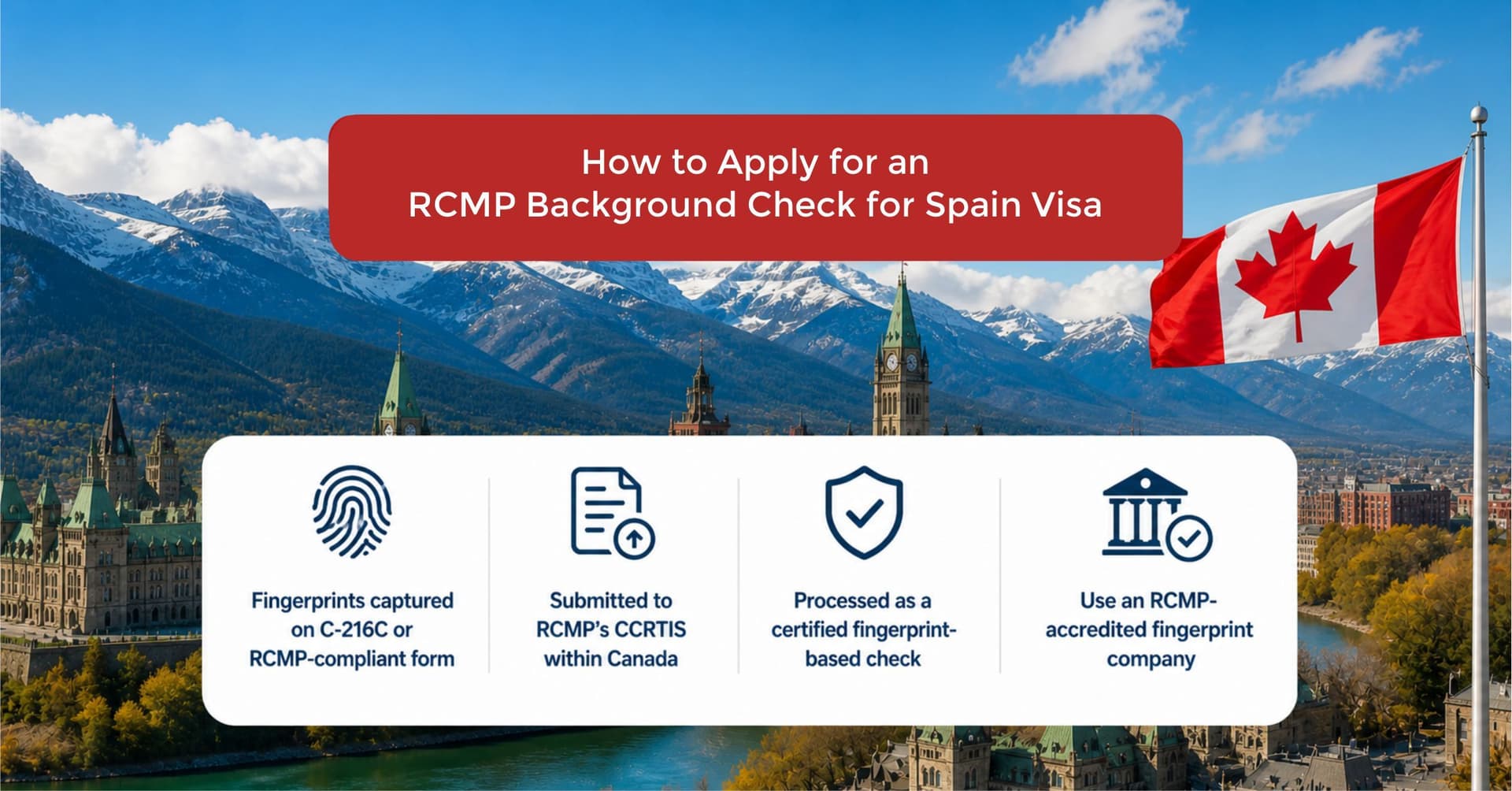
This means your application must go through Canada-based processing, and applicants must use an RCMP-accredited fingerprinting company to handle this correctly.
For an RCMP Certified Criminal Record Check, the key requirement is not only how fingerprints are captured, but how they are submitted. The RCMP does not accept paper-based fingerprint submissions for criminal record checks directly from individuals.
All fingerprint-based submissions must be processed through an RCMP-accredited company in Canada. These companies are authorized to capture fingerprints on the official C-216C form or equivalent form, then digitize them, and submit them electronically through the RCMP’s CCRTIS system. This submission pathway is the only accepted method for processing fingerprint-based criminal record checks.
Mailing physical fingerprint cards directly to the RCMP is not a valid submission method for individuals and will not be processed. And for this reason, an RCMP-accredited provider is required to ensure your fingerprints are correctly converted, submitted, and processed without delays or rejection.

On discovering how technical this process is, applicants choose to work with an RCMP-accredited fingerprinting company like Globeia to ensure everything is handled correctly from start to finish. Globeia is an RCMP-accredited company with a Canada-based office in Toronto, specializing in criminal record checks for immigration and international visa purposes.
Fingerprints are captured in RCMP-compliant formats such as the C-216C form or equivalent forms and are submitted through their Canadian office directly into the RCMP’s CCRTIS system. This ensures the application follows the only accepted processing route and reduces the risk of rejection caused by incorrect formatting, poor-quality prints, or submission errors.
For applicants dealing with Spanish visa requirements, this also matters from a documentation standpoint. Globeia is familiar with immigration-specific use cases and supports the entire workflow beyond just the RCMP background check, including apostille services and certified sworn translation, so everything is managed under one roof. This helps in ensuring the RCMP certificate is processed, authenticated, and translated in the correct sequence, reducing the risk of delays caused by handling multiple providers or misaligned steps.
For applicants outside Canada or those who cannot manage the submission logistics themselves, using an accredited provider ensures that the entire process- from fingerprint capture to RCMP submission is handled within Canada under the correct regulatory framework, rather than attempting to navigate it independently from abroad.
Once your RCMP background check for Spain visa purposes is issued, the apostille process begins. Receiving your RCMP certificate is not the finish line. Before it can be submitted to a Spanish consulate, it needs an apostille- a standardized international authentication stamp under the Hague Convention that confirms the document is genuine and was issued by an authorized authority.
Both Canada and Spain are signatories to the Hague Apostille Convention, which means apostille is the accepted authentication method. Embassy legalization is neither required nor accepted.
Who issues the apostille for the RCMP certificate?

The RCMP certificate is a federal document, which means the apostille authority is Global Affairs Canada in Ottawa and not your provincial authority. This applies regardless of which province you live in or which consulate handles your visa application. Provincial apostille authorities handle provincially issued documents. Your RCMP background check always goes to Global Affairs Canada.
How long does Global Affairs Canada take?
Global Affairs Canada processing times vary with workload and submission method- current turnaround times should be confirmed directly at the time you apply, as they shift throughout the year. The RCMP background check itself can arrive within 2 to 4 weeks. The apostille on top of it can take twice as long.
The reason why the RCMP background check needs to be one of the very first things you initiate- well before your consulate appointment is on the calendar.
After the apostille: certified translation
Once your apostilled RCMP certificate is in hand, there is still one final step before it is consulate-ready. Spanish consulates require a certified Spanish translation completed by a sworn translator- a traductor jurado. General translation services are not accepted regardless of the translator's qualifications.
The translation must be completed after the apostille is in place, not before. Sworn translators translate the full document as presented, apostille included. Translating before the apostille is attached means the translation is incomplete and will need to be redone.
Criminal record checks submitted to Spanish consulates must have been issued within the six months before your application date. The clock starts from the date printed on your RCMP certificate, not the date you ordered it, and not the date the apostille was attached. The apostille does not reset the validity window.
This creates a timing challenge that many applicants do not anticipate, especially those applying from Toronto where consulate appointment wait times can extend to 8-12 weeks during peak periods.
If you request your RCMP background check today and receive it in approximately three weeks, and then the apostille process at Global Affairs Canada takes several additional weeks, the overall timeline can extend well into the validity window before your consulate appointment even takes place.
Because of this, timing becomes critical. The RCMP check should be submitted for apostille as soon as it is issued, and the full visa timeline including consulate appointment booking, should be planned around both processing and apostille durations, not just document issuance. With Globeia, applicants can streamline this process through faster coordination between RCMP submission and Canada-based handling, helping reduce delays caused by sequencing gaps and administrative handoffs.
While the RCMP background check always goes to Global Affairs Canada, your provincial criminal record check is apostilled by your province's designated authority and these differ by province.
| Province | Apostille Authority |
| Ontario | Ontario Ministry of Public and Business Service Delivery |
| British Columbia | BC Ministry of Attorney General |
| Alberta | Alberta Ministry of Justice |
| Saskatchewan | Saskatchewan Ministry of Justice |
| Quebec | Ministère de la Justice du Québec |
| Manitoba, Nova Scotia, New Brunswick, PEI, Newfoundland and Labrador, Yukon, NWT, Nunavut | Global Affairs Canada |
If you have lived in multiple provinces, each check is apostilled by the authority of the province that issued it, not by the one where you currently live.
The RCMP certificate and its apostille sit on the critical path of your visa application. Everything else like your health insurance, financial documentation, medical certificate, can be prepared in parallel without hard dependencies. The RCMP background check has a hard dependency. Also an apostille cannot begin until the check exists, and translation cannot begin until the apostille is complete.
A realistic timeline for applicants:
Add to this the consulate appointment wait times- around 8 to 12 weeks in Toronto during peak periods, and somewhat shorter in Vancouver and Montreal. And most applicants should plan for a total preparation timeline of at least 5 to 6 months. The Global Affairs Canada apostille requirement applies uniformly across all provinces. The main variation in timelines comes from consulate appointment availability, not the federal processing steps.
The process above is feasible but it involves coordinating multiple authorities, managing strict document validity windows, and ensuring every step is completed in the correct sequence. For most applicants, the complexity is not in any single step, but in keeping everything aligned while simultaneously preparing the rest of the visa application.
Globeia is an RCMP-accredited fingerprinting and background check provider with a Canada-based office that manages the RCMP criminal record check process end-to-end for individuals applying for Spanish visas and other international immigration requirements.
If you’re trying to decide whether to handle this yourself or go through a service, here are a few key things to keep in mind:
Accreditation and correct form compliance
Globeia captures fingerprints using the RCMP-compliant C-216C form or equivalent form. The specific format required for fingerprint-based submissions. Incorrectly captured or improperly formatted fingerprints are rejected by the RCMP, which means starting over and losing weeks of your timeline.
Submission from within Canada
RCMP fingerprint-based checks must be submitted from within Canada. Globeia's Canadian office handles this directly, which is relevant for Canadians who cannot easily manage Canadian government submissions themselves.
Experience that counts
With over a decade of experience and more than 30,000 clients served, Globeia has processed enough RCMP background checks for immigration purposes to understand exactly which document version consulates require, how to sequence the apostille correctly, and where applications commonly run into problems.
Data security
Your personal information and biometric data are handled under strict compliance standards throughout the process.
Human support throughout
At every stage of the process, you have access to real people who understand immigration document requirements and not automated responses or generic customer service.
A portal that keeps you informed
Rather than chasing status updates across multiple government systems, Globeia provides a dedicated tracking portal where you can see exactly where your documents are at any point in the process and what has been submitted, what is in processing, and what is coming back. For applicants managing a full visa package across multiple document categories, this visibility removes a significant source of stress.
Applicants order the wrong type of check, such as a vulnerable sector or employment check, instead of the required Certified Criminal Record Check for Spanish visas. Another common issue is submitting fingerprints on the wrong form. The RCMP requires Form C-216C; incorrect formats are not processed.
Some applicants also send their RCMP certificate to a provincial authority for apostille, when all federal documents must go to Global Affairs Canada. Another common issue is missing the requirement for a provincial criminal record check, particularly if you have lived in more than one province.
Timing mistakes are equally critical like if your RCMP or provincial check exceeds the six-month validity window before submission, you may need to restart the process. Finally, skipping the sworn Spanish translation after apostille can lead to rejection, as only certified translations by a traductor jurado are accepted.
The RCMP background check is one of the most important and time-sensitive steps. Between fingerprint submission, processing, apostille through Global Affairs Canada, and certified translation, everything needs to happen in the right order and within a limited validity window. Most delays happen not because the process is difficult, but because it’s started too late or handled incorrectly. Plan it early, follow the correct sequence, and it is suggested for applicants to use a more streamlined approach, working with an RCMP-accredited provider like Globeia can help ensure everything is handled correctly from the start.
“Curated insights and top reads handpicked for the Globeia community.”


Have questions or need support? Our team is here to guide you through secure, reliable background checks—anywhere in the world.
Canada
1185 Victoria Park Avenue, Toronto, ON, M4B 2K5
USA
251 Post Street, Unit-300, San Francisco, CA, 94108

Need help with your application or background check?
Contact us now and speak with a dedicated Globeia expert today.