If you're a Canadian living in New Zealand, chances are you stopped counting the months here a while back; you've got a routine now, a GP, maybe even an opinion on the best fish and chips in town. Then, out of nowhere, an employer, immigration consultant, or visa application asks for an RCMP Criminal Record Check from New Zealand, and suddenly Canada feels a lot further away than it actually is.
The first assumption most people make is that this means booking a flight home. It doesn't. The process runs through a specific form and an accredited company back in Canada, and getting the order wrong is exactly what causes most delays.
This blog walks you through exactly the whole process in getting the RCMP Criminal Record Check, the mistakes that quietly cause delays, and what to prepare before you even begin.
Yes. Applicants outside Canada can obtain a fingerprint-based RCMP Criminal Record Check.
Your fingerprints are first collected on paper in New Zealand. Because electronic fingerprint submissions cannot originate from outside Canada, the physical form must be sent to an accredited fingerprinting company in Canada. That Canadian company digitises the impressions and submits them electronically to the RCMP’s Canadian Criminal Real Time Identification Services. The RCMP then processes and issues the Criminal Record Check.
This overseas route is different from a New Zealand criminal record request, Canadian immigration biometrics, and a Canadian vulnerable sector check.
Nobody applies for a Canadian criminal record check for fun. Something specific has asked for it, and in New Zealand, that something almost always traces back to time you spent in Canada or an organisation that wants to know about it. The common thread: when your history includes Canada, only the RCMP can document that chapter, no matter how clean your New Zealand record is.
Are You Applying for Immigration or a Visa?
Immigration files are the biggest trigger, but they work in two different directions, and the difference matters.
Immigrating to Canada?

Here is what surprises people: IRCC generally checks your Canadian record internally. Its police certificate requirement covers countries where you lived six months or more, but not time spent in Canada itself. An officer can still request additional documents at their discretion, and some citizenship applications do require certificates, so always read your document checklist rather than assuming.
Immigrating anywhere else?This is where the RCMP check becomes essential. If you lived in Canada and you are now applying for residence or a long-stay visa in another country, that country cannot access Canadian records, so it asks you for the fingerprint-based RCMP Criminal Record Check:
| Your situation | Who verifies your Canadian record |
| Canadian PR application | IRCC, internally; certificates required for other countries you lived in |
| Canadian citizenship application | Police certificates required; confirm your checklist on IRCC’s official site |
| Visa or residency for another country | You, by providing the RCMP Criminal Record Check yourself |
One practical note: immigration requirements can change, so always confirm the current document list for your specific stream on IRCC’s official site before you begin.
Do You Need It for Employment, Adoption, or Licensing?
The second group has nothing to do with visas, and it catches people off guard because the request often arrives late in the process.
| Who is asking | What they usually expect |
| Canadian employer or recruiter | RCMP Criminal Record Check covering your time in Canada |
| Adoption authority | Fingerprint-based check as part of the full dossier |
| Licensing or registration body | Fingerprint-based national check, sometimes with an apostille |
| Volunteer organisation | Varies; confirm before you book fingerprinting |
Whatever the situation, ask one question before anything else: do they need a name-based check or a fingerprint-based RCMP Criminal Record Check? The fingerprint-based version is the national, federally issued document and the one accepted most widely, but confirming upfront saves you from paying for the wrong process.
Short answer: yes, completely. They answer the same question, “does this person have a criminal record?”, but each country only answers for itself.
Think of it this way. Your New Zealand document, issued by the Ministry of Justice, reports what is on file in New Zealand. Your RCMP Criminal Record Check reports what is on file in Canada. Neither one can see across the ocean, which is exactly why an authority asking about your Canadian years will not accept a New Zealand document, no matter how spotless it is.
Here is the side-by-side view:
| RCMP Criminal Record Check | New Zealand Criminal Record Check | |
| Covers | Your record in Canada | Your record in New Zealand |
| Issued by | Royal Canadian Mounted Police (RCMP) | New Zealand Ministry of Justice |
| Based on | Fingerprints | Your name and identity details |
| Requested for | Canadian history: third-country visas, Canadian employment, adoption, licensing | New Zealand history: local jobs, visas, tenancy, volunteering |
| Can it replace the other? | No | No |
One more thing people mix up: the RCMP check is fingerprint-based, which is why it is treated as the definitive national document in Canada. New Zealand’s check is name-based, which is fine for its own purposes, but it tells the requesting authority nothing about Canada.
So the rule of thumb is simple. Match the document to the country being asked about. New Zealand questions need a New Zealand answer. Canadian questions need the RCMP.
Every Canadian Criminal Record Check from New Zealand follows the same cross-border route: local ink fingerprint collection, digitisation in Canada, and electronic submission to the RCMP. From New Zealand, the whole process comes down to three stages. You control the first two, and the choices you make there decide how smooth the third one goes.
Stage I: What Happens During the New Zealand Fingerprint Stage?
Everything starts with ink fingerprinting. The RCMP requires original, rolled ink fingerprints, and scanned, photocopied, or emailed prints are never accepted. The official form is the C-216C, and this is the version worth aiming for.
That said, the RCMP does accept fingerprint forms from foreign countries, provided they contain all of the following:
Your two options for getting fingerprinted in New Zealand:
| Option 1: Try it yourself | Option 2: Book a private fingerprinting agency | |
| Where | A New Zealand Police station, but read the fine print below | A private fingerprinting business, or your own address if they offer mobile appointments |
| The form | You source and bring it yourself; stations do not stock Canadian forms | Ask upfront whether they stock the C-216C or an accepted equivalent |
| Quality | Depends on the officer’s familiarity with foreign forms | Should include an on-the-spot quality review with immediate retakes |
| Identity check | Passport or valid photo ID required | Formally verified, often with a written record of collection |
According to New Zealand Police (Ngā Pirihimana o Aotearoa), fingerprinting for immigration and employment checks is handled by private businesses across much of the country, and in those regions, police stations do not offer the service at all; outside them, some major police stations may still provide it.
Outside those regions, major stations may still help, but availability varies and you must call ahead.
None of this makes DIY impossible. It just means the legwork is yours: confirming a station that will do it, sourcing the right form, making sure the officer signs and stamps it, and checking print quality yourself, with any mistake surfacing weeks later in Canada rather than on the day.
If you go with a private agency instead, a few questions are worth asking before you book:
Stage II: Why Must the Physical Fingerprint Form Be Mailed to Canada?
Because the RCMP does not accept fingerprint submissions from outside Canada. Every application from abroad must be digitised and electronically submitted by an RCMP-accredited company operating in Canada. There is no online portal for overseas applicants and no direct mail route to the RCMP itself.
So your form’s next destination is not the RCMP. It is an accredited company’s Canadian office.
If you are managing this yourself, your first task is choosing that company, and honestly, this is the fiddliest part from New Zealand. The RCMP publishes its list of accredited fingerprinting companies, but the list is long, each company has its own intake forms, fees, ID requirements, and delivery options, and you will be comparing them from the other side of the world, across time zones. It is doable; it just asks for patience. Once you have chosen, your courier package to their Canadian office typically needs:
Use a trackable courier. This envelope carries the only copy of your fingerprints, and the standard post gives you no visibility if something goes wrong.
If you would rather not manage that chain, this is where a full-coordination provider earns its keep: your form travels to their accredited Canadian office as part of the same appointment, the paperwork is reviewed before dispatch, and you follow progress through a tracking portal instead of chasing couriers across time zones. It is the same RCMP process underneath; you are simply choosing how much of the coordination you want to own.
Stage III: What Happens After the Fingerprints Reach Canada?
Your personal role ends here, and that is worth understanding clearly: you cannot submit fingerprints to the RCMP yourself, and neither can any New Zealand agency. From this point, only two parties touch your file.
First, the accredited company in Canada:
Then, the RCMP itself:
Processing times range from 3 to 120 days and are determined entirely by the RCMP based on application volume and individual circumstances. Mailing time is additional. No accredited company, agency, or applicant can shorten this stage, so the honest advice is simple: make the first two stages flawless, and then let the RCMP work.
Once complete, the result is delivered according to the option on your application, mailed directly to your address in New Zealand or returned through your accredited company for faster, tracked courier delivery.
A self-managed application generally costs around NZD 320–650, while a coordinated company service may cost approximately NZD 450–800 or more. The final amount depends on fingerprinting, courier choice, Canadian submission charges, and result delivery.
| Cost Stage | DIY Route | Coordinated Company |
| Ink fingerprint collection in New Zealand | NZD 55–150 | May be included or charged separately |
| Courier to Canada | NZD 50–120 | Often included in the package |
| Canadian digitisation and submission | CAD 125–195 | Usually included |
| Federal processing fee | CAD 25 | added separately |
| Result delivery | CAD 25–75 | May include tracked delivery |
| Estimated total | NZD 320–650 | NZD 450–800+ |
The CAD 25 federal processing fee is payable to the Receiver General of Canada, not to the RCMP. Overseas fingerprint digitisation generally costs approximately CAD 125–195.
Note: Apostille, translation, repeat fingerprints, and express international delivery are normally additional.

If piecing all of this together from New Zealand feels like a lot to manage alone, you are not wrong, and you are not alone either. Thousands of applicants across dozens of countries have faced the same chain of forms, couriers, and waiting. That is exactly why Globeia exists.
Behind the New Zealand appointments stands Globeia Incorporated in Toronto, Canada, which is accredited by the RCMP to take and submit civil fingerprint verification requests to the RCMP for civil purposes.
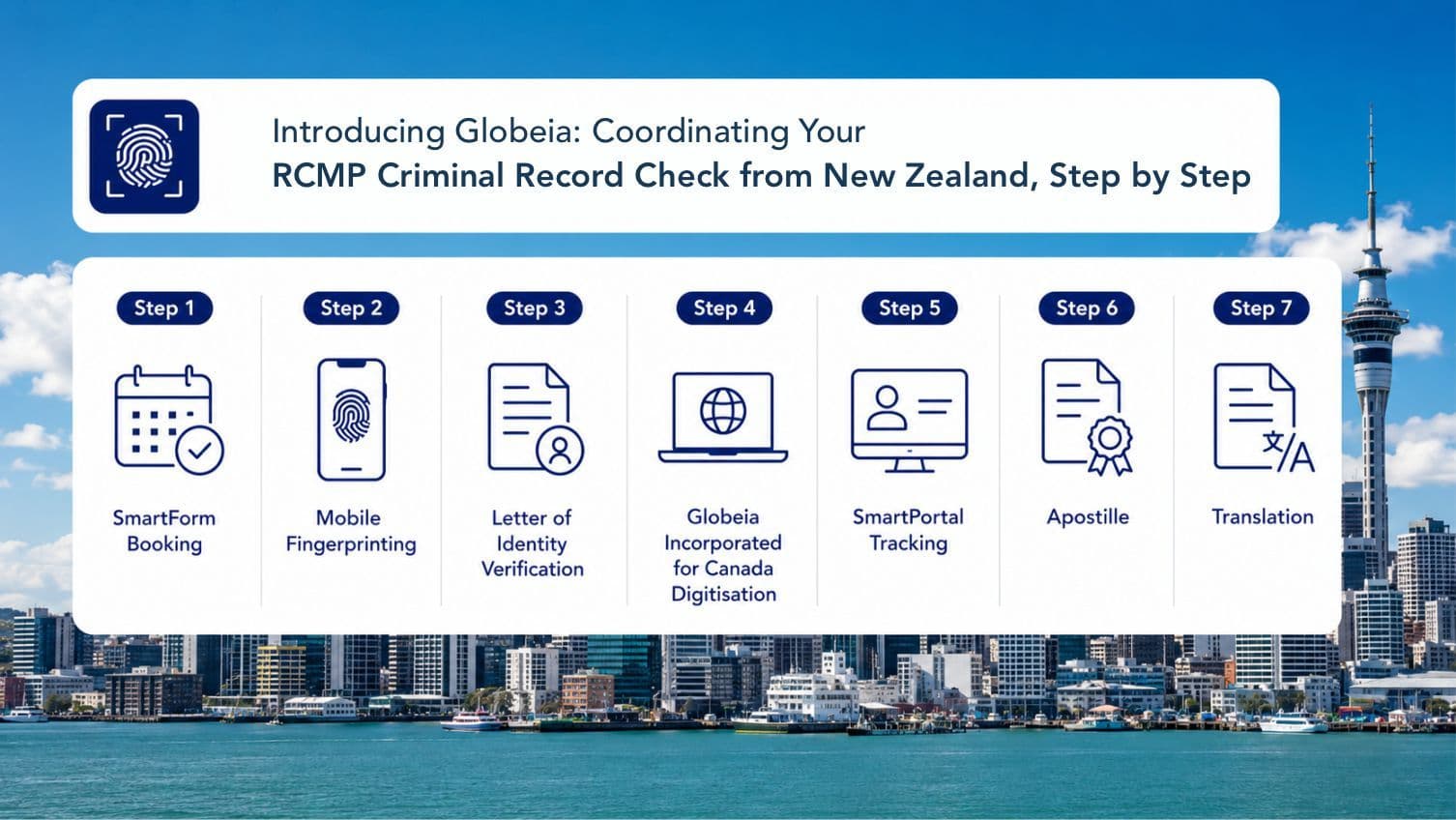
Step 1: SmartForm Booking
Everything begins with the SmartForm, where you share your details, your purpose, and your location. A quick Face ID verification confirms the booking is genuinely yours, and your appointment is locked in.
Step 2: Mobile Fingerprinting
From Auckland and Wellington to Christchurch, Hamilton, Dunedin, and the towns in between, a trained associate travels to your home or office with the official C-216C form and ink equipment. No station hunting, no form sourcing, no wondering whether the prints will pass. Every impression is reviewed on the spot before the associate leaves.
Step 3: Letter of Identity Verification
After your appointment, you receive Globeia's Letter of Identity Verification, an exclusive document confirming your fingerprints were collected by a trained associate following rigorous identity verification protocols, complete with a unique encrypted QR code for tamper-proof authentication.
The Letter of Identity Verification is issued by Globeia and is not issued by, endorsed by, or affiliated with the RCMP, the FBI, or any government authority.
Step 4: Globeia Incorporated for Canada Digitisation
Your completed form is couriered securely to Globeia Incorporated in Toronto, where it is digitised and electronically submitted to the RCMP's CCRTIS system through the accredited channel. No courier shopping, no intake forms, no time zone juggling on your end.
Step 5: SmartPortal Tracking
While the RCMP processes your file, you are never left guessing. The SmartPortal shows your application moving through each stage, with updates you can check from your phone in New Zealand whenever you like.
Step 6: Apostille and Translation
If the authority receiving your check also needs an apostille or a certified translation, Globeia coordinates both after your certificate is issued, in the correct order, so your document arrives complete rather than almost complete.
Please note that Globeia does not directly apostille official government documents and does not perform apostille services on behalf of any government authority. All apostille and authentication requests are submitted by our company to the designated competent government authority on your behalf.
Already Have Your Fingerprints Taken?
Then you are closer than you think. If your prints were recently collected on the C-216C or an accepted equivalent, Globeia can pick up your application from the Canada stage: digitisation, submission, tracking, and any apostille or translation you need.
Mention it on the SmartForm and the team will confirm whether your existing form qualifies before you pay for anything new.
Globeia's mobile ink fingerprint collection is available across New Zealand. A trained associate travels to your home, office, hotel, or any agreed location, bringing the official C-216C or equivalent form and everything needed for a clean, submission-ready set of prints. No searching for a fingerprinting facility, no taking a day off to cross the city.
Coverage spans New Zealand’s main centres and keeps growing:
| Region | Areas Covered |
| Auckland | CBD, Ponsonby, North Shore, Manukau, West Auckland, Mount Eden, and surrounding suburbs |
| Wellington | Wellington City, Lower Hutt, Upper Hutt, Porirua, and the Kapiti Coast |
| Canterbury | Christchurch, Riccarton, Papanui, Rolleston, and nearby towns |
| Waikato | Hamilton, Cambridge, and surrounding areas |
| Bay of Plenty | Tauranga, Mount Maunganui, and Papamoa |
| Otago and Southland | Dunedin, Queenstown, and Invercargill |
| Other regions | Reach out with your address; additional locations are supported subject to appointment availability |
Living outside the main centres? Do not count yourself out. Smaller towns and rural addresses are regularly accommodated, and the booking team will confirm coverage for your exact postcode before anything is scheduled, so there are no surprises on the day.
Every appointment, wherever it happens, follows the same careful routine: your identity is verified, your prints are rolled in ink and reviewed on the spot, and you receive Globeia’s Letter of Identity Verification before the associate leaves. From the far north to the deep south, the process is identical, and so is the care behind it.
Book through the SmartForm, add your address, and we will take it from there.
Most delays here aren't bad luck. They're small slips in the two stages you actually control, and each one carries a real cost if missed.
An RCMP Criminal Record Check from New Zealand does not require you to fly to Canada, but part of the application must still take place there.
New Zealand handles the physical identity and ink fingerprint stage. An accredited company in Canada handles digitisation and electronic submission. The RCMP handles the record search, processing, and issuance.
Still confused about how to get an RCMP Criminal Record Check? Get in touch today!
“Curated insights and top reads handpicked for the Globeia community.”


Have questions or need support? Our team is here to guide you through secure, reliable background checks—anywhere in the world.
Canada
1185 Victoria Park Avenue, Toronto, ON, M4B 2K5
USA
1901 Pennsylvania Ave NW, Unit 801, Washington, DC, 20006-3405

Need help with your application or background check?
Contact us now and speak with a dedicated Globeia expert today.