You applied for a Criminal Record Check and received a potential match result. Before you start worrying, the most important thing to understand is this: a potential match does not mean you have a criminal record.
It means the RCMP found a name, date of birth, or combination of personal details in their database that closely resembles yours and requires further verification. This happens more often than most people expect. The majority of applicants who receive this result are cleared once fingerprint verification confirms their identity.
Globeia Incorporated, accredited by the RCMP to collect and submit civil fingerprints to the RCMP for civil screening purposes, helps applicants in Canada and internationally resolve potential match situations and complete their RCMP Criminal Record Check applications. This guide explains what a potential match is, why it happens, what the RCMP does next, and how to move through the process without unnecessary delays.

A potential match is generated when the RCMP's system finds one or more records in the National Repository of Criminal Records that share similar identifying details with your application.
When you apply for a Criminal Record Check, also called a name-based check, the system searches that database using your full name, date of birth, and other personal details. If it finds a record with similar details, it flags the result as a potential match. At that point, the check cannot be completed without further verification.
The RCMP has not determined that you have a criminal record. It has determined that the personal details submitted are not precise enough to distinguish you with certainty from another individual in the system. Fingerprints resolve this because no two people share the same fingerprint pattern.
When a name-based Criminal Record Check returns a potential match, the police agency or third-party company is required by the RCMP Dissemination of Criminal Record Information Policy to issue the following standard response:
"Based on the names, date of birth, sex and criminal record information declared by the applicant, we were unable to complete a search of the RCMP National Repository of Criminal Records. To confirm whether a criminal record exists, the applicant is obligated to send fingerprints to the RCMP through an authorized police agency or RCMP-accredited private fingerprinting company."
The RCMP uses the word "obligated." If you receive this result, sending fingerprints is not optional. The Criminal Record Check cannot be completed without them.

This is one of the most important distinctions to understand before you proceed.
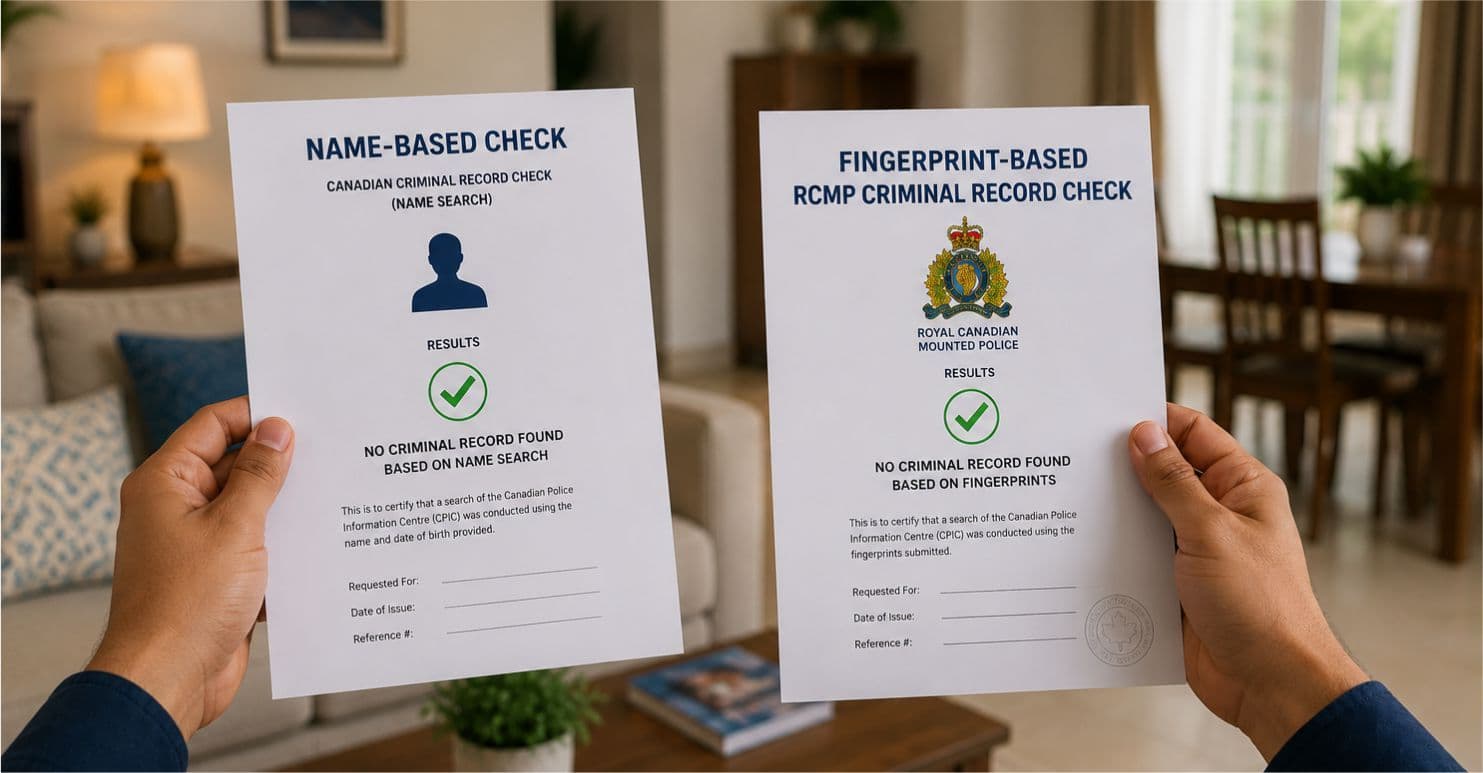
A name-based Criminal Record Check produces a Police Information Check product. This is not an RCMP Criminal Record Check. The report issued to you must state clearly that an absolute confirmation of a criminal record can only be done through fingerprint comparison.A fingerprint-based submission produces a Criminal Record Check product issued by CCRTIS (Canadian Criminal Real Time Identification Services) only after a fingerprint comparison has been completed. This is the product that employers, immigration authorities, and professional registration bodies require when they ask for an RCMP Criminal Record Check.
If you received a potential match on a name-based check, you will need to proceed to fingerprint submission. The result of that fingerprint submission is what produces the RCMP Criminal Record Check certificate.
| Pathway 1 | Pathway 2 | Pathway 3 | |
| How applied | Name-based check only | Name-based check, then fingerprints after match | Fingerprint-based RCMP Criminal Record Check from start |
| Result product | Police Information Check | RCMP Criminal Record Check | RCMP Criminal Record Check |
| Accepted by AHPRA, IRCC, international employers | Not always | Yes, once issued | Yes |
| Accepted by AHPRA, IRCC, international employersTimeline (no record found) | 3 business days | 3-120 business days | 3 -120 business days |
| Who issues the result | Police agency or third-party | CCRTIS only | CCRTIS only |
The end certificate from Pathway 2 and Pathway 3 is the same RCMP Criminal Record Check. The difference is time. If the requesting authority requires this certificate, starting with a fingerprint-based RCMP Criminal Record Check from the beginning is always the faster and more reliable route.
A name-based Criminal Record Check relies entirely on the accuracy and uniqueness of the personal details provided. If those details closely resemble someone else's in the database, the system cannot make a definitive identification. Several factors make a potential match more likely:
Common Names
If your name is shared by many people in Canada, particularly common first and last name combinations, the probability of a database overlap increases. The RCMP's national database contains records from every province and territory.
Similar Dates of Birth
When two individuals share both a similar name and a close or identical date of birth, the search algorithm is more likely to flag a potential match.
Previous Aliases or Name Changes
If you have used different names in the past, through marriage, legal name change, or otherwise, records associated with a former name may surface. The RCMP policy requires that all names, including given names, surnames, surnames at birth, and any legal name changes, are searched.
Data Entry Variations
Spelling differences, abbreviated versions, or transcription variations between records can contribute to a match flag even where the two individuals are clearly different people.
Junior and Senior Name Patterns
Where a parent and child share the same name and have records in the system, searches can surface results from both.
None of these situations mean a criminal record exists. They mean the name-based search has reached its limit and the identity question requires biometric confirmation.
A potential match is not a confirmed criminal record. It is not a finding of guilt. It does not appear on your final certificate as a negative result. It is an internal verification step that requires the RCMP to confirm your identity before it can issue a result.
Many employers, immigration authorities, and registration bodies understand this distinction. A potential match that resolves through fingerprint verification and results in a clean certificate does not affect the outcome of your application. What matters is the final RCMP Criminal Record Check certificate issued by CCRTIS after fingerprint verification is complete.
The RCMP follows a specific sequence once a potential match is identified.
The RCMP Flags the Submission for Further Review
The automated search cannot resolve the match on its own. The file moves to a manual review stage within the RCMP's Canadian Criminal Real Time Identification Services (CCRTIS) division.
A Fingerprint Request Is Issued
If fingerprints were not part of the original submission, the RCMP requires them at this point. The requesting authority or accredited fingerprinting agency will notify you that fingerprints are now required. Under the RCMP Dissemination Policy, you are obligated to send fingerprints to CCRTIS through an authorized police agency or an RCMP-accredited private fingerprinting company.
Fingerprints Are Collected
You attend an appointment with an RCMP-accredited fingerprinting provider. In Canada, accredited providers may capture fingerprints electronically using Live Scan technology and submit them directly to CCRTIS. If you are outside Canada, ink fingerprints are taken on a C-216C fingerprint card and submitted to a Canadian accredited agency for further submission. In both cases, two valid pieces of identification are required at the appointment. One must be government-issued and include your name, date of birth, signature, and photograph.
Fingerprints Are Submitted to CCRTIS
In Canada, Live Scan submissions go directly to CCRTIS electronically. Ink fingerprint cards are couriered back to Canada; they are digitized by the agency, then submitted to the CCRTIS system. The RCMP then processes the fingerprints against its Canadian Police Information Centre (CPIC) biometric database.
The RCMP Conducts Identity Verification
The RCMP compares your fingerprints against the record that triggered the potential match. This comparison determines definitively whether the record belongs to you or to another individual.
The RCMP Issues the Final Result
Once identity is confirmed, the RCMP independently issues your Criminal Record Check certificate. If the record does not belong to you, the certificate reflects that no criminal record was found. If the record does belong to you, the certificate will reflect that. The RCMP Criminal Record Check is issued directly by the RCMP. It is not issued by Globeia Incorporated or any other provider.
If You Are in Canada
RCMP-accredited fingerprinting providers use Live Scan technology to capture fingerprints electronically and submit them directly to the RCMP's Canadian Criminal Real Time Identification Services (CCRTIS). Because the submission is electronic, it eliminates the need to ship a physical fingerprint card, making the process faster while producing the same RCMP Criminal Record Check.
If You Are Outside Canada
Live Scan fingerprinting is only available at RCMP-accredited locations within Canada. If you are outside Canada, your fingerprints are collected using ink on an RCMP-approved C-216C fingerprint card by a qualified fingerprinting provider. The completed fingerprint card is then securely couriered to Canada, where it is converted into the required electronic format and submitted to CCRTIS for processing.
Does the Fingerprinting Method Change the Result?
No. Whether your fingerprints are captured electronically using Live Scan or on an RCMP-approved C-216C fingerprint card, the RCMP processes them through CCRTIS and issues the same RCMP Criminal Record Check. The method of fingerprint capture does not affect the content or validity of the final certificate.
In some cases, yes. The RCMP Dissemination Policy includes a pathway called Confirmation of Declared Criminal Record (Section 12). If an applicant declares their criminal record in advance on a separate form, and the declared record exactly matches the record held in the National Repository of Criminal Records, the police agency may be able to confirm the record without requiring a fingerprint submission.
This pathway applies only when the applicant's identity has been verified, informed consent has been obtained, the declared criminal record is an exact match to the record in the RCMP's database, and the record does not involve flagged pardoned sex offender records.
If you know you have a criminal record and want to declare it, speak to the accredited provider handling your application before your appointment. This pathway does not apply to applicants who do not have a criminal record and are dealing with a name-based potential match.
Fingerprints are the only biometric identifier the RCMP uses to make a definitive identity determination. No two individuals share the same fingerprint pattern, including identical twins. When your fingerprints are submitted in response to a potential match, the RCMP compares them directly against the fingerprint records associated with the flagged criminal record. If the prints do not match, the RCMP confirms there is no record linked to you and issues a clean certificate. The flagged record belongs to someone else.
The quality of the fingerprint impression affects how quickly this comparison can be completed. Poor quality prints caused by dry skin, worn fingerprint ridges, movement during impression, or incorrect ink pressure may not produce a clear enough image for comparison. If the RCMP cannot read the prints, you will need to attend another appointment and resubmit, adding more time to an already extended process.
Processing times are determined entirely by the RCMP. No fingerprinting provider, agent, or applicant can influence or accelerate the RCMP's internal review timeline.
According to the RCMP's published processing times:
| Situation | RCMP Processing Time |
| No match to a criminal record | Within approximately 3 business days |
| Possible match identified, identity verification required | Up to 120 business days |
| Criminal record confirmed after fingerprint comparison | Additional review may be required |
A note on business days vs calendar days: Business days exclude weekends and Canadian public holidays. 3 business days is approximately one working week. 120 business days is approximately 24 working weeks, or roughly six calendar months. These are RCMP-set timeframes. Mailing time for physical fingerprint cards is additional and is not included in these figures.
The 120-business-day figure is the upper limit for potential match cases. It is not the average. Processing time within that range depends on how quickly the fingerprint submission is received by CCRTIS, current submission volumes, and whether additional manual review is needed.
When you attend your fingerprinting appointment in response to a potential match, or when applying for a fingerprint-based RCMP Criminal Record Check from the start, bring the following:
Two Valid Pieces of Identification
The RCMP requires two valid pieces of ID. One must be government-issued and include your name, date of birth, signature, and photograph. A Canadian passport and driver's licence together meet this requirement. The name on your ID must match the name on your application exactly. Photocopies of both IDs are required for submission purposes.
RCMP Reference Number or Notification Letter
If you received a notification about the potential match, bring this documentation. It contains reference details needed during submission.
CCRTIS-Approved Consent Form
For RCMP submissions, the CCRTIS-approved consent form is required by CCRTIS.
Any Additional Supporting Documents
If the requesting authority, such as an employer, immigration body, or professional regulator, has provided a request letter or specific instructions, bring a copy to your appointment.
A potential match is most consequential where a criminal record check is mandatory and the requesting authority requires a clean certified result before proceeding.
Immigration and Permanent Residency
IRCC requires criminal history documentation as part of many immigration applications. A potential match that delays certificate issuance can push back application timelines significantly.
Healthcare and Professional Registration
AHPRA in Australia, regulatory bodies in the UK and EU, and provincial colleges in Canada all require criminal record checks before granting professional registration. A delayed certificate can hold up a registration that employment depends on.
Childcare, Education, and Volunteer Positions
Roles involving children or vulnerable populations require criminal history clearance before the person can begin work. A potential match that takes weeks to resolve can delay a start date.
Government Employment and Security Clearances
Federal and provincial government positions requiring security clearances depend on a completed criminal record check as part of the vetting process.
Financial Services and Licensing
Regulatory bodies for financial advisors, mortgage brokers, insurance professionals, and similar roles require criminal history checks as a condition of licensing.
International Employment
Many international employers and credentialing bodies require an RCMP Criminal Record Check specifically and will not accept alternative documents if the check has not yet been issued.
RCMP processing timelines are outside your control once a submission is under review. These steps reduce delays on your side.
Act on the Notification Immediately
Every day between receiving the notification and attending your appointment is time added to the overall process. The RCMP begins its timeline from the date it receives your fingerprint submission, not from the date you received the notification.
Use an RCMP-Accredited Provider
Only submissions from RCMP-accredited providers are accepted by CCRTIS. A submission from a non-accredited provider will not be processed. You will need to start again from the beginning.
Bring Both Required Pieces of Identification
If your identity cannot be verified at the appointment because your ID is missing, expired, or does not match your application, the appointment cannot proceed.
Ensure Your Prints Are Taken Correctly
Providers who complete RCMP submissions regularly understand the quality standards CCRTIS requires. A clean set of prints submitted once is significantly faster than a rejected set that requires a second appointment and resubmission.
Submit Complete Documentation
If the accredited provider or the RCMP requests additional supporting documents, supply them promptly. An incomplete submission remains in a pending state until the required information arrives.
Waiting for a Deadline Before Starting
The 120-business-day window is roughly six calendar months. Applicants who begin only after receiving a job offer or visa approval date frequently find the timeline does not fit their deadline.
Using a Name-Based Check When a Fingerprint-Based RCMP Criminal Record Check Was Required
If the requesting authority requires an RCMP Criminal Record Check and you submitted a name-based check, the result is a Police Information Check product that the authority will not accept. Confirm the required check type before applying.
Using a Non-Accredited Fingerprinting Provider
Fingerprint submissions from non-accredited providers are rejected by CCRTIS. The entire submission is invalid and must be redone with an accredited provider.
Personal Details That Do Not Match Your Identification
Discrepancies between your application and your ID, including spelling variations, middle name differences, or date of birth format errors, can contribute to a potential match flag or cause delays during review.
Ignoring the Notification
A potential match does not resolve on its own. Fingerprint verification requires action on your part. The sooner you submit, the sooner the RCMP can complete its review.
A fingerprint impression on a C-216C card, or a Live Scan capture in Canada, is the physical input CCRTIS uses to conduct its biometric comparison. If the impression is unclear, the comparison cannot be completed accurately. Prints that do not meet CCRTIS quality standards are returned for reprinting, meaning another appointment, another submission, and more time added to an already extended timeline.
Factors that produce poor quality prints include dry or recently washed hands, worn fingerprint ridges, excessive ink, insufficient ink, and movement during the roll. Experienced fingerprinting associates know how to prepare fingers correctly, apply the right amount of ink, and execute the roll at the right speed. Providers who complete RCMP submissions regularly produce consistently better print quality than those who do so infrequently.

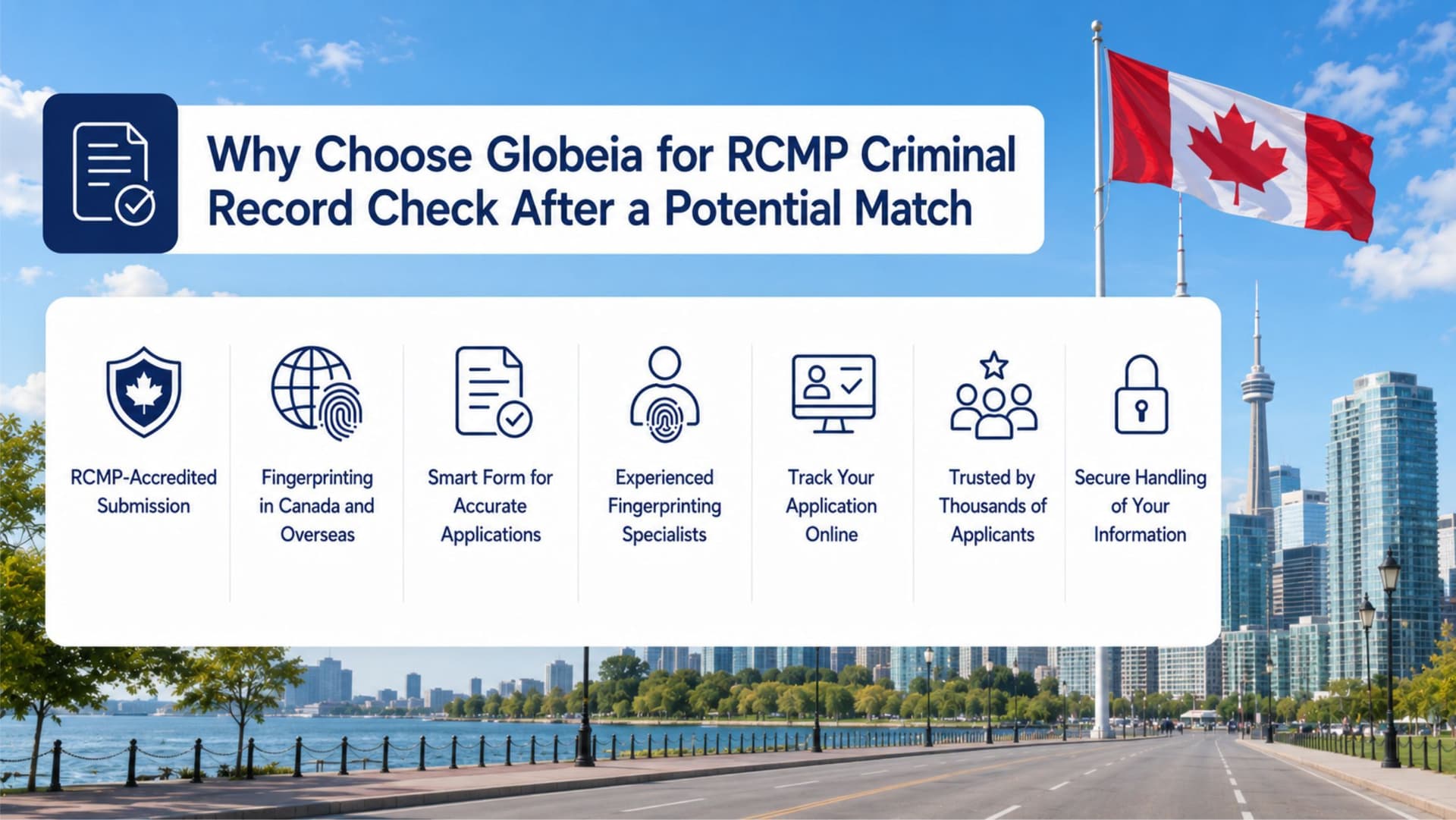
Receiving a potential match notification can delay your Criminal Record Check, especially if fingerprint verification is required. Globeia helps you complete the process correctly from the start by providing RCMP-compliant fingerprinting, secure submission, and expert guidance throughout every stage.
RCMP-Accredited Submission
Globeia Incorporated in Toronto is accredited by the RCMP to submit civil fingerprint verification requests to the Canadian Criminal Real Time Identification Services (CCRTIS). Your fingerprints are processed through an accredited Canadian office that meets RCMP requirements.
Applicants in Canada can visit Globeia for Live Scan digital fingerprinting. If you're outside Canada, Globeia's international network captures ink fingerprints on an RCMP-approved C-216C fingerprint card, which is securely sent to Globeia Incorporated in Toronto for electronic submission to the RCMP.
Globeia's Smart Form helps reduce common application errors by collecting your information accurately before submission. Correct personal details help minimize unnecessary processing delays.
Globeia's trained fingerprinting professionals follow RCMP quality standards to capture clear, high-quality fingerprints, reducing the risk of rejected prints and repeat appointments.
With Globeia's secure SmartPortal, you can monitor every stage managed by Globeia, from appointment confirmation and fingerprint submission to certificate delivery.
More than 30,000 applicants have trusted Globeia for RCMP Criminal Record Checks for immigration, professional licensing, employment, and international document requirements.
Your identity documents, fingerprints, and personal information are handled securely, with data stored in Canada in accordance with applicable privacy standards.
A potential match on a Criminal Record Check is a verification step in the identity confirmation process. It is not a determination that a criminal record exists.
It is triggered when a name-based check returns records that share similar details with your application. Fingerprint verification resolves it by confirming your identity through biometric comparison, which name-based checks cannot do. The result of that fingerprint submission is an RCMP Criminal Record Check certificate issued directly by CCRTIS, the only body authorised to issue it.
The process adds time. Depending on the RCMP's review outcome, it can add up to 120 business days, roughly six calendar months, to your overall timeline. Acting quickly once you receive notification, using an RCMP-accredited fingerprinting provider, and ensuring your prints are taken the first time correctly are the most effective ways to move through the process without adding further delays.
For applicants where timing matters, including immigration deadlines, employment start dates, and professional registration, starting with a fingerprint-based RCMP Criminal Record Check rather than a name-based Criminal Record Check is the most reliable way to avoid the potential match process entirely.
If you have received a potential match notification or want to avoid one by starting with a fingerprint-based submission, contact Globeia Incorporated to book your fingerprinting appointment.
“Curated insights and top reads handpicked for the Globeia community.”


Have questions or need support? Our team is here to guide you through secure, reliable background checks—anywhere in the world.
Canada
1185 Victoria Park Avenue, Toronto, ON, M4B 2K5
USA
1901 Pennsylvania Ave NW, Unit 801, Washington, DC, 20006-3405

Need help with your application or background check?
Contact us now and speak with a dedicated Globeia expert today.