By Sejal Jain · Updated July 1, 2026
Australia continues to attract Canadians not just lifestyle but for higher average salaries, strong job demand in skilled professions, employer-paid superannuation, and generous annual leave make the move appealing for many Canadians. Add a similar language, familiar culture, and milder winters, and the transition often feels more manageable than moving to many other countries.
That said, moving to Australia requires planning. Immigration is based on a structured points system where age, education, work experience, and English ability all matter. Processing times, skills assessments, and choosing the right visa pathway can also affect how quickly you can move.
This guide explains the visa options most Canadians consider, how the points system works, expected costs, job opportunities, taxes, healthcare, and long-term residency pathways. If you're thinking about relocating to Australia in 2026, this guide will help you understand what to expect and how to prepare.
Yes, Canadians can move to Australia, but there isn’t one simple visa that lets you relocate just because you want to. Australia uses a structured immigration system, and your options depend on factors like your age, education, work experience, profession, and English ability.
Canada and Australia have a strong relationship and many similarities, including language, education standards, and professional qualifications. Because of this, Canadian degrees and work experience are often recognized more easily. However, this doesn’t mean Canadians get a special shortcut. Like everyone else, Canadians still need to qualify through a specific visa pathway.
Australia’s system is clear and structured. If you meet the requirements, moving from Canada to Australia is very possible. The most important step is choosing the visa that fits your situation before starting the process.
It can be easier for some Canadians, especially depending on age, work experience, and profession. Canadians aged 18 to 35 often start with the Working Holiday Visa, which allows them to live and work in Australia for up to 12 months. Many applicants use this as a first step to explore job opportunities and consider longer-term options.
For skilled professionals, moving to Australia depends more on your occupation, experience, and points score. If your profession is in demand and you meet the requirements, permanent residency pathways can be realistic. However, eligibility varies from person to person, so checking your points and visa options early helps you understand the best path forward.
Australia offers both temporary and permanent visa pathways, and understanding the difference matters. Temporary visas include options like the Working Holiday Visa, employer-sponsored temporary visas, and graduate visas. These allow you to live and work in Australia for a set period, often with the possibility of transitioning to permanent residency later.
Permanent visas, such as skilled independent or state-nominated visas, grant long-term residency from the start. These are more competitive but provide immediate stability, access to healthcare, and a clear path to citizenship.
Many Canadians begin with a temporary visa and transition to permanent residency once they’ve gained Australian work experience or employer sponsorship.
In 2026, moving to Australia is more competitive than it was a few years ago, but it's still very possible if you understand how the points system works. Australia uses a clear points-based system where your age, education, work experience, and English ability all affect your chances.
For many skilled visas, recent invitation cut-offs especially in fields like IT, engineering, and professional roles often sit around 85 to 90 points. Applicants with 70 points or less may wait much longer for an invitation, sometimes 12–18 months or more, depending on occupation and demand.
The helpful part is that the system is transparent. You can calculate your points, review recent invitation scores, and see what improvements such as better English scores, more experience, or state nomination could increase your chances. Many applicants run into delays simply because they apply with a low score without realizing what’s currently competitive.

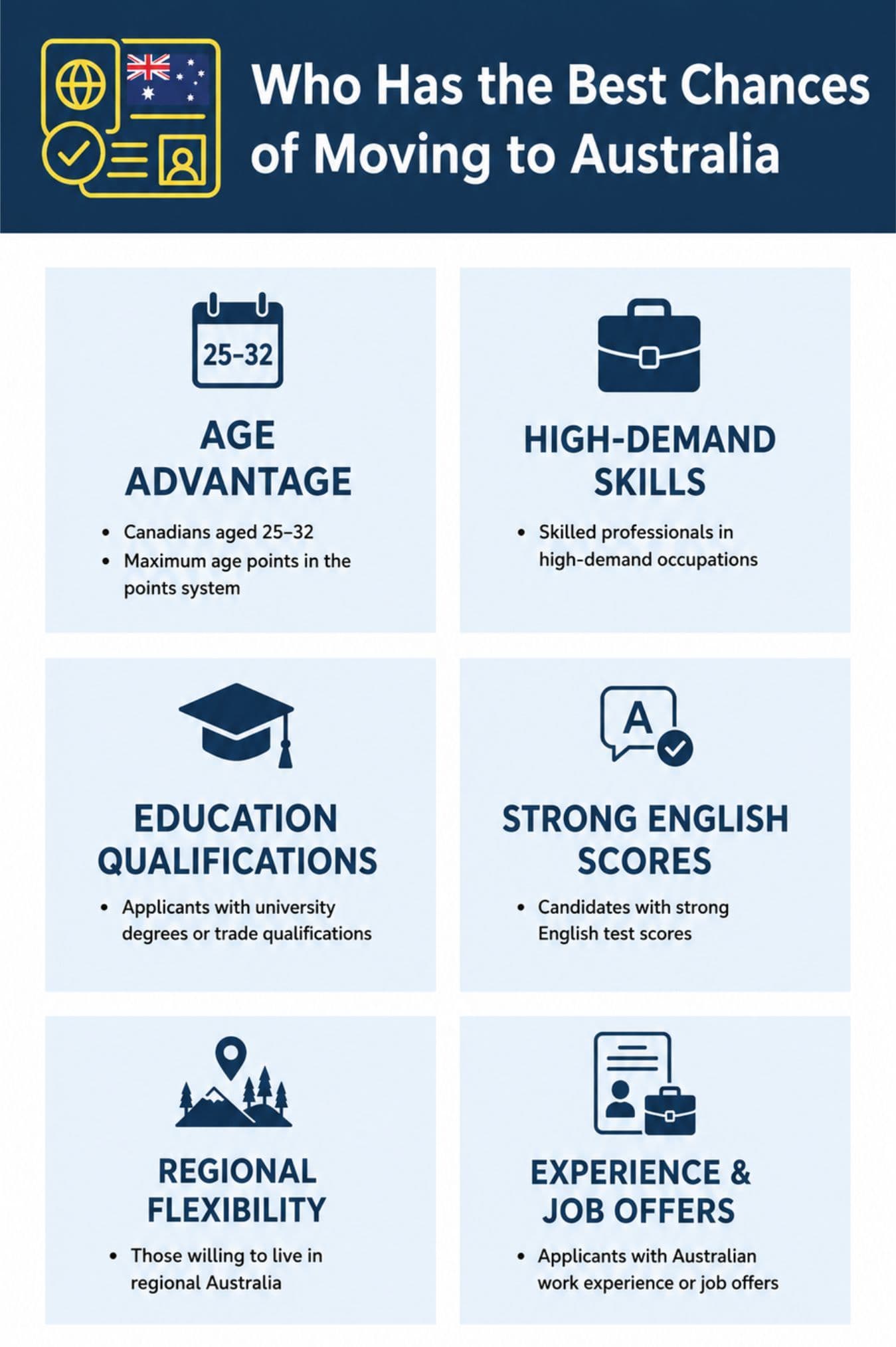
Some Canadians naturally have stronger chances, especially those who score higher in the points system. Generally, applicants with the best chances include:
Age plays a bigger role than many people expect. Applicants aged 25–32 receive the maximum 30 points, but this gradually drops after age 33 and becomes more challenging after 40. For applicants in their late 30s, state nomination or regional visas often make the difference by adding extra points and improving invitation chances.
There isn’t one single pathway, but understanding your strengths early helps you choose the most realistic route.
Australia isn’t a new destination for Canadians, but more people are seriously considering it and the reasons are mostly practical.
Money is often the first factor. Wages in healthcare, construction, engineering, and tech are higher in many cases. Australia’s national minimum wage sits around AUD $24.95 per hour, and median full-time salaries are close to AUD $95,000 per year. Skilled professionals frequently earn AUD $100,000 to $130,000, depending on experience and location.
There’s also superannuation, where employers contribute 12 % of your salary (rising to 12%) into retirement savings on top of your pay not from it. Most full-time workers also receive four weeks of paid annual leave as standard. For Canadians used to funding their own RRSP and starting with two weeks of vacation, the difference can feel significant.
The weather is another big shift. Sydney averages around 300 sunny days a year, and Brisbane winters rarely drop below 10°C. After long Canadian winters, many people find themselves spending more time outside walking, exercising, or simply enjoying the climate.
It’s not just about beaches. The milder weather often changes daily routines and makes weekends easier to plan year-round.
Australia continues to face shortages in healthcare, engineering, IT, construction, and trades. This creates real opportunities for Canadians with relevant qualifications and experience.
Many applicants aren’t just finding jobs they’re finding roles that connect directly to permanent residency pathways. Australia’s immigration system is designed to attract skilled workers, which works in favour of Canadians in these fields.
Australia’s public healthcare system, Medicare, is available to permanent residents and citizens. For Canadians, the system feels familiar and relatively easy to navigate.
Beyond healthcare, Australia offers modern cities, good infrastructure, and a strong work-life balance. Combined with higher salaries, this often changes the overall lifestyle equation.
One of the biggest advantages for Canadians is that English is the primary language. Job hunting, renting, and everyday tasks feel more straightforward than moving to a non-English-speaking country.
There are also cultural similarities, workplace expectations, social norms, and humour feel familiar. Many Canadians describe the move as recognisable, just warmer and better paid.
For many people, it’s this mix of higher earnings, better weather, strong job demand, and an easier transition that makes Australia stand out in 2026.
This quick comparison highlights why Australia often feels familiar to Canadians, despite the significant distance between the two countries.
| Category | Canada | Australia |
| Population | ~39 million | ~27 million |
| Official Language | English (and French federally) | English |
| Currency | Canadian Dollar (CAD) | Australian Dollar (AUD) |
| Time Zones | 6 time zones | 3 time zones |
| Distance (Toronto to Sydney) | - | ~16,000 km |
| Flight Time | - | ~20–22 hours (one stop) |
Australia’s immigration system is structured and points-based, which means your chances depend on factors like age, education, work experience, occupation, and English ability. Instead of one general visa, Australia offers different pathways based on your profile and long-term plans.
The useful part of this system is that you can calculate your points before applying. This helps you understand where you stand, what you may need to improve, and how competitive your profile is compared to recent invitation rounds published by the Australian Department of Home Affairs.
Most Canadians move to Australia through skilled migration, employer sponsorship, family visas, or temporary visas that can later lead to permanent residency. Many skilled visa applications begin with an Expression of Interest (EOI) submitted through the SkillSelect system. Invitations are then issued based on demand, occupation shortages, and your overall points score.
Choosing the right pathway early is important. One of the most common mistakes is starting the wrong occupation or visa route. A skills assessment alone can take 2 to 5 months and may cost AUD $500 to $1,000, depending on the assessing authority. If you choose the wrong pathway, you may lose both time and money, which is why planning carefully at the beginning helps avoid delays later.
Australia’s skilled migration system is based on points. Your score is calculated using factors such as your age, education, skilled work experience, English language ability, and sometimes state nomination. The higher your score, the better your chances of receiving an invitation to apply.
You don’t apply directly for many skilled visas. Instead, you first submit an Expression of Interest (EOI) through SkillSelect. The Australian government and individual states then review candidates and invite those with competitive scores in occupations that are in demand.
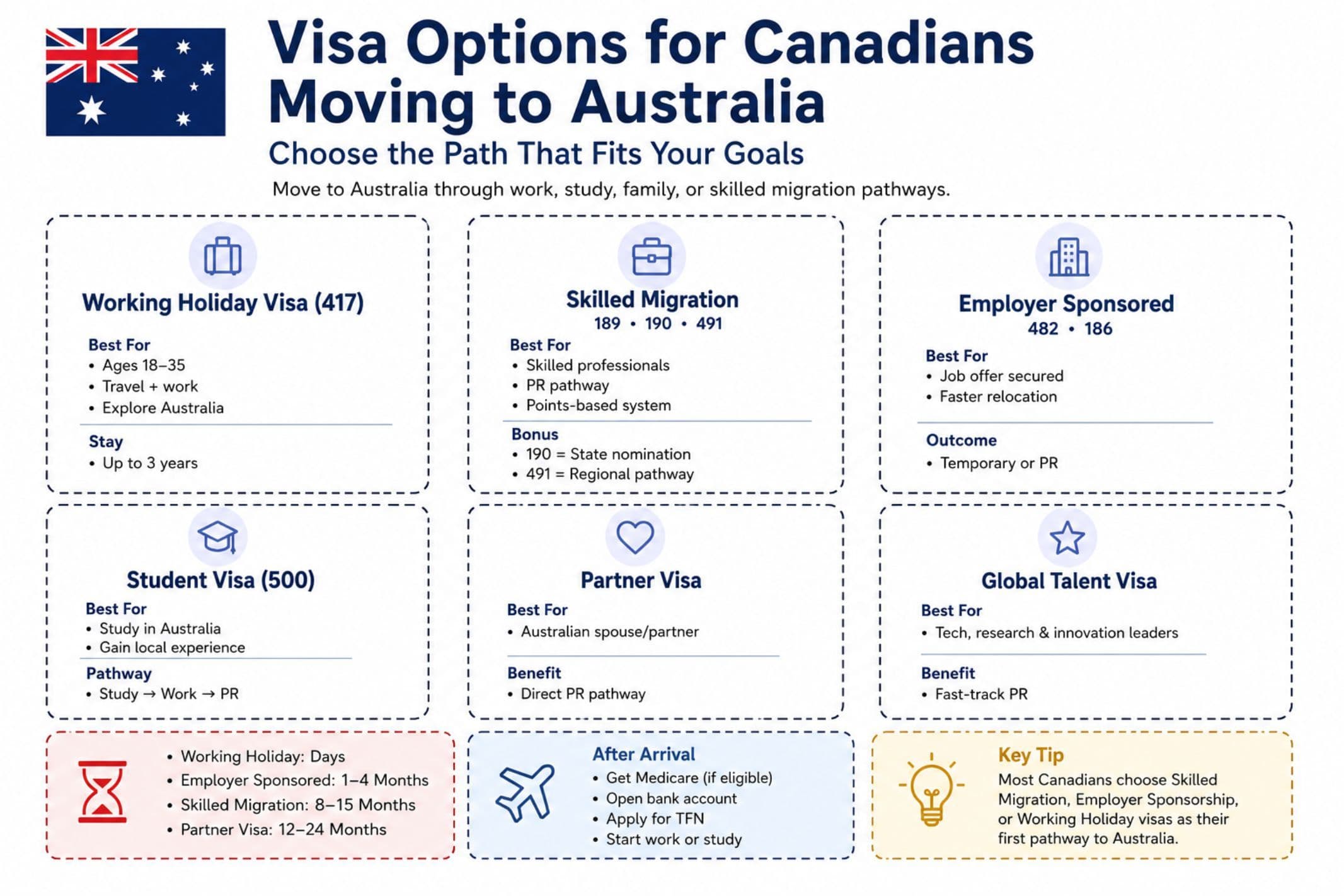
The most common visas under this system include the Skilled Independent Visa (189), Skilled Nominated Visa (190), and Skilled Work Regional Visa (491). These visas are popular with Canadians because they don’t always require a job offer and can lead directly to permanent residency.
Skilled migration and employer sponsorship are the two main pathways for Canadians moving to Australia. Skilled migration allows you to apply independently without needing a job offer. This pathway is often ideal for professionals in healthcare, engineering, IT, construction, education, and trades.
Employer sponsorship works differently. In this case, an Australian employer offers you a job and agrees to sponsor your visa. The Temporary Skill Shortage visa (482) is a common starting point, and many applicants later transition to permanent residency through the Employer Nomination Scheme (186).
Employer-sponsored visas can sometimes be faster, but they depend on securing a job offer first. Skilled migration, on the other hand, gives you more flexibility but may take longer depending on your points score and occupation demand.
Australia offers both temporary and permanent visa options, and many Canadians move through a combination of both. Temporary visas allow you to live and work in Australia for a limited time. These include Working Holiday visas, temporary employer-sponsored visas, and student visas.
Many Canadians start with temporary visas to gain Australian work experience and then transition to permanent residency. This approach can improve your chances and open more long-term opportunities.
Permanent visas, such as Skilled Independent (189), Skilled Nominated (190), and Employer Nomination (186), allow you to live in Australia indefinitely. Permanent residents can access public healthcare, work without restrictions, and eventually apply for Australian citizenship.
State nomination is another important part of Australia’s immigration system. Each Australian state and territory has its own list of in-demand occupations and can nominate applicants who meet their local workforce needs.
State nomination often adds additional points to your application, which can significantly improve your chances of receiving an invitation. In return, applicants are expected to live and work in the nominating state for a certain period.
For Canadians with competitive skills but slightly lower points, state nomination can be one of the most effective pathways to permanent residency.
Processing times vary depending on visa type, occupation demand, and how complete your application is. Skilled migration visas can take several months to over a year, while employer-sponsored visas are often processed faster once a job offer is secured.
Australia also sets annual migration caps, which means competition can vary each year. Submitting your Expression of Interest when your profile is strongest can improve your chances of receiving an invitation sooner.
While the process requires planning and documentation, Australia’s immigration system is designed to be predictable and transparent. For Canadians who meet the criteria, the pathway from planning to permanent residency is realistic and achievable.

Before reading the visa details, ask yourself one question: do you need to be in Australia within the next few months, or can you wait 12 to 24 months for a stronger application? If speed matters, the Working Holiday Visa or a 482 employer sponsorship moves fastest. If long-term stability is the priority, the 189 or 190 is worth the longer process. The visa that sounds best is rarely the visa that's actually right for your situation.
The WHV is the fastest way into Australia most applications are decided within 24 to 48 hours online, and the fee is under AUD $700. What it doesn't give you is certainty: you're limited to six months with any single employer, which prevents you from building the deep Australian work history that speeds up a 190 application. Use it as a scouting year. Figure out which city fits, land a good employer, and use that relationship to transition to a 482 or points-based visa. One thing most people don't find out until they're already planning a second or third year: the regional work required for year two (88 days) and year three (179 days) means physically demanding labour in agriculture, construction, or disaster recovery. Know this before you factor a multi-year WHV into your plan.
Who It's For
This visa is designed for young Canadians who want flexibility. It's ideal if you want to travel, work casually, or test life in Australia before committing to permanent residency. Many professionals also use this visa to move first and then secure skilled employment.
Eligibility Requirements
To qualify, you must:
Hold a Canadian passport
Be between 18 and 35 years oldHave at least AUD $5,000 in savingsMeet health and character requirementsNot have dependent children accompanying youThe application process is simple and usually completed online, with decisions often made quickly.
How Long You Can Stay
This means Canadians can potentially stay in Australia for up to three years using this visa.
Why Canadians Choose This Visa
The biggest advantage is flexibility. You can work in different industries, move between cities, and explore opportunities without long-term commitments. Many Canadians arrive on this visa and later transition to employer sponsorship or skilled migration once they settle.
The Subclass 189 is often considered the most straightforward skilled migration visa. If you receive an invitation, you get permanent residency from day one without needing employer sponsorship or state nomination. You’re also free to live and work anywhere in Australia, which gives this visa more flexibility than other skilled pathways.
The challenge is the invitation threshold. In IT and engineering, competitive rounds in 2025 often cleared at 85 to 90 points. If your score sits below 80, it’s usually more practical to treat the 189 as a longer-term goal while pursuing a 190 or 491 pathway at the same time. Waiting in the 189 pool at 70 points while also being eligible for state nomination is a common mistake that can delay applicants by 12 to 18 months.
Who This Visa Is For
The 189 visa is best suited for skilled professionals whose occupations appear on Australia’s Skilled Occupation List. Canadians working in healthcare, engineering, IT, construction, education, and trades commonly pursue this route.
How the Points System Works
You must score at least 65 points to qualify, although competitive applicants usually need 80 points or higher. Points are awarded based on:
You first submit an Expression of Interest (EOI) through SkillSelect and wait for an invitation to apply.
Processing times range from 8 to 15 months after receiving an invitation, depending on demand and application volume.The Subclass 190 leads to the same permanent residency outcome as the 189, but includes 5 extra points through state nomination, making it more achievable for many applicants. The trade-off is that you apply through a specific state or territory and are generally expected to live and work there after arrival.
State nomination requirements can change quickly. An occupation open in Victoria in January may be closed by March. For this reason, it's important to check official state migration websites directly rather than relying on third-party summaries, which are often outdated. If your occupation appears on multiple state lists, applying to more than one can significantly improve your chances.
How State Nomination Works
Each Australian state and territory runs its own migration program based on local workforce needs. If your occupation appears on a state's list and you meet the requirements, you can apply for nomination.
States may prioritise applicants with:
States that frequently nominate skilled migrants include:
Because each state has different requirements and priorities, your chances can vary depending on where you apply.
Living in the Nominating State
When you accept state nomination, you're generally expected to live and work in that state for at least two years. While not always strictly enforced, states nominate candidates based on local workforce needs and expect you to contribute locally.
Some Canadians find this helpful rather than restrictive. Smaller states often offer lower living costs, less competitive job markets, and a more balanced lifestyle. For applicants with slightly lower points scores, the Subclass 190 is often one of the most realistic and practical pathways to permanent residency.
The 491 is the most accessible skilled visa for applicants in the 65 to 75 point range. The 15-point state or family sponsorship bonus changes the math entirely; a 70-point applicant with 491 nomination is suddenly at 85, competitive in most occupations. 'Regional' covers more than most people assume: Adelaide, Canberra, Gold Coast, Geelong, and Newcastle all qualify. After three years of regional living and meeting the minimum income threshold (approximately AUD $53,900), you apply for the permanent subclass 191 visa. The regional living obligation is real, but for applicants not yet attached to a specific city, it's a minor constraint for a significant benefit.
What Counts as Regional Australia
Regional Australia includes most cities and towns outside Australia's largest metropolitan areas. Many regional cities are modern, well-developed, and offer strong employment opportunities.
Popular regional cities include:
These locations offer strong infrastructure, good healthcare systems, and growing job markets in industries such as healthcare, construction, engineering, and technology.
Points Advantage
One of the biggest benefits of the Subclass 491 visa is the additional points. State or family sponsorship under this visa adds 15 points to your application. This can significantly improve your chances, especially if your initial points score is slightly below competitive levels.
Because of this advantage, many Canadians who may not qualify for the 189 or 190 visas often find the 491 visa more achievable.
Pathway to Permanent Residency
The Subclass 491 visa is a temporary visa but provides a clear path to permanent residency:
This structured pathway makes the visa attractive for applicants willing to settle outside major cities.
Why Canadians Are Choosing Regional Australia
Many Canadians also find regional Australian cities similar in size and lifestyle to mid-sized Canadian cities, making the transition easier.
If you have a job offer, the 482 is usually faster than any points-based route standard applications process in 1 to 4 months. The trade-off is dependency: you're tied to your sponsoring employer. If the company downsizes, changes your role substantially, or closes, you have a limited window to find a new sponsor before your visa situation becomes complicated. Most people who use the 482 successfully either already have a strong employer relationship, or treat it explicitly as a 3-year stepping stone to the permanent employer nomination (subclass 186). Go in with that expectation rather than assuming you'll have full freedom once you land.
Employer Sponsorship
Employer sponsorship is the foundation of the Subclass 482 visa. An Australian company must offer you a full-time role and agree to sponsor your visa. The employer must also show that they have tried to hire locally and that your skills are needed in Australia.
This visa is common in industries where Australia faces ongoing worker shortages, including:
Once sponsored, you can move to Australia and begin working for your employer almost immediately after approval.
Who Qualifies
To qualify for the Subclass 482 visa, you need:
This visa is particularly attractive for mid-career professionals who want to move quickly without going through the points-based system.
Processing Times
Processing times vary depending on the employer and application details. In many cases, applications are processed within:
Because this visa is employer-driven, timelines are often faster than skilled migration visas.
Path to Permanent Residency
One of the biggest advantages of the Subclass 482 visa is the pathway to permanent residency. After working for your sponsoring employer, many applicants transition to the Employer Nomination Scheme (Subclass 186), which provides permanent residency.
This makes the 482 visa a popular stepping stone for Canadians who want to move quickly and secure long-term residency later.
The Employer Nomination Scheme (Subclass 186) is a permanent residency visa sponsored by an Australian employer. Unlike temporary visas, this option allows you to move to Australia as a permanent resident from the start.
This visa is often used by Canadians who already work in Australia on temporary visas or professionals who receive direct permanent job offers.Direct Permanent Residency
One of the biggest advantages of the Subclass 186 visa is that it grants permanent residency immediately. This means:
This stability makes the 186 visa one of the most attractive employer-sponsored options.
Eligibility Requirements
To qualify, applicants generally need:
Some applicants transition to this visa after working on a Subclass 482 visa, while others apply directly from Canada.
Employer Sponsorship
Your employer must nominate you for a permanent role and demonstrate that your position is genuine and ongoing. This means employers sponsor candidates they see as long-term hires.
Processing times usually range from 6 to 12 months, depending on the application and occupation demand.
The Student Visa (Subclass 500) is another pathway Canadians use to move to Australia, especially those looking to change careers, gain Australian qualifications, or improve their chances of permanent residency.
This pathway is popular because Australian education can lead directly to post-study work visas and eventually permanent residency.
Study-to-PR Strategy
Many Canadians follow a study-to-permanent residency strategy:
This approach is particularly helpful for applicants whose qualifications may not directly qualify for skilled migration.
Work Rights
Student visa holders are allowed to work while studying:
This allows students to support themselves financially and gain Australian work experience.
Popular Courses for PR
Some courses are more aligned with skilled migration pathways. Popular options include:
Choosing the right course can significantly improve your chances of transitioning to permanent residency after graduation.
The Partner and Spouse Visa is one of the most direct and reliable pathways to permanent residency in Australia. This visa is available to Canadians in a genuine relationship with an Australian citizen or permanent resident.
Unlike skilled visas, this pathway does not depend on occupation, qualifications, or points.Eligibility
To qualify, you must demonstrate a genuine relationship. This includes:
Applicants must provide documentation such as joint bank accounts, leases, photos, travel history, and statements from friends or family.
Processing Times
Partner visa processing times vary but generally range between:
The process usually involves a temporary visa followed by permanent residency after further review.
Costs
The Partner Visa is one of the most expensive Australian visas. The application fee is approximately:
This fee covers both temporary and permanent residency stages.
Common Challenges
While the partner visa is a strong pathway, there are some challenges:
Despite these challenges, this visa remains one of the most secure pathways to permanent residency for Canadians with Australian partners.
The standard parent visa (subclass 103) has an estimated wait time of 20 to 30 years due to annual allocation caps that is not a typo. For most families, the Contributory Parent Visa (subclass 143) is the only realistic route. It costs approximately AUD $48,000 per parent paid in stages and takes around 4 to 6 years. That is a significant financial commitment, but it provides permanent residency and stable long-term family reunification. The Sponsored Parent Temporary Visa (subclass 870) offers a faster, cheaper option for families who want time together while deciding on permanent plans up to 10 years of temporary stays.
Long Wait Times
One of the biggest challenges with Australian parent visas is processing time. Standard Parent Visas have extremely long queues due to limited places allocated each year.
Current estimated wait times:
Because of these long processing times, many families choose contributory parent visas, which are significantly faster but more expensive.
Contributory Parent Visa timelines:
These faster options are more realistic for families who want to reunite within a reasonable timeframe.
Costs
Parent visas are among the most expensive Australian visas. Contributory parent visas cost:
While expensive, these visas provide permanent residency, access to Medicare, and long-term stability for parents moving to Australia.
Many families treat this as a long-term investment in family reunification and lifestyle.
Temporary Options
For families who do not want to wait or pay for permanent parent visas immediately, temporary options are available.
The Sponsored Parent Temporary Visa (Subclass 870) allows parents to:
This visa does not provide permanent residency but offers flexibility and faster processing, making it a practical interim solution for many Canadian families.
Parent visas are best suited for Canadians whose children are already established in Australia and who are planning long-term relocation.
The Global Talent Visa is worth pursuing if you have genuine international recognition in your field published research, senior leadership roles at a recognisable company, patents, or a profile that an Australian government nominee can credibly vouch for. The income threshold in 2026 is approximately AUD $167,500. You don't need to currently earn that, but your evidence must credibly demonstrate you can command that salary in Australia. Most applicants don't qualify and the 189 or 190 reaches the same destination on a longer timeline. Apply for GTI only if your profile genuinely fits, not as a shortcut attempt.
Who Qualifies
This visa targets professionals in high-growth industries, including:
Applicants demonstrate:
Many successful applicants include senior engineers, tech leaders, researchers, executives, and entrepreneurs.
High-Income Threshold
A key requirement for the Global Talent Visa is meeting the high-income threshold. Applicants must demonstrate they can earn at or above the Fair Work High Income Threshold.
In 2026, this threshold is approximately:
You do not always need to currently earn this amount, but you must demonstrate the potential to reach this level in Australia.
This requirement ensures that applicants bring high-value skills to the Australian workforce.
Fast Processing
One of the biggest advantages of the Global Talent Visa is fast processing. While standard skilled visas can take many months or longer, Global Talent Visa applications are often processed more quickly.
Typical processing timelines:
The visa also offers:
Australia’s skilled migration system is built around a points test. Instead of applying directly for permanent residency, you first submit an Expression of Interest (EOI) through the SkillSelect system. Your profile is then ranked against other applicants based on your total points score.
Before doing anything else, it's worth using the Department of Home Affairs points calculator to get your number. Once you know your score, compare it against recent invitation rounds for your specific occupation. A software engineer and a nurse with the same points may face very different wait times depending on demand.
Your age, education, English ability, and work experience all contribute to your final score. The higher your points, the better your chances of receiving an invitation.
To enter the skilled migration pool, you need a minimum of 65 points. However, this number can be misleading. While 65 points allows you to submit an Expression of Interest, it does not guarantee you will receive an invitation.
In reality, invitations are issued to the highest-scoring candidates first. This means applicants with stronger scores are selected before those with lower scores.In 2026, competitive scores fall within:
Applicants with 65 to 70 points may remain in the pool for long periods without receiving an invitation. Because of this, the goal should always be to build the strongest possible score before submitting your application.
Australia awards points across several key factors. Each category contributes to your overall score:
| Category | Criteria | Points |
| Age | 25 to 32 years | 30 |
| Age | 18 to 24 or 33 to 39 | 25 |
| Age | 40 to 44 | 15 |
| English | Superior English | 20 |
| English | Proficient English | 10 |
| Experience | 8+ years overseas | 15 |
| Experience | 5 to 7 years overseas | 10 |
| Experience | 3 to 4 years overseas | 5 |
| Experience | 8+ years in Australia | 20 |
| Experience | 5 to 7 years in Australia | 15 |
| Experience | 3 to 4 years in Australia | 10 |
| Qualification | PhD | 20 |
| Qualification | Bachelor or higher | 15 |
| Qualification | Diploma | 10 |
| State Nomination (190) | State nominates you | 5 |
| Regional (491) | Regional sponsorship | 15 |
| Partner skills | Partner meets requirements | 10 |
| Community language | NAATI certified | 5 |
Each of these factors can significantly impact your chances of success.
Age is the highest-weighted factor in Australia's points test. Applicants aged 25 to 32 receive the maximum 30 points, with points decreasing as you get older:
Age is also the only factor you can't improve. Once you move past a bracket, those points are gone. If you're close to turning 33 or 40, starting your application earlier can make a meaningful difference.
Canadians still need to take an English test such as IELTS or PTE Academic. Your score can add valuable points:
Many Canadians assume they will automatically score Superior English, but this isn't always the case. For example, PTE Academic requires 79+ in all four sections for Superior English. Without preparation, fluent English speakers often score Proficient instead, leaving 10 points on the table.
Spending a couple of weeks preparing for the test is often the fastest and simplest way to increase your score.
Your skilled work experience in Canada or Australia adds to your score:
Overseas Experience (Canada):
Australian Experience:
Higher education earns more points:
Canadian qualifications are generally accepted if recognised by assessment authorities.
State nomination can significantly improve your score:
Many Canadians use state nomination to move from minimum eligibility to a competitive score.
If your score is below competitive levels, there are several strategies to improve it:
Even small improvements can make a big difference. For example:
Combining multiple strategies can move your application into a competitive range.
While 65 points allows you to submit an application, it rarely leads to an invitation on its own. Because invitations are issued to top-ranking candidates first, higher scores are strongly preferred.
Invitation chances:This is why planning your points strategy is essential. The stronger your score, the faster and more realistic your pathway to permanent residency becomes.
Australia's points-based immigration system rewards preparation and planning. If your score sits below 80, focus on the two fastest fixes first: retake your English test aiming for Superior, and explore state nomination through two or three states simultaneously. Combined, those steps can add 15 to 25 points often enough to go from waiting indefinitely to receiving an invitation within 6 to 12 months.
Before you can apply for skilled migration to Australia, you must complete a skills assessment. This is one of the most important stages of the process and often the one that causes the most delays.
A skills assessment is not checking whether you're good at your job. It's verifying that your education and daily work duties match Australia's official occupation definition under the ANZSCO system. Many applicants are qualified, but still run into problems because their experience isn’t documented clearly enough.
Where most people lose time isn’t missing documents it's documents that exist but aren't formatted correctly. For example, a reference letter that simply says "managed a team" may not pass. Assessing authorities expect specific duties, responsibilities, and practical examples that match the ANZSCO task list. Another common mistake is relying only on job titles. Australian authorities don’t assess you based on your title they assess you based on what you actually did day-to-day. Your reference letters should clearly show that your responsibilities match the occupation requirements.
Because of this, many applicants go back and forth with previous employers to revise letters, which can add weeks or even months to the timeline. For that reason, it's best to start the skills assessment early. It’s often the longest step in the process, and the outcome can affect your entire immigration pathway. Getting this stage right from the beginning helps avoid delays later.
A skills assessment is conducted by an approved Australian authority that reviews your:
A positive result confirms that your experience is considered equivalent to Australian standards for that occupation. A negative result means there is missing evidence, unclear documentation, or a mismatch between your duties and the occupation description.
In simple terms: it proves you are doing the right type of work, not just similar work.
Each occupation is assessed by a specific organisation. Choosing the correct one is essential because each has different rules and evidence requirements.
Common assessing bodies include:
Each authority sets its own requirements, including documentation standards, experience thresholds, and processing timelines. Submitting to the wrong body or misunderstanding their expectations can significantly delay your application.
Canadian applicants are often well-qualified but still face issues because of documentation gaps rather than skill gaps.
The most common mistakes include:
The biggest issue is not the experience itself, but how clearly it is presented. Even strong careers can be rejected if the documentation does not match the required format.
Processing times vary depending on the assessing body and complexity of your case:
Delays often occur when additional documents are requested or when work experience needs clarification.
Because this step can take several months, it should be started early often before or alongside other migration preparations.
You cannot submit an Expression of Interest (EOI) or enter the SkillSelect system without a positive skills assessment. This means:
This step acts as a gateway to the entire migration process.
Getting it right early with detailed, well-structured documentation can significantly improve your chances of a smooth and successful application.
Moving to Australia requires a complete set of verified documents covering your identity, education, work history, health, and finances. Australian immigration is highly detail-focused, meaning documents must not only exist they must be correct, consistent, and properly formatted.
Missing or unclear paperwork is one of the most common reasons applications are delayed, so preparation is critical.
These documents establish your legal identity and are required for almost every visa type.
Your passport is the central document in your application. Immigration authorities review all pages, including stamps, visas, and travel history, so it should be submitted in full (not just the photo page).
If your name has changed over time, ensure all documents are consistent or supported by official proof linking old and new names.
Education documents are essential for skilled migration and student visas. They are used to verify that your qualifications meet Australian standards.
Australian assessing bodies do not evaluate your university reputation they evaluate qualification level and relevance. A Bachelor’s degree from Canada is generally treated the same regardless of institution, as long as it meets equivalency standards.
Work experience documentation is one of the most important and sensitive parts of the application, especially for skilled migration.
You will need:
Ask your previous managers to rewrite your reference letters using the ANZSCO task list as a framework. Most managers are willing they just don't know what 'detailed' means to Australian immigration authorities until you show them the standard. The letter must include: your exact job title, employment start and end dates, hours per week, and a paragraph-by-paragraph description of your actual tasks matching the ANZSCO description as closely as possible.
For example, “Project Manager” must show specific tasks like planning, budgeting, stakeholder management, and delivery oversight, not just a general statement that you managed projects.
Self-employed applicants must provide additional proof such as tax filings, client contracts, invoices, and business registration documents.
Criminal Record Checks are required to prove you meet Australia’s character requirements.
For Canadians, this includes:
The RCMP check is the most important Canadian document and should be requested specifically for immigration purposes. It must be recent or issued within the last 12 months.
If you have lived in multiple provinces, you may need separate checks for each jurisdiction.
The RCMP criminal record check takes 3 to 8 weeks by mail, faster through accredited fingerprinting channels. If you've lived in multiple provinces or overseas for more than 12 months since age 16, you need separate certificates from each jurisdiction. Most applicants only discover this after receiving their invitation when they have 60 days left to lodge a complete application. Order police checks the same week you start your skills assessment, not after you receive your invitation.
All applicants for most long-term Australian visas must undergo a medical examination through an approved Panel Physician.
This includes:
Important points:
Medical results are generally valid for 12 months. If your visa processing takes longer than this, you may be asked to repeat the exam.
Book your medical exam through an approved Panel Physician only the list is on the Home Affairs website. Walk-in clinics and family doctors cannot perform the HAP examination. In Toronto and Vancouver, appointment wait times can stretch to 3 to 4 weeks during peak periods. Medical results are valid for 12 months. If your visa processing runs longer, you may need to redo the exam. Factor this into your planning if you have a lower points score that may take time to reach invitation.
Financial documents are required mainly for student visas and some temporary or skilled pathways.
Common requirements include:
These documents are used to confirm that you can support yourself financially during your stay or meet visa eligibility requirements.
Consistency is important. Sudden unexplained large deposits can raise questions, so financial history should look stable and traceable.
| Document | Required For | Notes |
| Passport | All visa types | Must be valid for entire stay |
| Birth Certificate | Identity verification | Issued by provincial authority |
| Degree / Diploma | Skilled & student visas | Certified copy required |
| Work Reference Letters | Skilled visas | Must detail job duties (critical) |
| RCMP Criminal Record Check | All visas | Must be recent (≤12 months) |
| Provincial Police Checks | Some applicants | Depends on residence history |
| Medical Exam (HAP) | Most visas | Done only via Panel Physician |
| Bank Statements | Student / financial proof | 3–6 months recommended |
Australian visa applications are not just about having documents they are about proving your background in a very specific format.
The most important success factors are:
Note on apostilles: Australia does not require apostilles for documents. Submit originals or certified copies as directed by the assessing authority.

The Australian immigration process is highly structured and must be followed in a strict order. These steps follow a fixed sequence, and you generally can’t skip ahead. The two stages that tend to slow people down most are Step 2 (skills assessment taking longer than expected) and Step 6 (getting all documents ready after receiving an invitation). Most delays aren’t rejections; they’re usually small things like a missing document or something that needs to be clarified.
The first step is selecting the correct visa based on your occupation, qualifications, and long-term goals in Australia. Most Canadians apply through skilled migration visas such as Subclass 189 (independent), Subclass 190 (state-nominated), or Subclass 491 (regional). Each pathway has different requirements, benefits, and levels of competition. This decision is important because it determines your eligibility, points strategy, and where you may need to live and work in Australia.
The skills assessment is one of the most important requirements in the entire process. It confirms that your education and work experience meet Australian standards for your nominated occupation. Each profession has a specific assessing authority that evaluates your documents in detail. This step can take weeks or even months, depending on your occupation and the completeness of your application. Without a positive skills assessment, you cannot move forward to the Expression of Interest stage.
Most applicants must complete an approved English test such as IELTS or PTE Academic. Even Canadians who speak English fluently are required to prove their ability through test results. Your score directly affects your points, with higher bands such as Superior English providing significant advantages in the ranking system. Because of this, preparing properly for the test is important, as even small improvements can make a meaningful difference in your overall migration score.
Once your skills assessment and English results are ready, you can submit an Expression of Interest through the SkillSelect system. This is not a visa application but a profile that places you in a national ranking pool. Your EOI includes your occupation, points score, qualifications, work experience, and state nomination preferences. The higher your points and the earlier you reach that score, the better your chances of receiving an invitation.
If your profile is competitive, you may receive an official invitation to apply for a visa. Invitations are issued in rounds and are highly competitive depending on your occupation and points score. Once invited, you have 60 days to submit your full visa application. At this stage, preparation becomes critical because all supporting documents must be ready and accurate to avoid delays.
After receiving an invitation, you must lodge a complete visa application through ImmiAccount. This includes identity documents, skills assessment, English test results, employment references, Criminal Record Checks, and medical examination results. Accuracy is extremely important at this stage because inconsistencies or missing information can result in delays or requests for further documentation. Everything must match exactly what was declared in your EOI.
Once your application is submitted, it enters the processing phase where Australian authorities assess your background, documents, health, and character. During this time, you may be asked to provide additional information or clarification. Responding quickly and correctly to any requests is essential, as delays or incomplete responses can negatively affect your application outcome. Processing times vary depending on visa type and occupation demand.
If your application is successful, you will receive a visa grant notification electronically through your ImmiAccount. The visa is digitally linked to your passport and includes important details such as conditions, validity period, and work or residency requirements. There is no physical visa stamp or label. Once granted, you officially hold permission to live and work in Australia under the conditions of your visa.
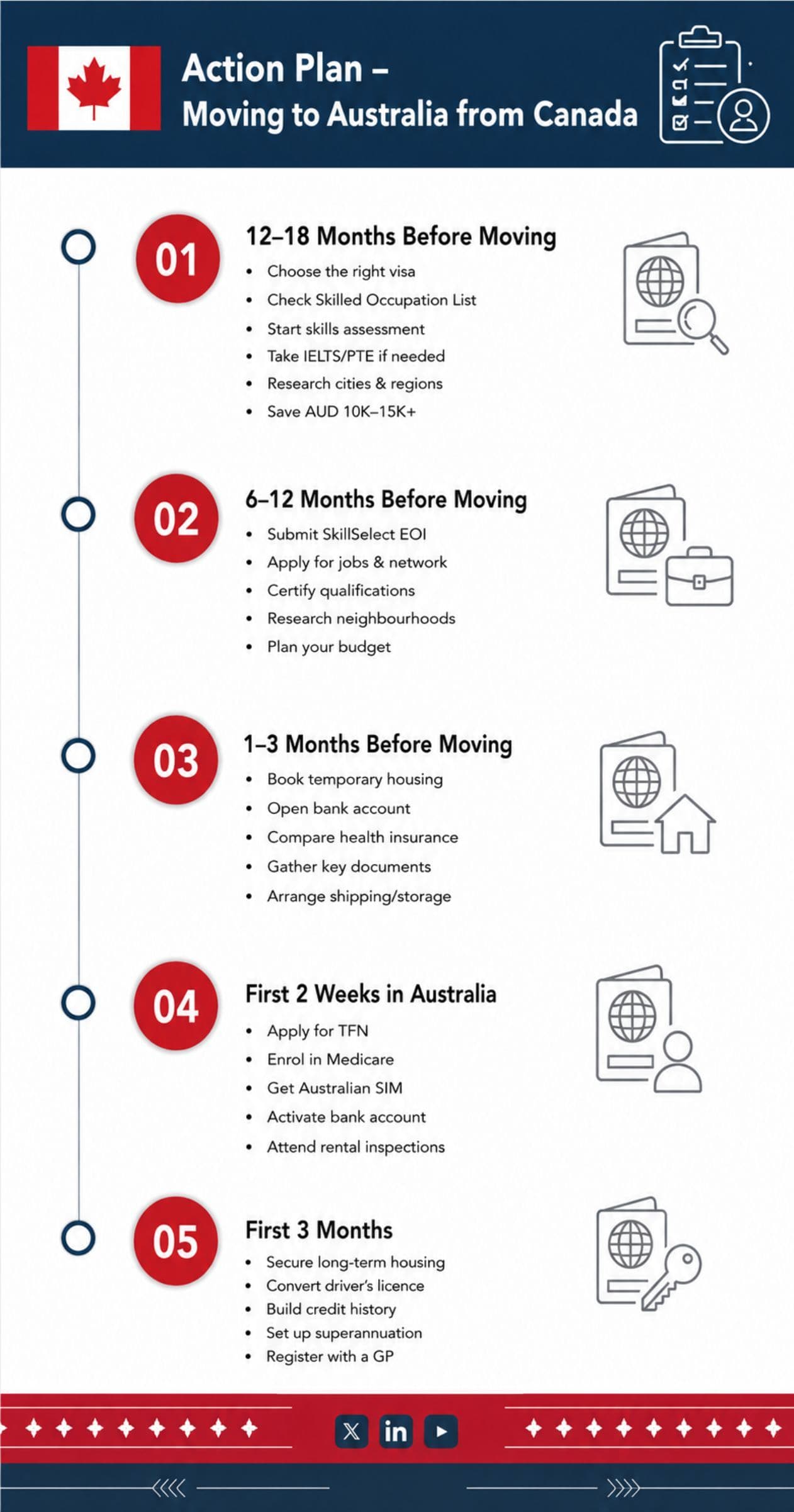
After receiving your visa approval, the final step is preparing for relocation. This includes arranging travel, securing temporary accommodation, and organizing finances for your first few weeks. Once you arrive, it’s helpful to apply for your Tax File Number early, enrol in Medicare if you’re eligible, open a bank account, and get a local SIM card. If you're planning to rent in cities like Sydney or Melbourne, attending inspections in person can make a big difference, since properties often receive multiple applications within a short time.
Applying for an Australian visa from Canada is straightforward because the entire process is completed online through ImmiAccount. Unlike some immigration systems where applications are handled by local consulates, Australia does not require in-person interviews or province-based submission centres. Your application is assessed directly by the Department of Home Affairs in Australia, meaning your province does not affect eligibility or processing decisions.
The Australian High Commission in Ottawa and consulates in Toronto, Vancouver, and Montreal mainly handle services like passports and notarisation. They do not process visa applications, which makes the system more centralized and consistent for all Canadian applicants.
However, your province still matters especially for police checks, medical exams, and document preparation timelines.
Australia does not assess your education based on where in Canada you studied. Whether your degree is from Ontario, British Columbia, or Quebec, it is evaluated using the same national standard through a relevant skills assessing authority linked to your occupation.
What does differ is the ease of document preparation. Ontario and BC generally have more digitalized systems for education records, employment verification, and police checks, which can speed up preparation. In contrast, some Quebec documents may require additional steps such as official English translation, especially when records are issued in French.
Despite these minor differences, credential recognition rules remain identical across all provinces. What matters most is whether your qualification matches Australian occupational standards, not where it was obtained.
Quebec applicants follow the same immigration process as the rest of Canada, but there are a few additional practical considerations.
Most official documents in Quebec, such as birth certificates, marriage certificates, and police records from the Sûreté du Québec (SQ), are issued in French. For Australian immigration purposes, these may require NAATI-certified translation into English before submission. This adds a small extra step in both time and cost compared to other provinces.
Criminal Record Check in Quebec may involve multiple sources, including the SQ and sometimes the SPVM (Montreal Police) for full coverage. This ensures all records are properly verified, especially for applicants who have lived in different municipalities.
Panel Physician availability is mostly concentrated in Montreal, so applicants from outside the city may need to travel for their medical examination. While this is manageable, it does require slightly more planning compared to Ontario or BC.
Overall, Quebec applicants follow the same rules; they simply need to account for translation and location logistics during preparation.Although the Australian visa system is national and uniform, the supporting steps vary slightly by province due to local administrative systems.
In Ontario, applicants benefit from a large network of RCMP-accredited fingerprinting services and multiple police services offering online record checks. Toronto, Ottawa, and surrounding areas also have several Panel Physician clinics, although appointment wait times can increase during peak migration seasons. Overall, Ontario offers strong access but high demand can sometimes slow scheduling.
In British Columbia, applicants experience slightly faster processing for police checks and more balanced medical appointment availability. Vancouver and surrounding areas have multiple fingerprinting providers and Panel Physicians, making logistics relatively smooth. Smaller towns rely more on RCMP detachments, but the system remains efficient and well-organized.
In Quebec, the main differences come from language and document structure. French-language records may require certified translation before submission, and Panel Physician options are more concentrated in Montreal. Applicants from outside major cities should plan ahead for travel and appointment scheduling.
Despite these differences, it is important to understand that visa eligibility, points calculation, and processing decisions remain exactly the same across all provinces. The variations are only operational, not legal or procedural barriers. No matter whether you are applying from Ontario, BC, or Quebec, your visa application is assessed under the same Australian immigration system. The differences lie only in preparation logistics, police checks, translations, and medical access, not in your chances of approval.
Applicants who prepare early, especially for documents and appointments, experience smoother processing and fewer delays regardless of the province.
Most Australian visa delays happen due to avoidable errors in planning, documentation, and strategy rather than true ineligibility. Careful preparation can significantly reduce processing issues and improve approval chances.
Many applicants apply for the wrong visa type by misunderstanding eligibility rules or selecting a pathway that does not match their occupation or long-term goals. Each visa category has different requirements, and choosing incorrectly can lead to refusal or wasted time.
A major issue is submitting a skills assessment under the wrong ANZSCO occupation code or with unclear employment evidence. The occupation must match actual job duties, and reference letters must clearly outline responsibilities, hours worked, and employment dates.
A low points score reduces the chance of receiving an invitation, especially in competitive occupations. Many applicants miss opportunities by not improving English test results, not using state nomination, or relying only on overseas experience.
Delays often occur when applicants fail to provide complete documentation. Common issues include expired English test results, missing police certificates, late medical exams, or inconsistent details across forms.
IELTS or PTE results are valid for only three years. Many applicants only realise their results have expired when they are ready to apply, which causes unnecessary delays.
Applicants must provide police certificates for every country or region where they have lived for 12 months or more since age 16. Missing even one required certificate can delay the application.
Panel Physician appointments can take weeks to secure, especially during peak periods. Booking too late can result in missed deadlines after receiving an invitation.
Submitting incorrect or inconsistent information in the Expression of Interest can lead to rejection or delays. All details must match supporting documents exactly.
Immigration rules and occupation lists change regularly. Using outdated advice or old eligibility lists can lead to incorrect planning and application errors.
Most visa delays come from preventable mistakes such as choosing the wrong visa, incorrect skills assessment, low points, missing documents, expired tests, incomplete police checks, and outdated information. Careful planning and accurate documentation greatly improve success rates.
A visa refusal can feel serious, but it does not automatically end your chances of moving to Australia. In most cases, there are still clear options available, depending on why the application was refused and which visa type you applied for. The key is understanding the reason for refusal and responding correctly.
Most Australian visa refusals happen due to avoidable issues rather than major ineligibility. Common reasons include missing or incomplete documents, inconsistent information in the application, or failure to meet specific visa requirements. For skilled visas, refusals often occur due to low points, incorrect occupation selection, or weak skills assessment evidence. For partner or student visas, refusals are often linked to insufficient supporting documents or unclear explanations of circumstances.
In many cases, the refusal letter clearly explains what was missing or not satisfied, and this becomes the starting point for your next step.
In many situations, you can reapply after a refusal, and there is no fixed waiting period unless specifically stated in the decision. Reapplying is often the most practical option when the issue is related to missing documents, expired medicals or English test results, or errors in the original submission.
However, reapplication must be done carefully. Simply submitting the same information again will lead to another refusal. A stronger application should directly address every issue mentioned in the refusal letter, with updated and complete supporting evidence.
Some visa refusals can be reviewed through the Administrative Appeals Tribunal (AAT), now operating as the Administrative Review Tribunal. This process allows an independent decision-maker to reassess your case from the beginning and consider additional evidence. In some cases, a refusal can be overturned if the original decision was not correct based on the information provided.
Appeal rights are commonly available for partner visas, student visas, and certain skilled or employer-sponsored visas. However, the process can take time, often several months to over a year depending on complexity and workload. In cases involving legal or procedural errors, a judicial review through the Federal Court may be possible. This process does not reassess your eligibility but examines whether the decision was made according to law. It is more technical and requires legal representation.
For serious cases involving character concerns under Section 501, professional legal support is essential. These cases are complex and involve a detailed assessment of criminal history or conduct, and should be handled by an experienced immigration lawyer.
A visa refusal is not the end of your Australian migration plans. In most cases, you can either reapply with stronger documentation or pursue a review process if eligible. The most important step is carefully reading the refusal reasons and responding with a clear, improved application strategy that directly fixes the issues identified.
The cost of living in Australia is heavily shaped by city choice, housing demand, and lifestyle expectations. While salaries are generally higher than Canada in many skilled roles, rent and housing costs vary sharply between cities. Understanding each city properly is the key to budgeting well and avoiding financial pressure after arrival.
Sydney
Sydney is Australia’s financial centre and most expensive city, where career opportunities are strong but rent creates constant financial pressure. Life feels fast and competitive, with beaches and global business all in one place. It suits people who want maximum career acceleration and are comfortable trading affordability for opportunity.
Melbourne
Melbourne feels more balanced and culturally rich, with strong café culture, arts, and diverse neighbourhoods. It is slightly cheaper than Sydney but still expensive in central areas. Many Canadians find it familiar and livable, offering a mix of solid job prospects and a more relaxed urban lifestyle.
Brisbane
Brisbane is warm, growing, and financially easier compared to southern cities. Rent is more manageable and daily life feels less pressured. It is expanding quickly due to infrastructure and population growth. It suits people who want outdoor living, affordability, and a long-term growth city without extreme housing stress.
Perth
Perth offers strong salaries in mining, engineering, and skilled industries, but feels more isolated than other capitals. Life is spacious, relaxed, and car-dependent outside central areas. Housing is moderate in cost compared to Sydney. It suits people who prioritise income strength, quiet living, and access to nature and beaches.
Adelaide
Adelaide is the most affordable major city in Australia, offering lower rent, simpler living costs, and a calm lifestyle. It is smaller and slower-paced but still has strong food, wine regions, and cultural events. It suits Canadians who want financial stability, low stress, and a more manageable urban environment.
| City | Monthly Cost | Rent Pressure | Job Market Strength | Lifestyle Feel | Transport Style | Best For |
| Sydney | $3,500 – $4,500 | Very high | Very strong | Fast, global, intense | Strong public transport | Career growth, high salaries |
| Melbourne | $3,000 – $4,000 | High | Strong | Cultural, balanced | Excellent tram/train system | Lifestyle + stable careers |
| Brisbane | $2,800 – $3,800 | Moderate | Growing fast | Relaxed, outdoor-focused | Good but car useful | Value + weather + growth |
| Perth | $2,800 – $3,600 | Moderate | Strong in mining/health | Quiet, spacious | Car-heavy | High income + space |
| Adelaide | $2,600 – $3,400 | Low | Smaller market | Slow, stable, easygoing | Simple transport | Affordability + stability |
Some expenses are consistently higher across all Australian cities. Rent is the biggest factor, especially in Sydney and Melbourne. Electricity costs are also higher due to climate conditions and energy pricing.
Alcohol is heavily taxed, making both pub drinks and retail alcohol more expensive. International travel is another major cost, especially flights between Australia and Canada.Childcare can also be expensive before subsidies, particularly in major cities.
Fresh food, groceries, and seafood are often cheaper and higher quality due to local production. Farmers’ markets and supermarket competition help keep prices stable.Dining out is also more accessible than in many Canadian cities, with cafés and casual restaurants playing a central role in daily life.
Healthcare is significantly more affordable for permanent residents under Medicare, which reduces long-term medical expenses compared to private systems.Australia’s cost of living is not uniform it changes dramatically depending on the city you choose.
Sydney and Melbourne offer the strongest job markets but come with higher rent pressure. Brisbane, Perth, and Adelaide provide better financial balance and more lifestyle flexibility.For Canadian migrants, the most important financial decision is not daily spending it is choosing the right city for long-term stability and savings potential.

Finding housing in Australia is one of the most important early steps after arrival. The system is organised and predictable, but in major cities it is also competitive and fast-moving. If you understand how it works and prepare properly, you can avoid stress and secure a place much faster.
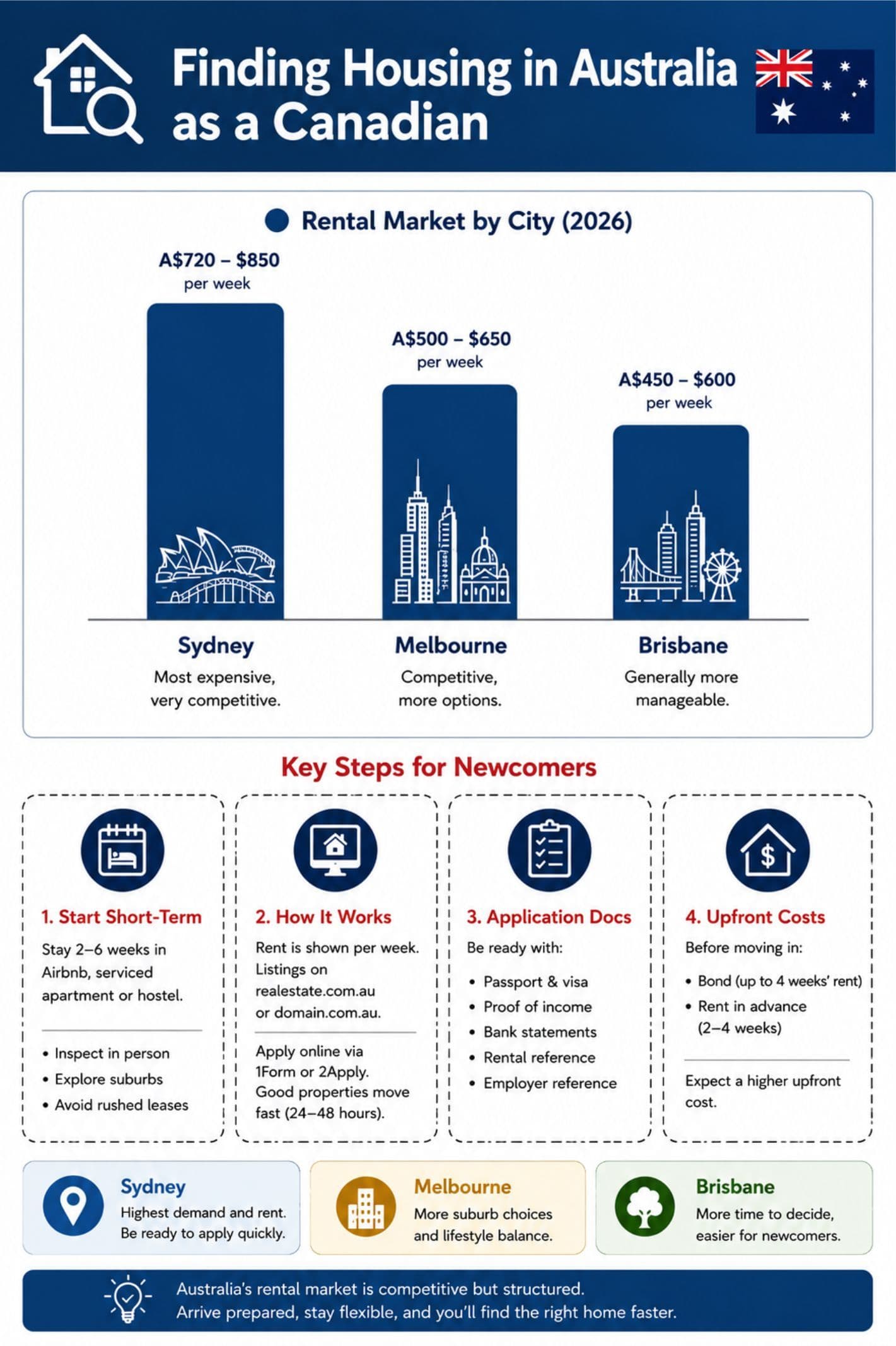
The Australian rental market is managed mainly through real estate agents and listed on websites such as realestate.com.au and domain.com.au. Applications are submitted online through platforms like 1Form or 2Apply.
Rent is shown per week, not per month. This is one of the first differences Canadians notice. When you apply, you are not casually expressing interest you are submitting a complete tenant profile with documents and references.
In cities like Sydney and Melbourne, well-priced properties can receive multiple applications within 24–48 hours. Speed and preparation matter more than negotiation.
The strongest approach for newcomers is to avoid rushing into long-term leases immediately.
Start with short-term accommodation such as an Airbnb, serviced apartment, hostel, or furnished room for 2–6 weeks. This gives you time to:
Think of this as your “settling phase” before committing.
Housing pressure changes a lot depending on the city.
Sydney is the most competitive. Rent is high across most areas, and demand is extremely strong. Good properties move quickly, so being ready to apply immediately is essential.
Melbourne is still competitive but offers more variety in suburbs and price points. It gives renters slightly more flexibility in balancing commute, lifestyle, and cost.
Brisbane is generally more manageable for newcomers. While demand is increasing, renters usually have more time to inspect and decide, making the process less intense.
The rental application process in Australia is structured and documentation-heavy. Agents want a complete picture of your financial stability and reliability before approving you.
You will need to submit:
As a newcomer, you may not have Australian rental history or payslips. This is common and expected, but it means your application needs to be well presented.
Before moving in, you will pay:
This means you should be prepared for a larger upfront cost before getting the keys.
Housing in Australia is competitive but very structured. If you arrive with short-term accommodation, organised documents, and a flexible mindset, you can significantly improve your chances of securing a good rental quickly.
Working in Australia is one of the biggest reasons Canadians make the move. The job market is strong in many industries, salaries are generally higher than Canada in several sectors, and work culture is more direct and structured. That said, success depends on understanding how hiring actually works locally, not just applying the Canadian way.
Australia has a stable and skills-driven job market, especially in major cities like Sydney and Melbourne. Employers place strong value on local experience, but skilled overseas workers are regularly hired in areas facing shortages.
Most hiring is done through platforms like Seek, LinkedIn, and recruitment agencies. Unlike Canada, networking and recruiter relationships play a much bigger role in getting interviews. The process can feel slow at first for newcomers, especially before you have Australian experience, but it improves significantly once you land your first role.
| Area | Description |
| Job platforms | Seek is the main job board, supported by LinkedIn and recruitment agencies |
| Hiring style | Structured process focused on skills, experience, and quick screening |
| Interview speed | Fast once shortlisted, but first interview can take time without local experience |
| Main barrier | Lack of Australian work experience is the biggest challenge for newcomers |
| Competition level | Moderate overall, but high in Sydney and Melbourne |
| Best job cities | Sydney, Melbourne, Brisbane |
| Employer expectations | Clean resume, local-style formatting, strong communication, and relevant skills |
| Networking role | Very important and often as effective as online applications |
| Key hiring focus | Skills, certifications, and ability to adapt to Australian workplace culture |
| First job strategy | Entry role or contract role often leads to faster long-term opportunities |
Australia’s labour market is heavily focused on skills shortages and professional sectors. Some of the most in-demand roles include:
These sectors tend to offer more consistent hiring and better visa pathways for skilled migrants.
Salaries in Australia are often higher than Canada in many industries, but they vary significantly by city, experience, and sector.
Entry-level professional roles generally start around AUD 55,000 to 75,000 per year. Mid-level roles often range from AUD 80,000 to 120,000, while senior or specialist positions can exceed AUD 130,000 or more.
Cities like Sydney tend to offer higher salaries but also higher living costs, while cities like Brisbane or Adelaide often provide better balance between income and affordability.
In many cases, the real financial advantage in Australia comes not just from salary, but from how well your income matches the cost of living in your chosen city.
One of the biggest adjustments for Canadians is how resumes are written and reviewed in Australia.
Australian resumes are more concise and practical compared to Canadian formats. Employers prefer clear, easy-to-scan documents that focus on results rather than long descriptions.Key differences include:
A well-structured resume often makes a bigger difference than experience alone, especially when applying from overseas.
Working in Australia is very achievable for Canadians, but success comes from adapting to local hiring systems. Once you understand how recruitment works, tailor your resume properly, and target in-demand industries, the job market becomes much more accessible and opportunity-rich.When you move from Canada to Australia, your tax situation changes more than most people expect. The key thing to understand is that both countries can potentially look at the same income and the Canada–Australia tax treaty exists mainly to make sure you’re not taxed twice on the same money. In simple words, though, it doesn’t mean “no tax twice anywhere.” It means one country gets the main right to tax an income, and the other country gives you a credit for tax already paid.
One of the most important concepts is tax residency.If you move to Australia intending to live there long-term, set up a home, and your daily life is based there, you will generally become an Australian tax resident from the day you arrive.
This is important because Australian tax residents are taxed on their worldwide income. That means your Canadian income sources don’t disappear for tax purposes. Things like RRSP withdrawals, investment income, rental income, and pensions must still be reported in Australia once you are a resident.Non-residents, on the other hand, are taxed only on Australian-sourced income and do not receive the tax-free threshold.
Your Tax File Number (TFN) is the Australian equivalent of Canada’s SIN. You should apply for it online through the ATO website (ato.gov.au) as soon as you arrive. Without a TFN, employers apply the highest withholding tax rate (up to 47%), which can significantly reduce your take-home pay until you sort it out.
Australia uses a progressive tax system:
| Taxable Income (AUD) | Tax Rate | Notes |
| 0 – 18,200 | 0% | Tax-free threshold (for residents) |
| 18,201 – 45,000 | 19% | Basic income range |
| 45,001 – 120,000 | 32.5% | Middle-income bracket |
| 120,001 – 180,000 | 37% | Upper-middle range |
| 180,001+ | 45% | Top marginal rate |
On top of this, there is a 2% Medicare Levy, which helps fund Australia’s public healthcare system. So in practice, most workers pay their income tax rate plus 2% extra.
This is where Canadian expats often get surprised. An RRSP is still recognised under the Canada–Australia tax treaty. You don’t lose it when you move. However, when you withdraw money, it is taxed in both countries in different ways:
The result is not double taxation, but timing and structure of withdrawals matter. Smaller, planned withdrawals are often more tax-efficient than large lump sums.
A TFSA, however, is treated very differently. While Canada continues to see it as tax-free, Australia does not recognise that status. The Australian Tax Office treats your TFSA like a normal investment account. That means:
So even though the TFSA remains useful, it loses its tax-free advantage once you become an Australian tax resident.
Canadian retirement benefits like CPP and OAS are treated under the tax treaty as social security income. Canada withholds tax at source (often around 15% for monthly payments for non-residents). When you declare this income in Australia, it is included in your taxable income.
However, you receive a foreign income tax offset in Australia for the Canadian tax already withheld. This helps prevent double taxation. In most cases, CPP and OAS are only lightly impacted by extra Australian tax, depending on your overall income level.
Australia runs on a different tax calendar than Canada.
Many people use a registered tax agent because it is affordable (often AUD 100–200) and the fee is usually tax-deductible. You can also file directly using the ATO’s online system.
Australia allows deductions for a wide range of work-related and investment expenses, including:
These deductions can significantly reduce taxable income if used correctly. Once you become an Australian tax resident, your Canadian financial life doesn’t disappear, it just becomes part of your global tax picture.
The biggest things to understand early are:
Superannuation (or "super") is Australia's mandatory retirement savings system. It is designed to slowly build your retirement wealth while you work, without requiring active saving decisions each month. For many people, especially newcomers from Canada, it feels like a mix between a pension plan and a long-term investment account, but with more structure and compulsory contributions.
Think of superannuation as a second salary you can't spend yet. Your employer pays 11.5% of your wage rising to 12% from July 2025 directly into a retirement fund on top of your take-home pay. On an AUD $90,000 salary, that is AUD $10,350 per year going into your super without you doing anything. Compounded over 10 to 15 years of Australian working life, it becomes a meaningful retirement asset. The trade-off is that you can't access it until age 60. That's also the point it's forced long-term saving that actually works.
One of the most important features of super is that your employer is legally required to contribute to it.
This means your income is effectively split into two parts: what you take home today, and what is automatically invested for your retirement.
Over time, these employer contributions can grow into a very large amount, especially if you work in Australia for many years or your salary increases steadily.
Superannuation is intentionally restricted because it is designed for retirement security, not everyday use.
When you become eligible, you can usually choose how to use your super:
The main idea is that super is built to support your lifestyle after work, not during it.
If you leave Australia permanently, you can claim your super through the DASP (Departing Australia Superannuation Payment). The tax rate is punishing: 65% for working holiday makers, 35% for other temporary residents. On a typical 12-month WHV, you might accumulate AUD $4,000 to $6,000 in super and walk away with AUD $1,400 to $2,100 after tax. Claim it but don't factor it into your travel budget as significant money.
Moving from Canada to Australia is not just about visas and flights it also means properly closing your Canadian tax life. If this step is done incorrectly, it can lead to double filings, unexpected tax bills, and long-term CRA issues that are completely avoidable with the right preparation.
When you leave Canada, you must file a departure tax return with the CRA. This return covers your worldwide income from January 1 up to your departure date.
After your departure date, Canada generally treats you as a non-resident, meaning:
Your departure date is not just your flight date it is the point when you sever your main residential ties with Canada and establish life in Australia.
This includes things like:
The CRA looks at your situation as a whole, not just one factor. If your life clearly shifts to Australia, your non-resident status is usually straightforward.
Tax residency is the key concept that determines how you are taxed.
In simple terms:
The tricky part is timing. If both countries consider you a resident at the same time, the tax treaty helps decide which country has taxing priority and how credits are applied to avoid double taxation.
Before leaving Canada, it is important to update your financial accounts and prepare for non-resident rules.
Key steps include:
If you don’t update your status, institutions may incorrectly treat you as a Canadian resident, which can lead to tax reporting issues later.
Australia has one of the strongest and most accessible healthcare systems in the world. It is built around a public system called Medicare, which provides affordable or free healthcare for eligible residents. The system is similar in spirit to Canada’s healthcare model, but the eligibility rules and structure are different.
Medicare mainly covers Australian citizens, permanent residents, and in some cases, visitors from certain countries under a Reciprocal Health Care Agreement (RHCA) while canada is not included in that.

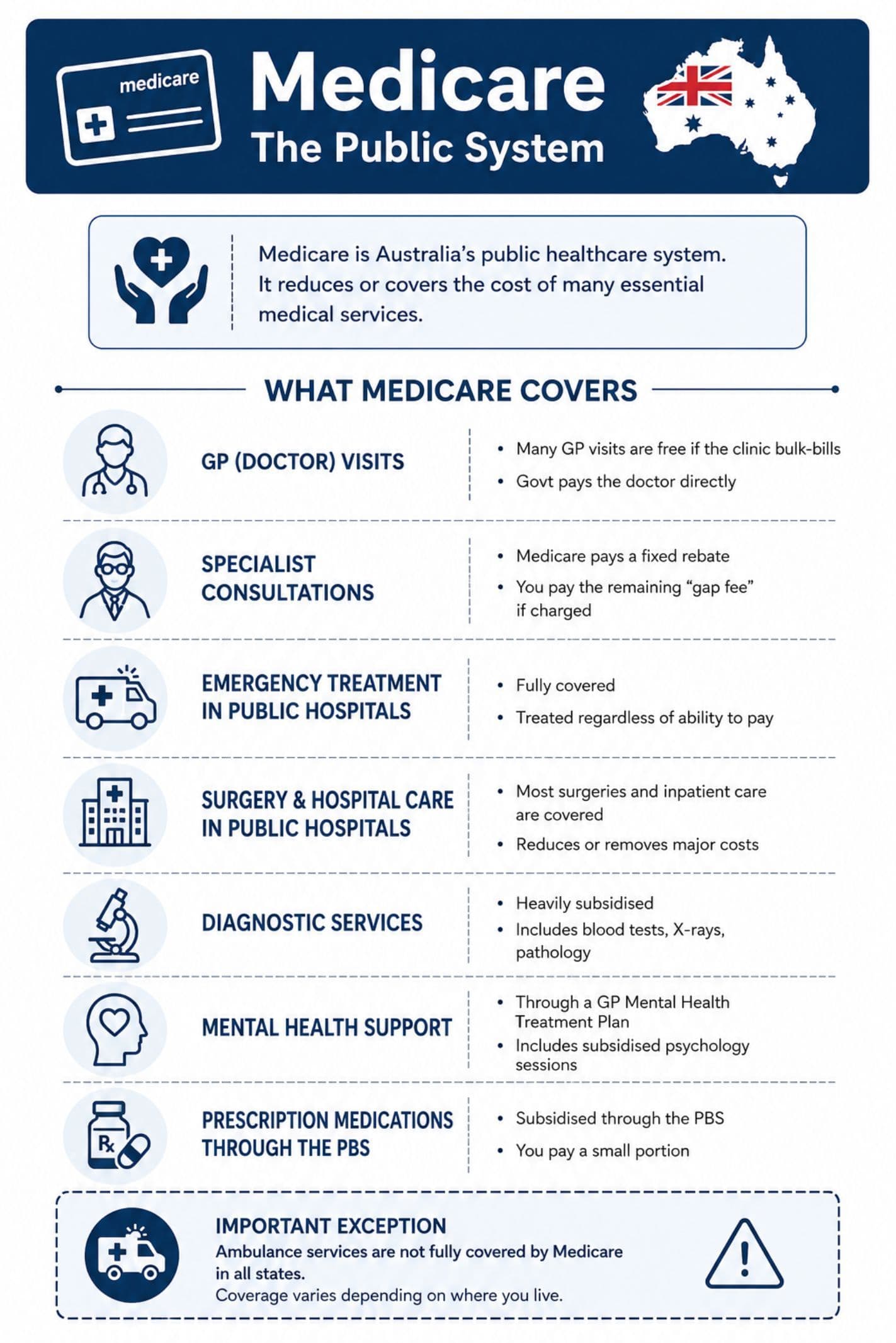
Medicare is the foundation of Australia’s healthcare system. It reduces or completely covers the cost of many essential medical services, making healthcare affordable for residents.
What Medicare Covers
One important exception is ambulance services, which are not fully covered by Medicare in all states. Coverage varies depending on where you live in Australia.
Canada and Australia do not have a full Reciprocal Health Care Agreement (RHCA). However, Canadians in Australia temporarily may still be able to access Medicare for medically necessary treatment, especially while waiting to become fully eligible.
This can be helpful for Working Holiday visa holders or others who have just arrived and are waiting to set up their Medicare access. That said, this coverage is limited to urgent or necessary treatment. It usually does not cover routine checkups, ongoing care, or elective procedures. Because of this, applying for your own Medicare card as soon as you're eligible is still the safest and most reliable option.
Private health insurance plays a major role in Australia’s healthcare system, especially for those who want faster access, more choice, or additional coverage.
Major private health insurers: Bupa, Medibank, HCF, NIB, HBF (Western Australia). Basic hospital cover costs roughly AUD 100 to 150 per month for a single person.
Medicare does NOT cover general dental or optical care. This is a significant adjustment from Canada where many employers provide dental plans.
Australia has a strong and well-structured education system that is widely respected internationally. It offers a mix of public and private schooling, as well as strong vocational and university pathways.
The Australian school system is divided into several stages, starting from early childhood and continuing through to university preparation. Children usually begin kindergarten around age four or five, followed by primary school and then secondary school through to Year 12.
In the final year of school, students complete state-based qualifications such as the ATAR (used for university entry), or equivalents depending on the state. Alongside traditional schooling, Australia also offers strong vocational pathways through TAFE for students who prefer hands-on careers.
Public schools in Australia are generally high quality and free for permanent residents and citizens, making them the most common option for families. However, school quality can vary depending on the suburb, so location plays a major role in outcomes.
Catholic schools are partially subsidised and usually have moderate fees, while independent private schools can range from affordable to very expensive. Some of the top private schools in major cities can cost over AUD 30,000 per year.
Because of this variation, parents often choose schools based not just on type, but on the reputation of the specific school and its surrounding area.
| Stage | Ages | Notes |
| Early childhood / Kindergarten | 3 to 5 years | State-funded pre-primary from age 4 in most states |
| Primary school | 5 to 12 years | Years 1 to 6 (Year 7 in some states) |
| Secondary / High school | 12 to 17 years | Years 7 to 12 (or 8 to 12 depending on state) |
| Year 12 (final year) | 17 to 18 years | State-based qualification (ATAR, VCE, QCE, etc.) |
| TAFE | 16+ years | Vocational and trades training highly regarded |
| University | 17+ years | 3 to 5 year degrees depending on course |
Australia's eight most prestigious research universities, widely known as the "Go8," are internationally respected:
For permanent residents and citizens, university fees are subsidised through HECS-HELP loans income-contingent repayments that only kick in when you earn above approximately AUD 54,000 per year.
TAFE stands for Technical and Further Education. It is the national vocational training network and is genuinely respected in Australia. Trades, nursing, hospitality, IT, childcare, and many other practical fields are delivered through TAFE. For Canadians who want to get a trade licence or retrain in a new field, TAFE is often the fastest and most practical path.
Setting up your finances properly from the start makes everything else easier. Australia's banking system is well-developed and straightforward for newcomers.
You can open an Australian bank account before you arrive. Many banks allow online opening and then in-person identity verification within 3 months of arrival.
Your Canadian credit history does not transfer to Australia. You start from zero. This can be frustrating, but it is manageable:
Most Canadians begin their life in Australia on a temporary visa, such as a Working Holiday Visa, student visa, or temporary skilled visa. These visas are designed to let you live, work, and experience Australia, but they are usually the first step rather than the final destination.
Over time, many people transition into permanent residency (PR) through skilled migration (such as subclass 189 or 190 visas), employer sponsorship (like the 186 Direct Entry pathway), or partner visas.Once PR is granted, your status is active immediately from the approval date. There is no separate activation process or extra paperwork needed to “become” a resident the visa grant itself is your permanent residency.
A key feature of Australian PR is the 5-year travel facility. This allows you to leave and re-enter Australia freely during that period. After five years, your PR status still exists, but your travel rights expire. To continue travelling in and out of Australia, you apply for a Resident Return Visa (RRV).
| Pathway | Starting Point | Timeline | Key Requirement |
| Points-tested (Subclass 189) | EOI in SkillSelect | 6 to 36 months | 65+ points, skills assessment |
| State-nominated (Subclass 190) | State nomination | 6 to 24 months | 65+ points plus state nomination |
| Regional (491 to 191) | Subclass 491 | 3+ years in regional area | Live and work regionally |
| Employer-sponsored (Subclass 186) | Subclass 482 | 3+ years with employer | Employer nomination required |
| Partner visa | Subclass 820 | 2 to 4+ years | Genuine partner who is PR or citizen |
Australian citizenship is based on time lived in the country and your residency pattern over those years.
In most cases, you need:
This means you cannot simply hold PR for a year anywhere in the world you must actually be living in Australia for most of that time.
Short overseas trips are completely normal and allowed, but long absences can delay your eligibility. If you spend too much time outside Australia, your citizenship timeline can stretch out even if you technically still hold PR.
Working Holiday Visa time does count toward the overall 4-year residency requirement, which is helpful for Canadians who arrive early and later transition to PR. However, it does not count toward the mandatory 12 months of permanent residency, which must be completed after you receive PR.
In simple terms:
Before becoming a citizen, you must pass a citizenship test designed to ensure you understand Australia’s core values and civic system.
The test includes:
The test is generally considered manageable and not overly difficult, especially with preparation.:
Australia allows dual citizenship, and Canada also permits it, which makes the transition very flexible for Canadians.
This means you can:
This is one of the biggest advantages of moving between Canada and Australia, especially for long-term mobility and lifestyle flexibility. Dual citizenship also makes travel easier, as both passports offer strong global visa access.

When you are actually making the move, you need a clear sequence of actions. Here is a practical timeline.
Before making any big decision, it helps to see the whole picture side by side. Here is an honest, realistic comparison.
| Topic | Canada | Australia |
| Climate | Cold winters, warm summers | Warm to hot year-round in most areas |
| Average full-time salary | CAD 65,000 median | AUD 90,000+ average full time |
| Minimum wage | CAD 17.30/hr federal | AUD 24.95/hr national (as of fair work) |
| Healthcare | Universal Medicare | Universal Medicare |
| Dental coverage | Many employer plans exist | Limited public, private extras needed |
| Employer retirement savings | CPP (employer + employee) | Superannuation (12% on top of salary) FY2025-26 |
| Annual leave (minimum) | 2 weeks federally | 4 weeks guaranteed by law |
| University cost for residents | CAD 6,000 to 15,000/yr | HECS deferred, very affordable |
| Housing costs | High in Toronto and Vancouver | High in Sydney and Melbourne |
| Crime rate | Very low | Very low |
| Outdoor lifestyle | Seasonal, summer-focused | Year-round |
| Multicultural society | Yes, very diverse | Yes, very diverse |
| Wildlife hazards | Bears, moose, coyotes | Snakes, spiders, jellyfish, crocodiles |
| Natural disaster risk | Blizzards, ice storms, floods | Bushfires, floods, cyclones, heatwaves |
| Distance from Canada | Your base | 16,000+ km away |
Australia is a genuinely good place to live, not because it's perfect, but because the day-to-day basics work well. Healthcare functions. Workers' rights are enforced. The outdoors is accessible in a way that requires money and logistics in Canada. What it asks in return is distance from home, expensive housing in the major cities, and the patience to rebuild a professional and social network from zero.
Most Canadians who make the move and stick it out past 18 months say they wouldn't go back. Most who leave do so within the first year, before the network has had time to build. Give it two years before making a permanent judgement either way.
Learn how Canada apostille services work after the Hague Convention. Understand provincial authorities, Global Affairs Canada process, fees, timelines, document requirements, and how to apostille Canadian documents for international use.
Everything Canadians need to know about moving to New Zealand - visas, salaries, healthcare, taxes, schools, and city comparisons. Updated with official INZ rules for 2026.