By Sejal Jain · Updated July 17, 2026
More Canadians are moving to New Zealand in 2026 for a better work-life balance, lower stress, and a fresh start. Rising housing costs in Canada, long winters, heavy traffic, and expensive city life are pushing many people to explore living in New Zealand instead. For Canadians, moving to New Zealand feels easier because both countries share a similar language, culture, and lifestyle. New Zealand also offers milder weather, shorter commutes, and a more relaxed way of life.
From skilled workers and young professionals to families planning a long-term relocation, interest in immigrating to New Zealand from Canada continues to grow each year. This guide covers everything Canadians need to know about moving to New Zealand, including every visa, salary figure, and policy detail and other official government rules. Immigration New Zealand updates its rules regularly - verify current conditions at immigration.govt.nz before submitting any application.

More than 22,000 Canadian-born residents were counted in New Zealand at the 2023 census. That figure does not include the thousands on long-term work visas. Canadian arrivals grew steadily from 2019 onward, with the sharpest acceleration between 2022 and 2024.
The provinces sending the most migrants are British Columbia, Ontario, and Alberta - the same three provinces where Canada's housing affordability gap is widest. A detached home in Vancouver costs more than twelve times the median annual household income. In Toronto, the ratio exceeds ten.
Healthcare wait times add to the pressure. The Canadian Institute for Health Information reported a national median wait of 27.7 weeks from specialist referral to treatment in 2023. British Columbia, Ontario, and Alberta all report documented GP shortages in their published health workforce data. These are not abstract statistics - they represent real delays Canadians experience.
Winter duration matters too. Calgary averages 128 days per year with a daily high below 0°C. Edmonton: roughly 120. Auckland's coldest month is July, with an average low of 8°C and a high of 14°C. No snow, no ice, no road closures.
The cost of renting is the most-cited push factor. The Canada Mortgage and Housing Corporation's 2024 data puts the average asking rent for a two-bedroom in Toronto at $2,800 per month and in Vancouver at $3,200 per month. A household earning the median income in either city spends more than 40% of gross earnings on rent alone.
Career ceiling is a less-discussed factor, but it appears consistently in mid-career migration decisions. Senior roles in technology, finance, and engineering are heavily concentrated in Toronto, Calgary, and Vancouver. Professionals who want to advance without relocating to one of those three cities find their options narrow quickly.

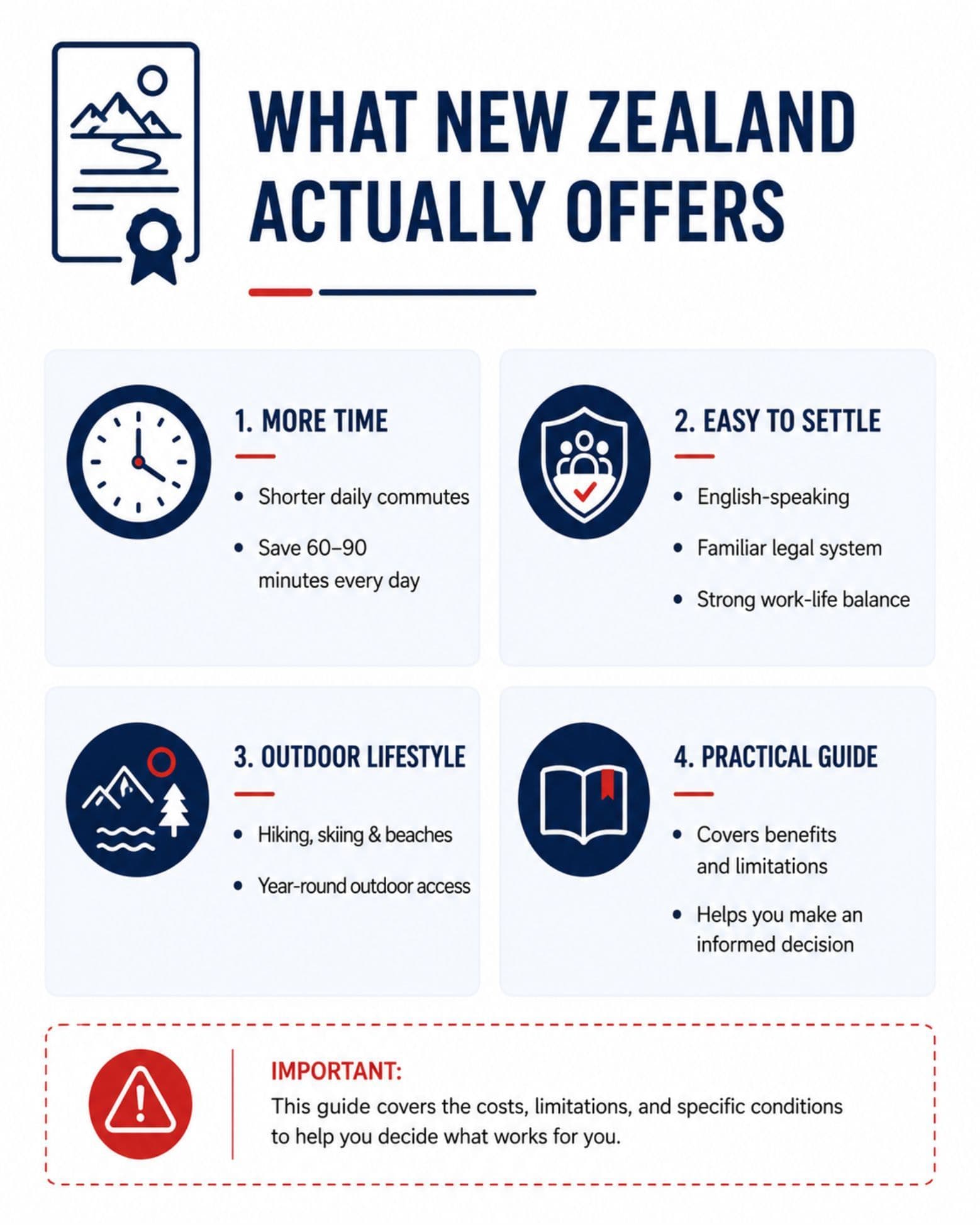
The lifestyle comparison between Canada and New Zealand is easiest to understand through commute data. Stats NZ's 2023 census travel-to-work data shows the average Auckland commute at 31 minutes, Wellington at 24 minutes, and Christchurch at 21 minutes. Toronto's average commute is 54 minutes. Vancouver's is 47. That gap represents 60 to 90 minutes of daily life returned to the commuter.
The language, legal system, and civic framework are familiar. New Zealand operates a Westminster parliamentary democracy based on British common law. There is no language adjustment and no fundamental shift in institutional culture. The OECD Better Life Index consistently places New Zealand above the OECD average on work-life balance, safety, and environmental quality.
Outdoor access is year-round. Skiing, hiking, mountain biking, and ocean swimming are within 40 minutes of most major NZ cities across all twelve months - not confined to a Canadian summer window.
This guide does not argue that the move is right for every Canadian. Every chapter covers the costs, limitations, and specific conditions that determine whether something works in practice.
Moving from Canada to New Zealand is a multi-year commitment. The visa process, financial reset, shipping logistics, and social rebuilding take longer than most pre-departure research suggests. Before spending money on applications or shipping quotes, answer these six questions honestly.
Is your occupation on the NZ Green List or in documented shortage?
The Green List determines whether you can access residence directly. If your occupation is not listed, your starting point is an Accredited Employer Work Visa.
Can your household absorb 6 to 12 months of income disruption?
The gap between leaving a Canadian job and starting an NZ role - including visa processing - runs 3 to 9 months for most skilled migrants. Budget for the worst case.
Does your partner's career translate to the NZ market?
A dual-income household where one career has no NZ equivalent is effectively a single-income move from day one. This changes which cities are viable.
Have you priced a return flight home?
Vancouver to Auckland costs $1,800 to $3,200 CAD one-way. Toronto to Auckland via Los Angeles: $2,000 to $4,000 CAD one-way. Two return trips per year for a couple costs $14,000 to $32,000 CAD annually.
Can you work legally on arrival?
An Accredited Employer Work Visa requires employer accreditation to be confirmed before employment starts. Confirm your employer holds current accreditation status before handing in notice in Canada.
Does NZ offer something a smaller Canadian city doesn't?
Victoria, Halifax, and Kelowna all have lower housing costs than Toronto or Vancouver, shorter commutes, and outdoor access. If the primary driver is escaping urban density, a domestic Canadian move is worth comparing before committing to a 17,000-km relocation.
Healthcare workers on the NZ Green List - including registered nurses, general practitioners, midwives, and diagnostic radiographers - are the strongest candidates. Tier 1 occupations access permanent residence directly without years on a work visa first.
Skilled trades workers in construction, electrical, plumbing, and gasfitting fill documented shortages across most NZ regions. Canadian Red Seal certification is assessed by NZQA and maps closely to NZ trade registration requirements.
Remote workers earning in Canadian or US dollars while living in New Zealand capture the income ceiling of the North American market and the cost-of-living floor of a NZ city. The tax structure requires careful setup.
Civil engineers, secondary STEM teachers, and software developers at companies with existing NZ offices have established pathways. In a market of 5 million people, direct outreach to potential NZ employers before applying for a visa is more effective than passive applications.
Single-income families moving without a secured NZ job offer face a significant financial gap. Settling-in costs for a couple arriving in Auckland without income run NZD $35,000 to $50,000 before the first paycheque.
Professionals in Canada-specific regulated roles - some legal positions, federal government roles, and Quebec-specific professions - may find no direct NZ equivalent. The move is not impossible, but career continuity requires a plan that pre-departure research rarely resolves.
Buyers expecting Canadian suburban housing on a median NZ salary will encounter the same fundamental problem in Auckland they were trying to leave in Toronto.
Canadians have eight legal pathways from a Canadian passport to a New Zealand life. They are presented here from fastest to most complex. The right choice depends on age, occupation, employer situation, and family structure. All visa conditions are published at immigration.govt.nz.
A Canadian passport holder can enter New Zealand visa-free for up to 90 days. An NZeTA (New Zealand Electronic Travel Authority) - costing starts from NZD $17 - is required before boarding. A separate Visitor Visa extends stays up to 9 months but requires proof of return travel, accommodation plans, and sufficient funds.
Neither the NZeTA nor the Visitor Visa authorises paid work. This includes remote work for a Canadian employer if it is regular, ongoing, and performed while physically in New Zealand.
The Working Holiday Visa (WHV) is available to Canadian citizens aged 18 to 35 at application. It is an open work visa - any employer, any role, no job offer required. The cost is NZD 770. Processing takes 3 to 5 weeks when the application is complete.
Canadians can apply for 12 or 23 months. The 23-month option is applied for directly; extending a 12-month visa by 11 months from inside NZ also works. The WHV can only be held once in a lifetime.
The WHV is not a residency pathway without a deliberate conversion plan. It is the right entry point for Canadians who want to try life in NZ before committing to a longer immigration process.
The Accredited Employer Work Visa (AEWV) is the primary route for Canadians with a job offer from a New Zealand employer. It operates through three sequential gates:
The AEWV is granted for up to 5 years for roles at ANZSCO Skill Level 1, 2, or 3 (skilled and specialist occupations). Roles at ANZSCO Skill Level 4 or 5 are granted for up to 3 years as of March 2025. Partners and dependent children under 24 can be included. A partner whose primary holder earns above the median wage receives open work rights. Processing takes 6 to 12 weeks for a complete application with a pre-accredited employer.
The Green List is New Zealand's direct immigration track for occupations in critical shortage. It has two tiers.
Tier 1 : Straight to Residence: Applicants in Tier 1 occupations apply directly for a resident visa without holding a work visa first. A relevant NZ registration and a job offer from an accredited employer are required.
Tier 2 : Work to Residence: Applicants in Tier 2 occupations hold an AEWV for 24 months in the qualifying role, then apply for residence.
| Canadian Job Title | Tier | NZ Registration Body |
| Registered Nurse | Tier 1 | Nursing Council of NZ |
| General Practitioner | Tier 1 | Medical Council of NZ |
| Specialist Physician | Tier 1 | Medical Council of NZ |
| Midwife | Tier 1 | Midwifery Council of NZ |
| Secondary Teacher (STEM) | Tier 1 | Teaching Council of NZ |
| Diagnostic Radiographe | Tier 1 | Medical Radiation Technologists Board |
| Civil / Structural Engineer | Tier 2 | Engineering New Zealand |
| Electrician | Tier 2 | EWRB |
| Plumber / Gasfitter | Tier 2 | PGD Board |
Check the current Green List at immigration.govt.nz - it is updated when occupation shortage profiles change.
The Skilled Migrant Category (SMC) uses a points-based system. . To qualify, you need a job with an approved New Zealand employer, meet a minimum wage requirement, and score at least 6 points.
Points come from one of three things: a New Zealand professional licence, your qualification level, or how much you earn. You only use whichever scores highest. If you still need a point or two, each year of skilled work experience in New Zealand adds one more.
There is no quota and no waiting list. Once your points check out, Immigration New Zealand invites you to apply, and your full residency application is processed from there. That typically takes 6 to 18 months. From August 2026, two new entry routes open up for trades workers and experienced professionals who struggle to hit 6 points through the standard method. Verify current requirements at immigration.govt.nz before applying.
The Partnership Visa allows a Canadian to live in New Zealand if their partner is a NZ citizen, resident, or work visa holder. Evidence of a genuine and stable relationship is assessed through cohabitation history, financial interdependence, and declarations from people who know the couple.
A temporary Partnership Visa is granted for relationships under 12 months at application. A residence-class Partnership Visa applies to relationships of 12 months or more.
The Parent Resident Visa is the main route for Canadian parents of NZ-resident or citizen adult children. It is subject to an annual ballot. The sponsoring child must meet an income threshold to demonstrate they can support the parent without public funds. Wait times commonly run 5 or more years.
A student visa allows full-time study with part-time work rights (20 hours per week during study; full-time during breaks). Post-study open work rights depend on qualification level and study location. A master's or doctoral degree from any NZ institution gives a 3-year open work visa. A bachelor's from outside Auckland gives 3 years; from Auckland, 2 years. Current rules are published at immigration.govt.nz.
The Active Investor Plus Visa targets individuals with NZD 5 million or more available for qualifying NZ investments. A minimum portion must be in high-growth categories (direct investments, venture capital, managed funds). Compliance obligations are specific - legal advice from an IAA-registered adviser is required for this track.

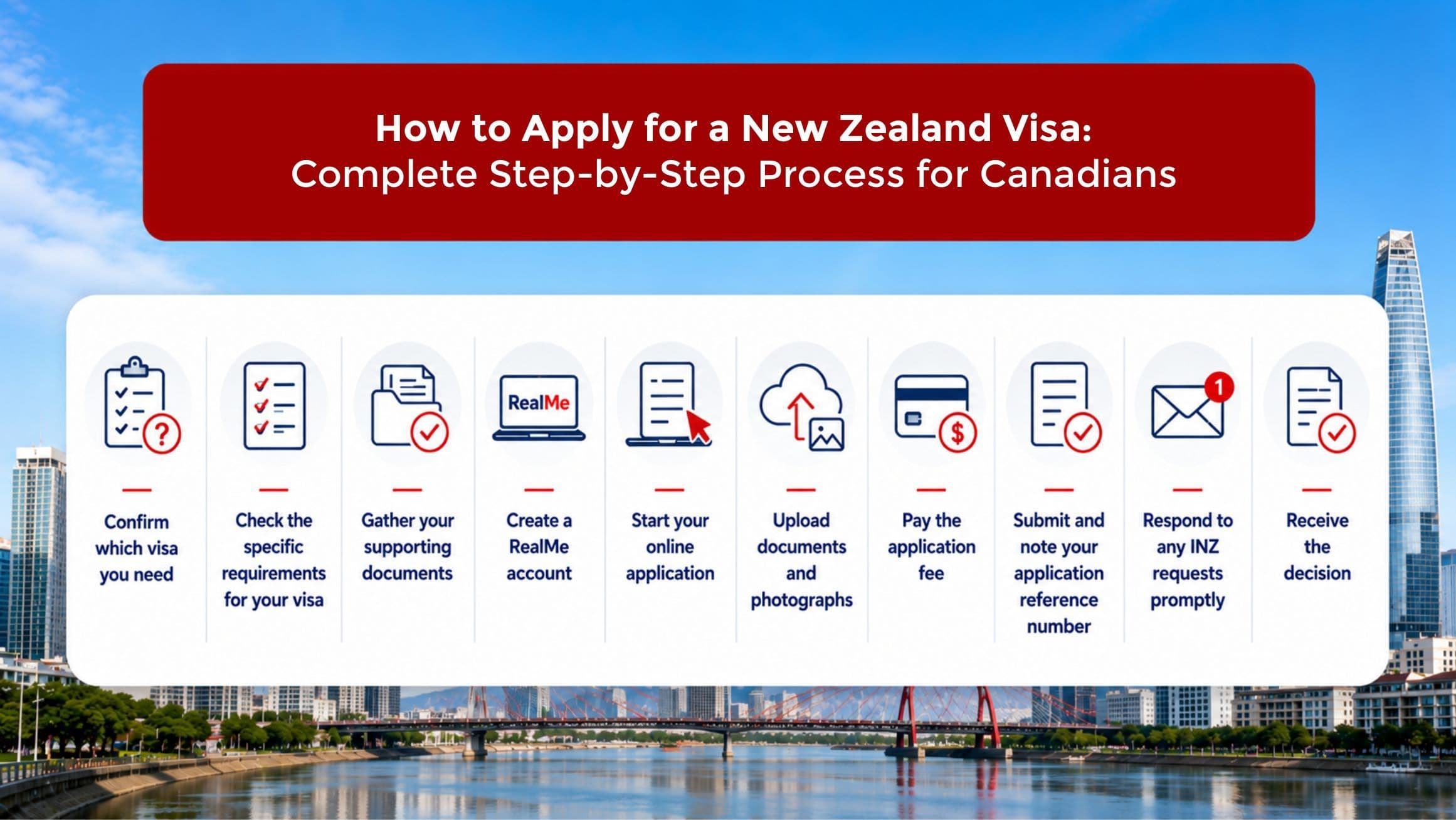
All New Zealand visa applications for Canadians are processed through Immigration New Zealand's online system at immigration.govt.nz. There are no paper applications accepted at NZ diplomatic offices in Canada, and the NZ High Commission in Ottawa does not process visa applications on INZ's behalf. The entire process - from application to decision - happens online.
Here is the exact sequence.
Use INZ's visa finder tool at immigration.govt.nz/visas to compare options. The key decision is whether you need a temporary visa (Working Holiday, AEWV, Student, Visitor) or a residence-class visa (Green List, Skilled Migrant Category, Partnership, Parent). Do not assume based on your occupation alone - the Green List is updated and your specific job title may have a different tier than a similar-sounding title.
If you have health disclosures, a criminal record, or an occupation not clearly on the Green List, consult an IAA-registered immigration adviser before proceeding. The adviser register is at iaa.govt.nz. A consultation costs NZD $200–$400 and can prevent a refusal that would delay your plans by months.
Each visa page on immigration.govt.nz lists the exact eligibility conditions, documents required, and processing timeframes. Read the page for your specific visa - not a summary or third-party guide - before gathering documents. Requirements change. The page was last updated more recently than any guide.
Documents commonly required across most NZ visas:
All documents must be in English or accompanied by a certified English translation.
A RealMe account is New Zealand's government identity verification system - used by INZ, IRD, and other agencies. Go to realme.govt.nz and create an account using your email address. You need this account to access Immigration Online. If you already have a RealMe account from a previous NZ interaction, you can use the same login.
Log into immigration.govt.nz using your RealMe credentials. Select "Apply for a visa" and choose your visa type. The enhanced Immigration Online system uses smart forms that adapt to your answers - you will only be asked questions relevant to your situation. The system saves progress automatically.
For Working Holiday Visas, the form takes approximately 20–30 minutes. For residence-class applications, expect 60–90 minutes across multiple sessions.
Upload all required documents in the formats INZ accepts (PDF, JPG, PNG). File size limits apply per document - compress large PDFs if necessary. Your passport photo must meet INZ's specific dimensions and quality requirements, detailed at immigration.govt.nz/photographs.
Fees are paid by credit or debit card within the online system at the submission stage. Fees vary by visa type. Current fees are listed on each visa's page at immigration.govt.nz. As a reference point: the Working Holiday Visa fee is NZD $770, and residence visa fees range from NZD $2,000 to $3,900 depending on category. Fees are non-refundable, whether approved or declined.
After submission, INZ generates an application reference number. Save this. You will use it to check status and respond to any INZ requests.
INZ may contact you via your RealMe email address to request additional documents, medical certificates, or clarification. Respond within the timeframe stated in the request - typically 10–15 working days. Delays in responding extend your processing time proportionally.
Decisions are delivered via the Immigration Online portal and by email. Approval grants your visa with specific conditions (start date, employer conditions for work visas, permitted activities). Read the conditions carefully - your visa is only valid within those conditions.
| Visa type | Typical processing time |
| Working Holiday Visa | 3–5 weeks (complete application) |
| AEWV (with pre-accredited employer) | 6–12 weeks |
| Green List Tier 1 Residence | 3–6 months |
| Skilled Migrant Category (post-ITA) | 6–18 months |
| Partnership Visa (residence) | 6–18 months |
Processing times are estimates. INZ does not guarantee timeframes. Do not book non-refundable flights until your visa approval letter is in hand.
Official application portal: immigration.govt.nz | IAA-registered adviser register: iaa.govt.nz
New Zealand maintains three diplomatic offices in Canada. Understanding what each office does - and more importantly, what they do not do - prevents wasted trips and misunderstood expectations.
Important: NZ visa applications are not submitted at these offices. All Immigration New Zealand visa applications, for all visa types, are submitted online through immigration.govt.nz. The NZ High Commission and consulates in Canada do not accept visa applications, do not forward applications to INZ, and cannot influence processing times or decisions. Their primary purpose is consular services for New Zealand citizens in Canada, and bilateral trade and diplomatic functions.
150 Elgin Street, Suite 1401 Ottawa, Ontario K2P 1L4
Phone: +1 (613) 238-5991 Email: info@nzhcottawa.org Website: mfat.govt.nz/en/countries-and-regions/americas/canada/new-zealand-high-commission Office hours: Monday to Friday, 08:30 to 16:30
The High Commission is the primary New Zealand diplomatic mission in Canada. It handles consular services for NZ citizens (emergency travel documents, notarial services, welfare assistance), bilateral government relations, and trade promotion. For Canadian applicants, it can provide general information about New Zealand and refer you to INZ for immigration enquiries - but it cannot accept or process visa applications.
1050 West Pender Street, Suite 2250 Vancouver, BC V6E 3S7
Consul-General and Trade Commissioner to Canada: Ms Rhea Cowell Website: mfat.govt.nz/en/countries-and-regions/americas/canada/new-zealand-high-commission
The Vancouver consulate operates by appointment only for in-person services. Services available in-person are limited to certifying authentic copies of documents and witnessing statutory declarations for use under NZ law. Contact the consulate directly for fee information and to book an appointment. All other consular assistance is provided by telephone and email.
New Zealand also maintains an honorary consulate in Toronto. Honorary consulates provide limited consular assistance to NZ citizens in the Toronto region. They do not process visas or provide immigration advice.
| Your need | Where to go |
| Apply for any NZ visa | immigration.govt.nz (online only) |
| Find an IAA-registered immigration adviser | iaa.govt.nz |
| Check current visa requirements and fees | immigration.govt.nz/visas |
| Report a problem with an INZ online application | INZ contact centre: +64 9 914 4100 |
| Consular emergency (NZ citizen in Canada) | NZ High Commission Ottawa: +1 613 238 5991 |
| Register your move with Canadian government | travel.gc.ca (Registration of Canadians Abroad) |
Addresses and phone numbers verified against mfat.govt.nz, May 2026. Contact details can change - verify at mfat.govt.nz before visiting or calling.
Every visa application, regardless of category, is assessed against four eligibility criteria: health, character, English language, and qualifications.
The Acceptable Standard of Health requirement is a risk-weighted evaluation, not a blanket pass/fail test. Minor conditions do not disqualify. Conditions requiring expensive ongoing treatment may trigger a Specific Medical Assessment.
A chest x-ray is mandatory for all applicants aged 11 and over applying for a visa of more than 12 months. A full medical examination is required for visas exceeding 24 months. Both must be completed at an INZ-approved physician in Canada, with results submitted digitally through INZ's eMedical system.
All applicants aged 17 and over must provide a police certificate from each country they have lived in for 12 months or more in the past 10 years. For most Canadians, this means an RCMP Criminal Record Check. The paper certified version takes 6 to 8 weeks. Order it early - it is the most common document holding up Canadian applications.
A DUI conviction more than 5 years ago with no further offences is disclosed but does not automatically trigger a refusal. A DUI within 3 years or involving injury is assessed more stringently. All disclosable offences must be declared - failure to disclose is treated as a character issue in itself.
Canadians who completed a full degree or trade qualification in English in Canada are exempt from English language tests on most visas. Some professional registration bodies require independent evidence regardless of nationality. The Nursing Council of NZ, for instance, requires IELTS Academic 7.0 in each component (or OET grade B) for nurses trained outside NZ or Australia.
The New Zealand Qualifications Authority assesses overseas qualifications against the NZ Qualifications Framework (NZQF). Assessment is required when SMC points depend on the qualification level, or when a professional registration body requires it.
Work visa applications do not have a formal funds requirement, but settling-in costs create a practical minimum. NZ landlords require a bond of up to 4 weeks' rent plus rent in advance. Add vehicle purchase, furniture, and daily costs before first pay - the realistic reserve for a couple arriving in Auckland is NZD $35,000 to $50,000.

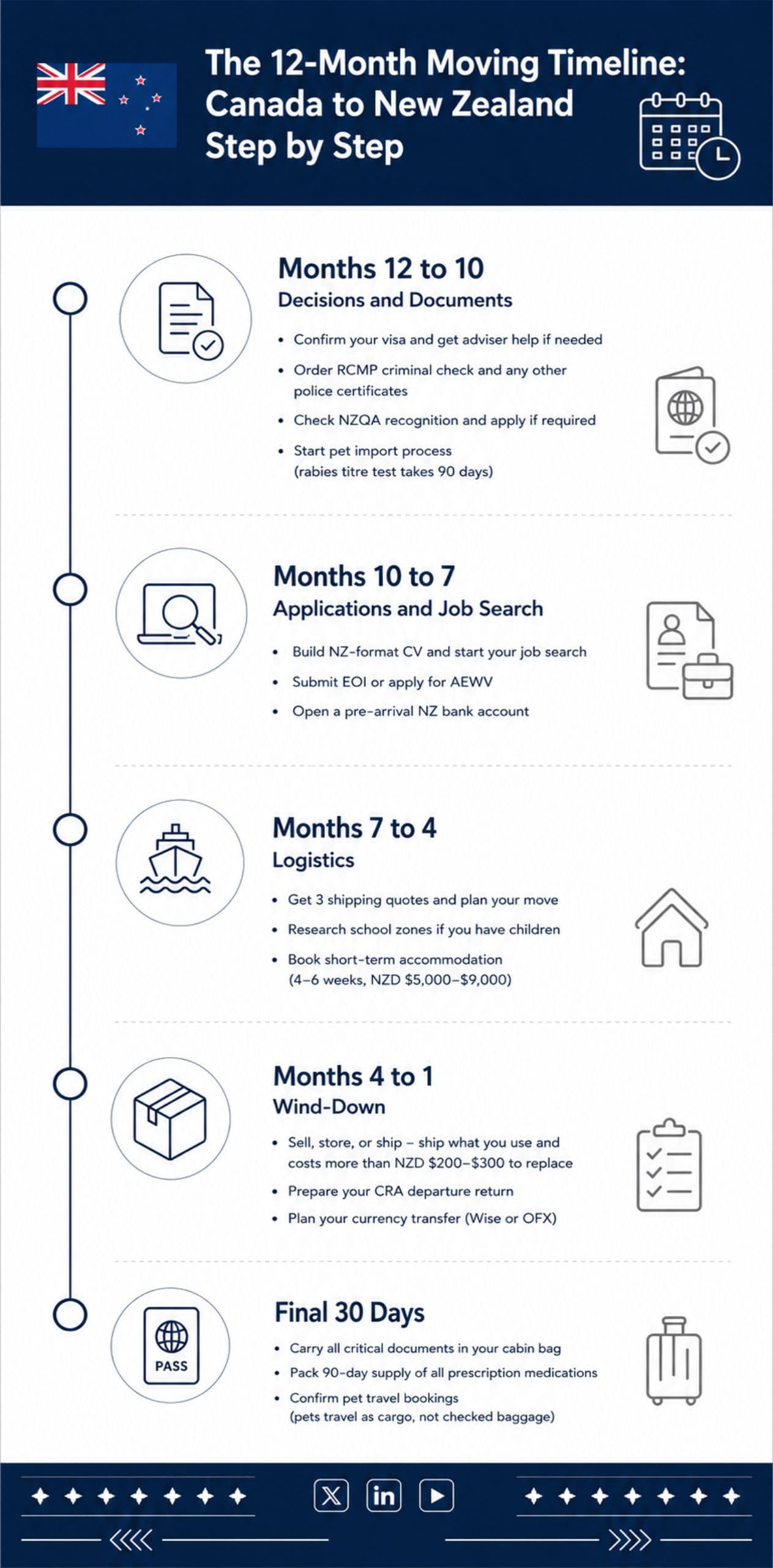
The move from Canada to New Zealand has a natural dependency chain. Some steps cannot begin until others are complete. Ignore the order and you will lose weeks - or worse, miss the move entirely because a pet's titre test didn't start on time.
Confirm your visa target. Book a consultation with an IAA-registered immigration adviser if you have any health disclosures, prior refusals, or an occupation not clearly on the Green List.
Order your RCMP Criminal Record Check immediately. If you lived outside Canada for 12+ months in the past 10 years, order police certificates from each country - the FBI check for US residency takes comparable time.
Check your NZQA recognition status. Apply for assessment if your visa or registration depends on it.
If you have a dog or cat, begin the pet import process now. The rabies titre test has a mandatory 90-day waiting period. This is the longest single lead time in the entire move - it cannot be shortened.
Build your NZ-format CV: no photo, no date of birth, two pages, achievement-led. Search at Seek.co.nz and
. LinkedIn with a NZ location filter helps for professional roles.
Submit your EOI or apply for an AEWV through your NZ employer's accreditation. Open a pre-arrival NZ bank account - ANZ, ASB, and Westpac all accept pre-arrival applications and provide an account number for your IRD application.
Get three written shipping quotes: full 20-foot container, LCL (shared container), and air freight. Sea transit from Vancouver to Auckland: 4 to 5 weeks. From Toronto via Halifax: 7 to 10 weeks.
Research school zones if you have children. In Auckland, the school determines where you must live - not the reverse. Check school zones at the Ministry of Education's zone map.
Book short-term accommodation for arrival: 4 to 6 weeks in a furnished apartment. Budget NZD $5,000 to $9,000.
Sell, store, or ship. The decision rule: ship what costs more than NZD $200 to $300 to replace and that you actively use. IKEA and Trade Me fill the gaps cheaply.
Prepare your CRA departure return. Your final Canadian tax year ends on your departure date. Deemed disposition rules apply to most capital property on that date.
Plan your currency transfer. Use Wise or OFX for amounts under CAD $200,000. Splitting the transfer over 2 to 3 transactions averages out the exchange rate.
Carry all critical documents in your cabin bag - passports, visa letters, medical records, pet permits, children's school records. Pack a 90-day supply of all prescription medications. Confirm pet travel bookings: pets travel as cargo, not checked baggage, on approved airlines.

Carry originals in your carry-on. Scan and store encrypted digital copies in cloud storage before departure.
Most New Zealand visa applications - including the AEWV, Working Holiday Visa, and Green List residence applications - do not require apostilled documents. Immigration New Zealand typically accepts original documents or certified copies without an apostille stamp. This is one area where the NZ immigration process is less bureaucratic than many countries.
That said, there are two situations where apostille becomes relevant:
Some professional registration bodies - particularly in healthcare - may ask for authenticated copies of overseas credentials during the registration process. The Nursing Council of NZ, for instance, sometimes requests certified or authenticated qualification documents from specific countries. Check with the relevant NZ registration body (Nursing Council, Medical Council, Teaching Council, Engineering NZ) for your specific requirements before applying.
Even if INZ does not require it, your vital records - birth certificate, marriage certificate, and if applicable, divorce decree - are worth apostilling before you leave Canada. Here is why: once you are in New Zealand, getting a document authenticated from Canada takes weeks longer, costs more in courier fees, and creates logistical complexity at exactly the moment you want to focus on settling in. Apostilling your vital documents in Canada before departure removes that problem entirely.
Canada acceded to the Hague Apostille Convention on January 11, 1965. The competent authority for federal documents (passports, citizenship certificates, RCMP certificates) is Global Affairs Canada. For provincial documents (birth certificates, marriage certificates), the competent authority is the provincial government - typically the provincial court or the Secretary of State office, depending on the province.
For a provincial birth or marriage certificate:
For RCMP criminal record certificate and federal documents, submit to Global Affairs Canada Authentication Services, 125 Sussex Drive, Ottawa, ON K1A 0G2. Processing takes approximately 10 business days for standard service.
Bottom line. Apostille is not required by INZ for most applications. But for birth certificates, marriage certificates, and any educational credentials you may need to register with a NZ professional body, apostilling in Canada before you leave is a straightforward 2–3 week task that eliminates a potential bureaucratic bottleneck later. Do it as part of your 10-to-7-month timeline window.
Verify current apostille requirements with the specific NZ registration body relevant to your profession and with your provincial vital statistics office before proceeding. Requirements can change.
The all-in cost depends on family size, how much you ship, and whether you have pets. All figures are in Canadian dollars at an approximate CAD/NZD rate of 0.84 - check the current rate at the Bank of Canada before planning.
| Cost Category | Solo, 2 Suitcases | Couple, Partial Shipment | Family of 4, Full Container |
| Visa fees | $350–$800 | $700–$2,400 | $1,400–$4,800 |
| Flights (per person, economy) | $1,800–$3,200 | $3,600–$6,400 | $7,200–$12,800 |
| Shipping / freight | $0 | $4,000–$8,000 | $12,000–$18,000 |
| Pet relocation | $0 | $0–$5,000 | $3,000–$8,000 |
| First-month accommodation | $2,500–$4,000 | $3,500–$5,500 | $5,000–$8,500 |
| Bond and advance rent | $2,500–$5,000 | $3,500–$6,000 | $5,500–$9,000 |
| Vehicle purchase on arrival | $0–$8,000 | $8,000–$16,000 | $10,000–$20,000 |
| Settling-in reserve | $5,000 | $8,000 | $15,000 |
| Total estimate | $12,000–$21,000 | $31,000–$49,000 | $59,000–$96,000 |
| Expense | Toronto (CAD) | Auckland (NZD) | Vancouver (CAD) | Wellington (NZD) | Calgary (CAD) | Christchurch (NZD) |
| 1-bed rent / month | $2,300–$3,000 | $2,400–$3,600 | $2,400–$3,200 | $2,200–$3,200 | $1,600–$2,200 | $1,700–$2,500 |
| 2-bed rent / month | $3,200–$4,200 | $3,200–$5,000 | $3,200–$4,500 | $2,900–$4,200 | $2,200–$3,000 | $2,200–$3,400 |
| Monthly groceries, 2 adults | $600–$900 | $700–$950 | $600–$900 | $650–$900 | $550–$800 | $600–$850 |
| Monthly utilities | $150–$250 | $150–$300 | $120–$220 | $180–$320 | $180–$300 | $160–$280 |
| Internet | $70–$110 | $70–$120 | $70–$110 | $70–$110 | $65–$100 | $65–$100 |
| Public transport pass | $160–$180 | $200–$250 | $110–$140 | $170–$220 | $110–$130 | $90–$120 |
| Childcare, 1 child/month | $1,500–$2,200 | $600–$1,200* | $1,400–$2,000 | $600–$1,200* | $1,200–$1,900 | $500–$1,000* |
*NZ figures reflect the 20 Hours ECE subsidy for children aged 3–5.
Cars. The used car market relies on Japanese imports. A reliable 2019 Toyota Corolla costs NZD $18,000 to $24,000. In Canada the same car trades at $15,000 to $19,000 CAD. The premium is real.
Electronics. A mid-range laptop costing $1,200 CAD in Canada costs $1,800 to $2,100 NZD in New Zealand. Import duties, 15% GST, and a smaller retail market all contribute.
Winter heating. NZ homes lack the insulation and central heating Canadians expect. A heat pump running 6 to 8 hours daily in a Wellington two-bedroom adds $120 to $220 NZD per month to the electricity bill in winter.
Domestic flights. Auckland to Queenstown return, booked 2 weeks out: $400 to $700 NZD. The two islands have no road or rail link - inter-island travel is a recurring cost.
GP visits. Enrolled patients at a community health centre pay $15 to $50 NZD per standard consultation. Walk-in rates are $80 to $150 NZD.
Accident cover (ACC): New Zealand's no-fault accident compensation scheme - is funded through wage levies. Personal accident insurance is not needed once you are enrolled.
Childcare (ages 3–5): The 20 Hours ECE subsidy applies at any licensed childcare provider. A child under 3 years costs $1,400 to $2,200 NZD per month for full-time care - significantly less than comparable Canadian cities.
| Provider | Fee Structure | Best For |
| Wise | 0.4–0.7% of amount | Transfers under CAD $100K, transparent pricing |
| OFX | No flat fee, 0.3–0.8% margin | Larger one-off transfers |
| TorFX | Negotiable above CAD $20K | Large transfers, forward contracts |
| Bank international wire | $25–$50 flat + 2–4% margin | Convenient but expensive, avoid for large amounts |
On a CAD $100,000 transfer, the difference between a bank wire (3% margin = $3,000 CAD lost) and Wise (0.5% = $500 CAD) is $2,500 CAD. Use a specialist service for any transfer above CAD $10,000.
New Zealand's unemployment rate was 5.3% in the March 2026 quarter, per Stats NZ Labour Market Statistics. According to Trading Economics, Canada’s unemployment rate rose to 6.9% in April 2026, the highest level in six months. At the same time, skill shortages continue across healthcare, construction, engineering, education, and several areas of the technology sector
The NZ job market is smaller than it looks. The total working-age population is around 3 million. Passive applications - sending 30 CVs and waiting - performs poorly here. Direct outreach, professional referrals, and targeted LinkedIn engagement with NZ-based professionals in your field outperform volume-based approaches.
This table compares monthly net take-home (after income tax) minus median two-bedroom rent in each city. This reflects actual purchasing power, not advertised gross salaries.
| Occupation | Auckland Net/month (NZD) | Toronto Net/month (CAD) | Auckland after rent | Toronto after rent |
| Registered Nurse | $5,200–$5,900 | $5,400–$6,200 | $1,000–$2,700 | $1,200–$3,000 |
| Civil Engineer | $5,800–$7,200 | $6,200–$8,000 | $1,600–$4,000 | $2,000–$4,800 |
| Licensed Electrician | $5,000–$6,200 | $4,800–$6,000 | $1,200–$3,400 | $600–$2,800 |
| Secondary Teacher | $4,800–$6,000 | $5,200–$6,800 | $600–$2,800 | $1,000–$3,600 |
| Software Developer | $5,800–$7,800 | $7,500–$10,500 | $1,600–$4,600 | $4,300–$7,300 |
| General Practitioner | $9,500–$13,000 | $9,000–$14,000 | $6,300–$9,800 | $5,800–$10,800 |
The software developer row shows the sharpest gap. After rent, a Toronto-based developer retains $4,300 to $7,300 CAD. An Auckland developer retains $1,600 to $4,600 NZD. For technology professionals, this is the central financial trade-off.
New Zealand's Employment Relations Act 2000 allows employers with 19 or fewer employees to include a 90-day trial period clause in employment agreements. During that period, dismissal cannot be challenged as unjustified dismissal. It does not protect employers from discrimination or harassment - those remain actionable throughout.
Read your employment agreement before signing. Confirm the employer meets the size threshold, and verify your AEWV conditions allow you to change employers if dismissed during the trial.
This is possible but creates three specific problems most Canadians underestimate.
NZ tax residency. You become an NZ tax resident after 183 days in the country in a 12-month period, or from the date you establish a permanent home in NZ. From that point, IRD taxes your worldwide income - including your Canadian salary.
Permanent establishment risk. If your NZ presence constitutes core business activity for your Canadian employer, IRD may treat that as a permanent establishment, giving NZ the right to tax the profits from that activity. Most Canadian employers are unaware of this risk.
The practical solution. Restructuring as an NZ-incorporated contractor providing services to the Canadian employer under a services agreement eliminates the permanent establishment risk and creates a clean NZ tax entity. Initial legal and accounting setup costs NZD $2,000 to $3,500.
Three differences from a Canadian resume matter in practice:
This chapter reflects general principles under the Canada–New Zealand Double Taxation Agreement as of May 2026. Tax law is complex. Consult a Canadian cross-border CPA and a registered NZ tax adviser before acting on any of this.
Two tests trigger NZ tax residency. The first: physical presence in New Zealand for more than 183 days in any 12-month period. The second: establishing a permanent place of abode in NZ - a settled, regular home- regardless of day count.
Both can apply simultaneously. A Canadian who signs a 12-month Auckland lease and starts work in week one is an NZ tax resident from day one under the permanent place of abode test.
From that point, IRD taxes worldwide income - Canadian salary, Canadian rental income, dividends from a TFSA, everything.
CRA considers you a Canadian tax resident until you sever residential ties with Canada. Primary ties: a home available for your use in Canada, a spouse or common-law partner remaining in Canada, dependants remaining in Canada.
Secondary ties - Canadian bank accounts, provincial health card, Canadian driver's licence, professional memberships - support the argument for continued residency if primary ties have not been severed first.
The deemed disposition rule applies on the date you cease Canadian tax residency. CRA treats you as having sold most capital property at fair market value on that date. Gains are taxable. Your principal residence is exempt if you qualify for the principal residence exemption. RRSPs and RRIFs are also exempt from deemed disposition.
Canada and New Zealand have had a tax treaty since 1980, updated in 2012. The treaty prevents double taxation through exemptions and foreign tax credits.
Employment income is taxed in the country where the work is performed. Canadian rental income received by an NZ resident is subject to 25% CRA withholding tax unless a Part I election is made - and must also be declared to IRD. The treaty credit mechanism helps but does not always fully eliminate double exposure, particularly in years where NZ rates exceed what CRA has already withheld.
| Account | CRA Treatment After Departure | IRD Treatment as NZ Resident | Key Risk |
| RRSP | Tax-deferred while held; withdrawals taxed at 25% NR withholding (reducible to 15% under treaty) | IRD may tax growth as foreign superannuation income | Potential double tax on growth without planning |
| TFSA | No Canadian tax on growth or withdrawal | IRD does not recognise TFSA as tax-free - growth is taxable | NZ taxes what Canada exempts - real exposure |
| RESP | CRA rules unchanged for grant repayment | IRD may treat as foreign trust with complex reporting | Get advice before emigrating if RESP has significant value |
| CPP / OAS | Payable to NZ residents; 25% NR withholding, reducible to 15% under treaty | Declarable as foreign pension income; treaty credit applies | Manageable with coordination |
| Non-registered investments | Deemed disposition on departure triggers capital gains | Post-departure gains taxable as foreign income | Depends on asset type |
| Annual Income (NZD) | Tax Rate |
| $0 – $14,000 | 10.5% |
| $14,001 – $48,000 | 17.5% |
| $48,001 – $70,000 | 30% |
| $70,001 – $180,000 | 33% |
| Over $180,000 | 39% |
Source: Inland Revenue Department
Provisional tax applies when residual income tax (income not covered by PAYE) exceeds NZD $5,000. It is paid in three instalments during the income year. Late payment attracts use-of-money interest charges from IRD.
New Zealand's publicly funded healthcare system is administered by Te Whatu Ora - Health New Zealand, which replaced the district health board structure in 2022. For Canadians who qualify, most primary care, specialist care, and hospital care is publicly funded. But eligibility is not automatic on arrival.
The direct answer: Canadian citizens holding a New Zealand resident visa, or a work visa of 24 months or more, qualify for publicly funded healthcare from the date their visa is granted. Canadians on Working Holiday Visas, short-term work visas, or visitor visas do not qualify and must fund their own care.
| NZ Component | NZ Name | Canadian Equivalent | Key Difference |
| Primary funder | Te Whatu Ora | OHIP / MSP / AHCIP / RAMQ | NZ is a single national funder; Canada has 13 provincial systems |
| Drug funding | Pharmac | Provincial formularies | Pharmac funds a narrower list; some Canadian medications not available |
| Accident cover | ACC | No direct equivalent | ACC covers all accidents for everyone physically in NZ, including visitors |
| GP system | Enrolled GP | Family doctor | NZ requires active enrolment; un-enrolled patients pay higher rates |
The Accident Compensation Corporation (ACC) is New Zealand's no-fault accident compensation scheme. It covers medical treatment, rehabilitation, and partial income replacement for injuries caused by accidents. It applies to everyone in New Zealand - residents, work visa holders, visitors, and tourists.
Coverage includes injuries at home, on the road, in sport, and in the workplace. It is funded through levies on wages (via PAYE), vehicle registration, and petrol. An employed Canadian earning NZD $90,000 pays approximately $1,500 in ACC levies annually - and in return receives funded surgery, physiotherapy, and up to 80% of pre-injury income during recovery from any accident, without needing personal accident insurance.
What ACC does not cover: illness, cancer, infection, heart disease, or medical complications not caused by an identifiable accident. Public health funding applies to those conditions for eligible residents.
When you enrol with an NZ GP, the government pays a per-patient capitation subsidy to the practice. This reduces your cost per visit.
Enrol in your first week. Use Health Point to find practices accepting new patients near your address. Practices in central Auckland and Wellington reach capacity and may decline new enrolments - check before arriving and contact your preferred practice ahead of time.
Pharmac manages the list of publicly funded pharmaceutical drugs in New Zealand. The Pharmaceutical Schedule is the funded medication list. Most prescriptions cost NZD $5 per item for a 3-month supply. Over 65, prescriptions are free.
Not every medication available in Canada is funded in NZ. Common differences include: specific blood pressure medication formulations, some ADHD medications (methylphenidate is funded; some amphetamine salt formulations are not), newer diabetes medications, and some mental health prescriptions.
Check the Pharmac schedule for every regular medication before emigrating. Un-funded medications are available by prescription at full cost: $80 to $300 NZD per month depending on the medication.
| Province | Coverage Ends After Absence |
| Ontario (OHIP) | 212 consecutive days outside the province |
| British Columbia (MSP) | 6 months in a calendar year outside BC |
| Alberta (AHCIP) | 183 days outside Alberta in a calendar year |
| Quebec (RAMQ) | 183 days, circumstances-dependent |
| Manitoba (MHSP) | 6 months outside Manitoba |
The gap between losing Canadian provincial coverage and qualifying for NZ public funding - which requires 24 months of visa validity for work visa holders - is the window where travel insurance with medical coverage is mandatory.
| NZ Year | Canadian Grade | EquivalentAge |
| Year 1 | Kindergarten / Grade 1 | 5–6 |
| Year 3 | Grade 2 | 7–8 |
| Year 6 | Grade 5 | 10–11 |
| Year 9 | Grade 8 | 13–14 |
| Year 11 | Grade 10 | 15–16 |
| Year 13 | Grade 12 | 17–18 |
The NZ school year runs from late January to mid-December, divided into four terms. This creates a disruption challenge for Canadian families moving mid-year.
A family departing Canada in June arrives in NZ mid-Term 2. A child joining in July has left a Canadian school mid-year and enters an NZ school mid-year. There is no clean break in either system.
The two best arrival months for school continuity are January (start of Term 1, first day of the NZ school year) and April (start of Term 2, after the mid-summer break). Arriving in October or November means entering two months before the NZ year ends and restarting entirely in February.

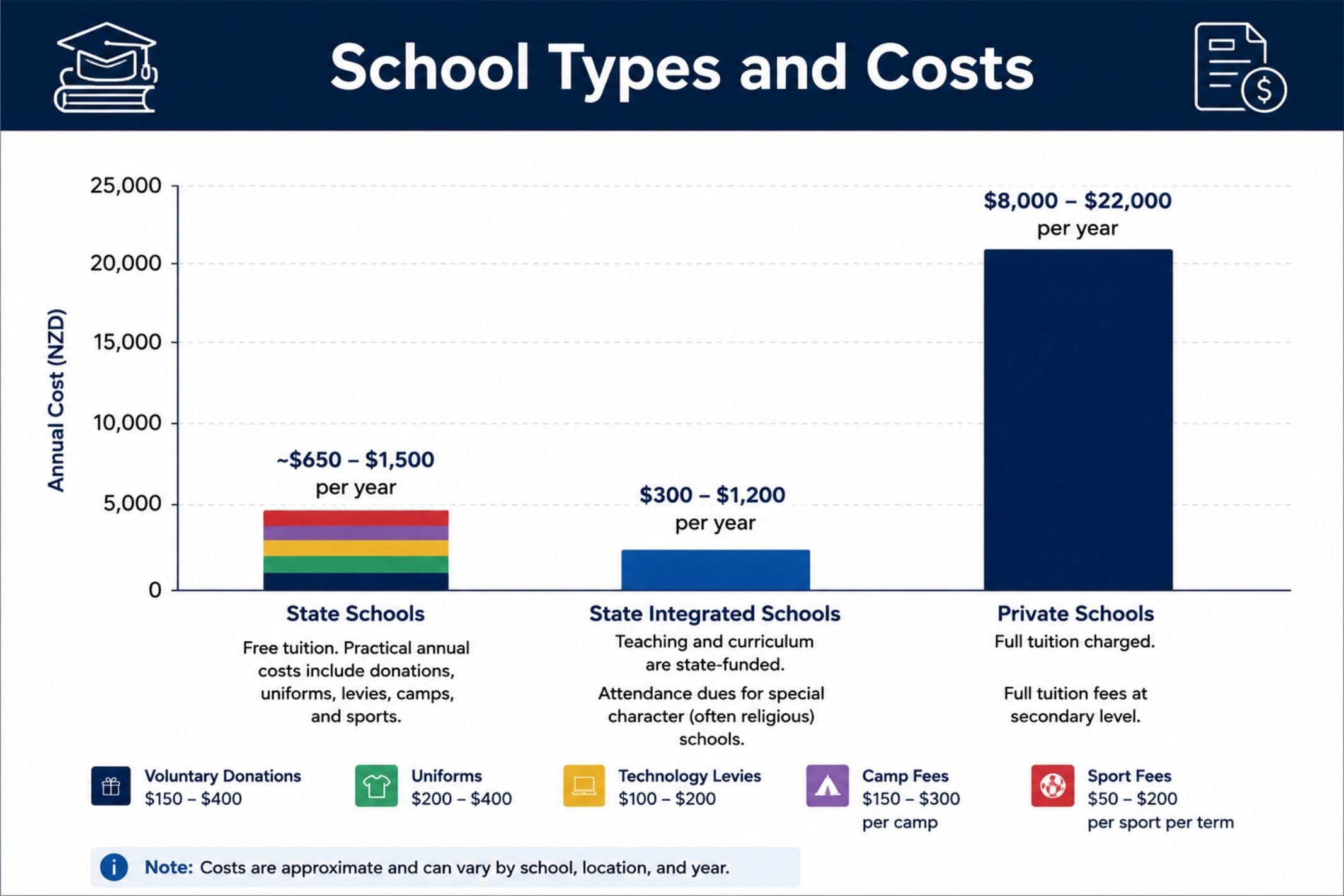
State schools are free for domestic students. The school cannot compel payment - tuition is free by law. Voluntary donations ($150 to $400 NZD per year), uniforms ($200 to $400 NZD), technology levies ($100 to $200 NZD per year), camp fees ($150 to $300 NZD per camp), and sport fees ($50 to $200 NZD per sport per term) are the practical annual costs.
State integrated schools retain a special character (often religious) and charge attendance dues of $300 to $1,200 NZD per year. Teaching and curriculum costs are state-funded.
Private schools charge full tuition. Fees range from NZD $8,000 to $22,000 per year at secondary level.
Auckland's most sought-after state secondary schools operate within strict geographic zones. You can only enrol at a zoned school if you live at an address within that zone. The zone is verified using a lease agreement, property title, or utility bill.
The zoning for Auckland Grammar and Epsom Girls' Grammar - the most requested state schools in Auckland - covers inner eastern suburbs including Remuera, Epsom, and Newmarket. Renting a 3-bedroom house in these suburbs costs NZD $1,000 to $1,600 per week.
Wellington operates with less strict zoning. Most Wellington state schools have an out-of-zone ballot process. Check school zones before signing any Auckland lease - the address determines school access, not the reverse.
Find zone maps at the Ministry of Education.
Children aged 3 to 5 are entitled to 20 free hours of ECE per week at any licensed provider. Above those funded hours, the hourly rate is $8 to $14 NZD. Full-time childcare under 3 years costs $1,200 to $2,200 NZD per month in Auckland and Wellington.
Wait lists at popular Auckland and Wellington ECE centres run 6 to 18 months. Add your child to the wait list before you arrive in NZ - many providers accept international registrations by email.
New Zealand winter temperatures are mild compared to Canada - Wellington's July average low is 6°C, Christchurch's is 2°C. The problem is indoors.
New Zealand's rental housing stock was built across an era when thermal insulation was minimal. The Healthy Homes Standards, mandatory for all rentals from July 2024, require landlords to provide a fixed heating device capable of maintaining 18°C in the main living area, plus minimum ceiling and underfloor insulation values.
Many properties meet the Standards' minimum requirements but remain cold by Canadian standards. A property with compliant ceiling insulation, single-glazed windows, and no underfloor insulation runs 8°C to 12°C indoors in Wellington winter with no heating active. The damp cold of a NZ winter feels colder than dry -15°C in Calgary because the body loses heat faster in damp conditions.
Before signing a lease, ask: What is the heating source, what is the insulation rating, is there double glazing, and what is the average winter electricity bill at the property.
Rent is advertised per week, not per month. To convert: multiply weekly rent by 52, divide by 12. A $600 pw rent equals $2,600 per month.
The bond is a security deposit of up to 4 weeks' rent, lodged with Tenancy Services NZ - a government agency - not held by the landlord. The landlord must lodge the bond within 23 working days of receipt. This is a meaningful tenant protection: a landlord cannot withhold a bond without the Tenancy Tribunal's authorisation.
Fixed-term tenancies cannot be terminated before the end date without mutual agreement or specific grounds. Periodic tenancies can be ended by the tenant with 28 days' notice, and by the landlord with 63 to 90 days' notice. Applications to the Tenancy Tribunal cost NZD $20.44.
| City | Median 2-Bed Rent (pw, NZD) | Avg Commute to CBD | Character |
| Auckland Central / Ponsonby | $700–$950 | 10–20 min walk/bus | Dense, expensive, walkable |
| Auckland suburbs (Epsom, Mt Eden) | $600–$850 | 20–40 min bus/rail | Quieter, school-zoned |
| Wellington central | $580–$750 | 10–25 min walk | Compact, windy, café culture |
| Christchurch | $450–$600 | 15–30 min car | Affordable, suburban, car-dependent |
| Tauranga | $520–$680 | 20–40 min car | Coastal, growing, warm |
| Dunedin | $380–$520 | 15–25 min | University town, heritage, cold |
| Hamilton | $440–$580 | 15–25 min car | Mid-sized, industrial base |
Source: Trade Me Property Rental Price Index, Q1 2026.
Resident visa holders can purchase residential property in NZ without restriction under the Overseas Investment Act. Work visa holders face restrictions on purchasing existing properties.
Before buying any property built between 1992 and 2006, commission an independent building inspection from a New Zealand Institute of Building Surveyors (NZIBS) member. This is the leaky building era - properties with monolithic cladding and no cavity drainage may have latent structural moisture damage. The LIM report from the local council shows outstanding consents and weathertightness-related notices.
A property without a code compliance certificate (CCC) for any addition or renovation is a significant red flag.
The first week in NZ has a dependency chain. The bank account feeds the IRD number. The IRD number feeds KiwiSaver and PAYE. Get these done in the right order in week one.
| Bank | Pre-Arrival Option | Monthly Fee | Notes |
| ANZ | Yes | $0–$5 NZD | Most ATMs nationally |
| ASB | Yes | $0 | Strong app, popular with new arrivals |
| BNZ | Limited | $0–$6 NZD | Strong business banking |
| Westpac NZ | Yes | $0–$5 NZD | Good international transfer tools |
| Kiwibank | No | $0 | NZ-owned, no pre-arrival option |
Activate the account in-branch on arrival with your passport and visa confirmation. A debit card is issued same-day or couriered within 3 days.
An IRD number is NZ's equivalent of a Social Insurance Number. You cannot legally be employed in NZ without one. Apply at myIR in your first week. You need your NZ bank account number, passport, and visa details. Processing takes 8 to 15 working days.
If you start work before your IRD number arrives, inform your employer. Tax is withheld at 45% until the number is provided - any overpayment is reconciled in your annual tax return.
| Feature | KiwiSaver | RRSP |
| Employee contribution | 3 %, 4%, 6%, 8%, or 10% of gross wages* | Up to 18% of prior year's earned income |
| Employer contribution | Mandatory minimum 3% to 3.5% | Employer-discretionary |
| Tax treatment | Contributions from gross wages (after tax) | Contributions deductible from taxable income |
| Retirement access | Age 65 | Mandatory conversion to RRIF at age 71 |
| First home access | Yes - after 3 years of membership | Yes - Home Buyers' Plan, up to CAD $35,000 |
| Government contribution | Up to NZD $260.72 /year if minimum contributed** | None |
KiwiSaver and RRSP are separate systems. RRSP funds cannot be contributed to KiwiSaver, and KiwiSaver withdrawals are not treated as RRSP income in Canada.
*April 2026 change: KiwiSaver default contribution rates increased from 3% to 3.5% for both employees and employers. If you prefer to stay at 3%, apply to opt down at ird.govt.nz before your first NZ pay period.
* *As of July 2025, the KiwiSaver government contribution is $260.72/year (IRD) - the government contributes 25 cents for every dollar you contribute, up to a maximum of $260.72 annually. You must contribute at least $1,042.86 in the KiwiSaver financial year (July 1 to June 30) to receive the full amount. Note: this rate was halved from $521.43 effective July 1, 2025. Verify current rates at ird.govt.nz/kiwisaver.
The most common mistake in choosing a NZ city is selecting by climate alone. Job market depth, housing affordability, school access, and commute time determine daily quality of life. Each profile below uses a "feels like which Canadian city" anchor to calibrate expectations.
Auckland is home to 1.7 million people - one third of New Zealand's total population. The job market is the most extensive in the country for corporate roles in finance, technology, healthcare, and law.
The commute is the main drawback. Auckland's narrow isthmus between two harbours restricts road capacity. The Northern, Northwestern, and Southern Motorways all operate under heavy peak congestion.
Median house price in Auckland exceeded NZD $1 million in most suburbs (REINZ, March 2026). Rent for a 3-bedroom house in a school-zoned suburb runs $1,000 to $1,600 NZD per week.
Feels like: Greater Toronto Area, multicultural, sprawling, traffic-heavy, expensive, economically dominant.
Best for: Career-focused movers in finance, technology, senior healthcare roles, and corporate management.
Honest trade-off: Cost of living relative to NZ salaries. Property unaffordability for first buyers.
Wellington has approximately 215,000 urban residents. It is the seat of government and the centre of the NZ public service. A significant technology cluster includes Xero's NZ headquarters, Vista Group, and government IT departments.
The inner suburbs - Thorndon, Mt Victoria, Kelburn, Brooklyn are within 20 minutes' walk of the CBD. The commuter rail network serves the Hutt Valley, Porirua, and the Kapiti Coast.
Wind is real. Wellington's average annual wind speed makes it one of the windiest cities in the world at its latitude. The Interislander ferry to the South Island is weather-affected several times per year.
A 2-bedroom apartment in Wellington central runs $580 to $750 NZD per week. Suburban options in Lower Hutt and Porirua run $450 to $600 NZD per week for a 3-bedroom house.
Feels like: Halifax with stronger café culture and more government-sector energy.
Best for: Government and public sector workers, technology professionals, academics, dual-income couples who prefer walkability over car dependency.
Honest trade-off: Smaller social scene than Auckland. Earthquake risk is real and discussed locally.
Christchurch has approximately 400,000 residents. The 2011 earthquake destroyed a significant portion of the central city. The rebuild - now 14 years in - has produced modern central infrastructure alongside visible gaps still being filled.
Housing is the most affordable of any major NZ city. A 3-bedroom house in Riccarton, Halswell, or Rolleston rents for $550 to $750 NZD per week. Buyers find detached houses on usable sections below NZD $700,000 - a figure that does not exist in Auckland or Wellington.
The job market concentrates in construction, engineering, agriculture, healthcare, and manufacturing. The technology sector exists but is smaller than Auckland or Wellington.
Feels like: Calgary or Saskatoon - grid-plan streets, car-dependent, suburban culture, mountain access within 90 minutes.
Best for: Families wanting space and affordable housing, construction and engineering professionals, healthcare workers.
Honest trade-off: CBD still has rebuild gaps. Flat geography is pleasant in summer and windswept in winter.
Tauranga has been New Zealand's fastest-growing urban area by percentage for most of the past decade. The Bay of Plenty offers a warmer and drier climate than Auckland, a working port city, and strong orientation toward coastal living.
The job market is smaller than the main centres. Tauranga suits remote workers and retirees better than career-track professionals in specialist fields. Healthcare, retail, agriculture, and hospitality are the primary employment bases.
Feels like: Kelowna, BC - warm, coastal, retirement-oriented, infrastructure catching up to population growth.
Best for: Remote workers, retirees, hospitality workers, those prioritising coastal lifestyle.
Honest trade-off: Traffic on State Highway 2 into Tauranga is a documented ongoing problem.
Skiing at the Remarkables and Coronet Peak runs June to October. Mountain biking, trail running, and lake access dominate the warmer months. Queenstown is the outdoor lifestyle peak.
Housing is the most expensive in NZ relative to local salaries. A 2-bedroom apartment rents for $700 to $1,100 NZD per week. Salaries in the local market - dominated by hospitality, tourism, and real estate - do not support this cost base for most workers. Remote workers earning offshore incomes or individuals with independent capital sustain residency here.
Feels like: Whistler, BC - mountain resort town, transient workforce, high cost of living, world-class outdoors.
Best for: Remote workers earning in CAD/USD, hospitality and tourism professionals, outdoor sports professionals.
Honest trade-off: Most housing-unaffordable city in NZ relative to local wages. Limited career depth in specialist fields.
Dunedin is a university town with Victorian and Scottish heritage architecture, a strong arts scene, and the lowest rent of any major NZ city. Cold winters are real - Dunedin is noticeably colder than the rest of the South Island's east coast. It suits students, academics, healthcare workers, and those who prefer quiet and affordable.
Nelson receives the highest sunshine hours of any major NZ city. It has a functional airport (daily flights to Auckland and Wellington), a small but modern hospital, strong arts and craft culture, and housing costs well below Auckland. Well-suited to retirees, remote workers, and creative professionals.
Hamilton is NZ's fourth-largest city and sits 90 minutes south of Auckland. The job market centres on agriculture, food processing, healthcare, and a growing technology cluster. Housing is affordable by NZ standards and the city has expanded its café and restaurant scene significantly since 2020.
| City Pair | Avg July High / Low | Avg Jan High / Low | Annual Rain | Annual Sunshine Hours |
| Auckland vs Toronto | 14°C / 8°C vs -2°C / -8°C | 24°C / 18°C vs 27°C / 17°C | 1,200mm vs 831mm | 2,060 vs 2,066 |
| Wellington vs Vancouver | 12°C / 7°C vs 7°C / 3°C | 21°C / 14°C vs 22°C / 13°C | 1,249mm vs 1,153mm | 2,065 vs 1,938 |
| Christchurch vs Calgary | 11°C / 2°C vs -2°C / -12°C | 24°C / 12°C vs 23°C / 9°C | 617mm vs 413mm | 2,100 vs 2,396 |
Source: NIWA NZ Climate Data and Environment and Climate Change Canada.
NZ winters are substantially milder outdoors. Sunshine hours are more comparable than most Canadians expect. NZ is wetter - particularly Wellington and the West Coast of the South Island.
The UV index on a clear Auckland summer day reaches 11 to 13. Christchurch: 12 to 14. On the equivalent day, Vancouver reaches 6 to 7, Toronto 7 to 8.
The difference exists because NZ sits closer to the Southern Hemisphere ozone hole, which reduces atmospheric UV filtering. New Zealand's Ministry of Health records approximately 4,000 melanoma diagnoses annually in a population of 5 million - roughly double Canada's per capita rate.
The practical response: SPF 50+ sunscreen applied 20 minutes before going outdoors and reapplied every 2 hours, a wide-brim hat, UV-protective clothing for extended outdoor time. This is not optional for Canadians who are accustomed to milder UV exposure.
New Zealand records approximately 15,000 earthquakes per year; roughly 200 are felt by people. The Canterbury sequence (2010–2011) caused 185 deaths and NZD $40 billion in damage. The Kaikōura earthquake (2016) caused significant infrastructure damage to State Highway 1 on the South Island.
The Earthquake Commission - Toka Tū Ake provides government-backed natural disaster insurance for residential property. For homeowners with eligible insurance, EQC covers up to NZD $300,000 (excl. GST) of the building and land. Renters are not covered for contents - contents insurance handles personal property.
Standard NZ earthquake preparedness: store 3 to 7 days of food and water per person, know how to shut off gas and water, keep a grab bag ready, and know the Drop, Cover, Hold procedure (drop to hands and knees, cover head and neck, hold on until shaking stops).
New Zealanders communicate with consistent understatement. "Not bad" means good. "A bit tricky" signals a serious problem. "She'll be right" is a genuine cultural response to adversity - not resignation, but a social preference for calm over drama.
Canadian communication norms particularly in professional settings are more direct about achievements and more explicit when something is wrong. Canadians who bring North American-style self-advocacy into NZ workplaces are read as overconfident by some Kiwi colleagues. The cultural adjustment runs the other way too: a Kiwi manager saying a timeline is "a bit tight" is signalling a delivery risk, not a minor inconvenience.
Tall poppy syndrome is a cultural tendency to resist individuals who appear to elevate themselves above peers. It operates through social pressure rather than explicit criticism. Someone who speaks frequently about their own achievements, salary, or status makes others uncomfortable, and social correction follows.
This affects Canadian professionals who are used to a culture where self-promotion is expected and career advancement requires visible advocacy for one's own work. In NZ workplaces particularly in the public sector, education, and healthcare - framing achievements in terms of team outcomes and collective contribution works better than first-person success narratives.
Te reo Māori, the Māori language - appears on government communications, road signs, television broadcasts, and in most public institutions. All government departments have Māori names used alongside their English names. Mihi (greetings) and pōwhiri (formal welcome ceremonies) are held at many workplace events, particularly in government, health, and education.
Non-Māori New Zealanders are not required to speak te reo but are expected to show basic respect for its use. Canadians who have worked in First Nations contexts or in bilingual Quebec institutions adapt to this more quickly than those without that exposure.
The Treaty of Waitangi - Te Tiriti o Waitangi, signed in 1840 is not a historical document in NZ. It is actively applied in law, public policy, resource management, and healthcare planning. Crown agencies have Treaty obligations. This context is present in many professional environments, particularly in healthcare and education.
Tipping is not expected in New Zealand. Leaving a tip in a restaurant is unusual. Workers in hospitality are paid the national minimum wage - NZD $23.95 per hour as of April 2026 - without a tipped income supplement.
The pub remains central to social life across age and professional groups. After-work drinks on Friday is a genuine social institution. Canadians who do not drink are not excluded, but social gatherings are built around the pub or the backyard in ways that differ from the broader Canadian shift toward restaurant-based socialising.
The minimum annual leave entitlement is 4 weeks, and it is taken. Most NZ workplaces have a functional close-down between Christmas and early January, accounting for 2 of those 4 weeks.
Canadians researching New Zealand almost always run the NZ versus Australia comparison at the same time. Both are English-speaking Commonwealth countries with accessible immigration systems and outdoor-lifestyle cultures. The differences between them matter for specific decisions.
| Factor | New Zealand | Australia | Better for Canadians Who... |
| Median tech salary | NZD $95,000–$120,000 | AUD $110,000–$150,000 | Prioritise income: Australia |
| Median nursing salary | NZD $70,000–$95,000 | AUD $80,000–$105,000 | Fastest residency: NZ (Green List Tier 1) |
| 2-bed rent, major city | $2,600–$4,200 NZD/month | $2,400–$4,400 AUD/month | Similar cost at equivalent levels |
| Residency timeline (healthcare) | 6–12 months, Tier 1 Green List | 12–24 months, Skills in Demand | Speed: NZ |
| Flight home to Canada | $1,800–$4,000 CAD return | $1,600–$3,500 CAD return | Negligible difference |
| Climate (major cities) | Mild, 20–25°C in most cities | Hot, 30–42°C possible in most cities | NZ for Canadians who find intense heat difficult |
| Dual citizenship | Both countries permit it | Both countries permit it | No difference |
Technology and finance professionals comparing salaries need to account for the AUD/NZD exchange rate. AUD $130,000 in Sydney converts to approximately NZD $143,000 - a premium over NZD $100,000 to $120,000 for the same Auckland role.
Construction trades in Queensland and New South Wales face sustained demand tied to post-flood infrastructure, government housing supply programmes, and the 2032 Brisbane Olympics build pipeline.
Canadians with existing business connections to Asian markets will find Sydney and Melbourne better positioned for Pacific Rim business activity than Auckland.
Healthcare workers on the NZ Green List Tier 1 access permanent residence in 12 months or less from a confirmed job offer. Australia's Skills in Demand pathway does not have an equivalent direct-to-residence route - it requires employer-sponsored work followed by a further residency application.
Remote workers earning in Canadian or US dollars find NZ's mid-sized cities - Christchurch, Tauranga, Hamilton, Nelson - more affordable bases than Melbourne or Sydney.
Canadians who want a smaller scale of daily life - fewer people, shorter commutes, proximity to wilderness - find NZ's scale more consistent with what they are seeking. New Zealand's largest city is 1.7 million people. Australia's is 5 million.
Netflix NZ operates a different content library from Netflix Canada. Crave, CBC Gem, and TSN Direct are geo-restricted to Canada and blocked from NZ IP addresses. Spotify, Apple Music, and Audible are available in NZ at comparable pricing.
Canadian bank apps - TD, RBC, BMO, Scotiabank, CIBC - function from New Zealand for balance checks, transfers, and bill payments. INTERAC e-Transfer does not function internationally. Use Wise to send money to a Canadian recipient from NZ.
Keep at least one Canadian bank account and one Canadian credit card permanently active. You will have ongoing Canadian-denominated expenses: RRSP management, Canadian property costs if retained, subscriptions, and any CRA payments.
Your Canadian credit score (Equifax Canada / TransUnion Canada) does not transfer to NZ. NZ credit bureaus - Equifax NZ, Illion, and Centrix - have no access to Canadian credit history. You start NZ credit history from zero, and building it takes 12 to 24 months.
A Canadian phone number can be kept alive through eSIM options on Freedom Mobile or Koodo at a minimal monthly plan, or ported to a forwarding service for two-factor authentication and family calls.
NZ SIM on arrival: Spark has the most extensive rural coverage - recommended for anyone planning to travel around the South Island. One NZ covers urban areas well. 2degrees offers competitive prepaid pricing. Prepaid SIMs are available at any Countdown, New World, or The Warehouse.
Decision rule: Ship what costs more than NZD $200 to $300 to replace in NZ and that you actively use. Sell the rest and buy again on arrival.
A 20-foot container holds the contents of a standard 3-bedroom house. Costs:
LCL (shared container) costs CAD $5,000 to $9,000 for partial loads - cheaper but slower.
MPI biosecurity restrictions prohibit: soil of any kind, used gardening equipment with soil traces, untreated timber, most food products, and feathers. Outdoor gear (camping equipment, ski boots, golf bags) can be shipped but must be cleaned of all soil and organic matter. MPI inspectors check incoming containers - non-compliant items are held or destroyed at the owner's expense.
New Zealand is a rabies-free country. Pet import rules are strict, and the mandatory waiting periods cannot be shortened. Start 9 months before your intended departure if possible. Starting at 6 months is the absolute minimum.
Stage 1: Check breed eligibility. American Pit Bull Terriers, Dogo Argentinos, Brazilian Mastiffs (Fila Brasileiro), and Japanese Tosas are prohibited. Check the MPI prohibited breeds list first.
Stage 2: Microchip, then vaccinate. The pet receives an ISO 15-digit microchip, then a rabies vaccination. This order is legally required. Do not vaccinate before microchipping.
Stage 3: Titre test and 90-day wait. A blood titre test confirms adequate rabies antibody levels (≥ 0.5 IU/mL) at an MPI-approved laboratory. A mandatory 90-day waiting period begins from the blood draw date - not when the result is received.
Stage 4: Import permit. Apply to MPI for an import permit once the titre result is confirmed and the 90-day wait is complete.
Stage 5: Pre-export requirements. Within 5 days of departure: a health inspection by an NZ-approved vet in Canada, a health certificate, and approved parasite treatments as specified in the MPI import health standard.
Stage 6: Arrival inspection. The pet travels as manifest cargo on an approved airline. MPI inspectors examine the pet and documents on arrival at Auckland Airport. If documentation is complete, the pet is released immediately.
Total cost using a registered pet relocation company: CAD $3,500 to $8,000 per animal.
Birds, reptiles, amphibians, rabbits, guinea pigs, and hamsters are either prohibited or subject to prohibitive quarantine requirements. Confirm with MPI before any other planning.
The first week has four priority tasks. Everything else can wait.
| Priority | Task | Why It Can't Wait |
| 1 | Activate NZ bank account in-branch | Needed for IRD number application |
| 2 | Apply for IRD number at myIR | Without it, 45% tax is withheld from wages |
| 3 | Enrol with a local GP at Health Point | Enrolled patients pay $15–$50 NZD vs $80–$150 walk-in |
| 4 | Buy a local SIM card (Spark recommended) | Communication and 2FA codes from day one |
Week 2: Convert your Canadian driver's licence at any VTNZ or VINZ testing station. You have 12 months from arrival - do not wait. Bring your Canadian licence, visa evidence, and NZD $42.40. An eyesight test is conducted on-site. After 12 months, a full NZ licence process is required.
Enrol children in school. Bring: lease agreement as proof of address, previous school reports, vaccination records, and birth certificates.
Week 3 to 4: Register your NZ address with the High Commission of Canada in New Zealand through the registration form at travel.gc.ca. This allows consular contact in a national emergency - it is free and takes 10 minutes.
Update your address in CRA My Account. This is part of your Canadian tax residency severance record.
Purchase a vehicle. In Auckland and Christchurch, a car is necessary. In Wellington, it is optional for CBD residents. Search at Trade Me Motors. A reliable 2020 Toyota Corolla: NZD $20,000 to $26,000. A 2016 Honda Jazz: NZD $14,000 to $18,000.
A resident visa granted by Immigration New Zealand is not the same as a Permanent Resident Visa (PRV). A resident visa gives indefinite right to live and work in NZ, but travel conditions expire 2 years after the grant date.
To obtain a PRV, resident visa holders must demonstrate commitment to NZ through one of four methods: filing NZ income tax returns with taxable NZ income, owning or operating a NZ business, spending time in NZ as the primary place of residence, or making a significant investment in NZ.
A PRV does not expire. Once granted, it allows travel in and out of NZ without renewing travel conditions.
Eligibility for NZ citizenship by grant requires:
Application fee: NZD $470.70. A citizenship ceremony is mandatory - citizenship is not granted by post. Full criteria are at Department of Internal Affairs.
Canada permits dual citizenship. NZ permits dual citizenship. Canadians who become NZ citizens retain their Canadian citizenship and both passports.
NZ permanent residents - not just citizens - have the right to vote in NZ general and local elections. This is unusual globally. It means Canadians on resident visas can participate in NZ democracy without completing citizenship.
There is no dedicated retirement visa for Canadians. This is the most common misunderstanding among Canadians researching retirement in NZ.
The Temporary Retirement Visitor Visa allows retirees aged 66 or older to stay up to 2 years. It requires NZD $750,000 in NZ investments, private health insurance, and a NZ family sponsor. It does not provide a pathway to permanent residency.
The Parent Resident Visa is the primary pathway for Canadian parents of NZ-resident or citizen adult children. The sponsoring child must earn at least the NZ median wage (approximately NZD $62,000 as of 2026). The visa is subject to an annual ballot. Wait times of 5 to 10 years are common. Details at immigration.govt.nz.
Note: Immigration New Zealand restructures visitor visa categories periodically. Confirm the current name, age threshold, investment amount, and availability of this visa at immigration.govt.nz before citing it in financial planning.
CPP and OAS are payable to Canadians living in New Zealand. CRA applies 25% non-resident withholding tax, which is reducible to 15% under the Canada–NZ Tax Treaty. The Canada–NZ Social Security Agreement coordinates contribution periods in both countries' pension systems.
NZ Superannuation - the government-paid retirement benefit at age 65 - requires residency in NZ for at least 10 years after age 20, with at least 5 of those years after age 50. A Canadian arriving at age 55 on a resident visa qualifies after exactly 10 years of residency.
NZ Super is subject to an overseas pension offset. CPP and OAS income is counted against your NZ Super entitlement. A Canadian receiving full CPP and OAS may receive significantly reduced NZ Super. Model this with an adviser who understands both systems before making retirement relocation decisions.
Tauranga: warm summers, coastal lifestyle, growing medical infrastructure, strong retiree orientation.
Nelson: highest sunshine hours of any NZ city, functional airport, small hospital, arts culture, affordable housing.
Napier and Hastings: wine country, Art Deco heritage, warmer-than-average climate. Specialist care requires Wellington or Auckland travel for complex needs.
NZ rentals are smaller than Canadian equivalents. A king-size bed, sectional sofa, and North American dining table often do not fit. Measure your intended NZ accommodation before deciding what to ship. Many Canadians sell their container contents within 12 months.
Canadian licences convert directly to NZ licences without a driving test but only within 12 months of arrival. After 12 months, a full NZ licence process is required: eyesight test, written theory test, practical test, and a 6-month wait between stages. Convert your licence in week 2.
Canadians who maintain substantial ties to Canada a home available for their use, a spouse remaining behind, a Canadian business may continue to be assessed as Canadian tax residents while also being NZ tax residents. This creates a dual-residency position requiring professional management that costs $5,000 to $20,000 in accountant fees to untangle. A $500 pre-departure consultation with a Canadian cross-border CPA prevents this.
It does not. NZ credit bureaus have no access to Canadian records. A Canadian with a Beacon score of 800 arrives in NZ as a credit blank. Building NZ credit history takes 12 to 24 months of consistent NZ financial activity.
In Auckland, the address determines which school your child can attend not the reverse. Signing a lease and then discovering the preferred school is in a different zone means breaking the lease or accepting a school you did not want.
The 90-day mandatory waiting period after the titre test blood draw is non-negotiable. No documentation can shorten it. A family that books flights 4 months out and starts the pet process 2 weeks later will arrive in NZ without their pet. The pet waits in Canada until the process is complete.
The first NZ winter electricity bill arrives in August and covers months of heat pump use. A heat pump running in a 2-bedroom Wellington apartment for winter heating costs $120 to $250 NZD per month above the base power bill. Budget for it explicitly.
Tauranga has excellent climate and coastal lifestyle. It does not have a deep job market for corporate professionals, senior engineers, or technology specialists. Canadians who move to Tauranga for lifestyle and expect to find a $90,000 NZD specialist role within 3 months frequently relocate to Auckland or Wellington within a year.
INZ processing times are estimates, not guarantees. A documentation query, health assessment request, or processing backlog can delay any application without warning. Non-refundable flights booked before the visa approval email arrives risk losing $2,000 to $8,000 CAD. Buy changeable tickets until the visa is confirmed.
The WHV is a single-use, time-limited work authorisation. It grants no priority or points in subsequent residency applications. Canadians who spend 23 months on a WHV and then apply for residency start from the same position as those who never held one. The WHV is valuable for testing life in NZ it requires a conversion plan to become part of a residency track.
The six-month mark is the point at which most Canadian migrants report the most difficulty. The novelty is gone. The practical friction a job that is not quite right, a rental that is colder than expected, the cost of a flight home sitting at $3,000 accumulates into a weight heavier than any individual issue justifies.
This is a documented phase of international migration, not a personal failure. The most consistent factor in navigating it is community. Canadians who have built one or two genuine friendships not just work colleagues by six months report significantly better adjustment. Sport clubs, interest groups, and professional networks outside the immediate workplace build these connections more reliably than office socialising.
The emotional reality of distance becomes concrete when a grandparent is ill, a sibling has a baby, or a parent dies. These events happen.
When it is 8:00 AM Tuesday in Toronto, it is midnight Monday in Auckland in winter. Real-time communication requires one party to be available at an inconvenient hour. Most families settle on a scheduled weekly call and accept that spontaneous contact is mostly text-based.
Plan for 1 to 2 return flights home per year as a budget line not a nice-to-have. This is $4,000 to $9,000 CAD per couple per year.
New Zealand's workforce is approximately 2.9 million people. The number of senior roles in any specialist field is proportionally smaller than in a Canadian market of 40 million. A technology executive managing a team of 40 in Toronto may find the equivalent NZ role manages 8 people.
This is not universally a problem. For Canadians who want to step down in scope and live better on a smaller income, the NZ scale is an asset. For those at career peak who want to continue climbing, the ceiling appears within 2 to 4 years.
The most common solution among high-achieving Canadian migrants is remote work for a non-NZ employer a Canadian software architect working remotely at Canadian pay rates while living in Wellington captures the income ceiling of the North American market and the cost-of-living floor of a NZ city.
New Zealand is one of the most accessible English-speaking countries in the world for Canadians to immigrate to. The visa pathways are clear, the language is the same, and the culture is familiar enough that the adjustment rarely comes as a shock.
But the move takes longer and costs more than most people expect. Budget realistically, get your tax situation sorted before you leave Canada, and never book non-refundable flights before your visa is approved.If your occupation is on the Green List, start there. If it is not, an Accredited Employer Work Visa with a confirmed job offer is your most direct route.
Do one thing today: check your occupation at immigration.govt.nz and order your RCMP criminal record check. Those two steps alone put you ahead of most people who say they are thinking about moving.
Learn how Canada apostille services work after the Hague Convention. Understand provincial authorities, Global Affairs Canada process, fees, timelines, document requirements, and how to apostille Canadian documents for international use.
Everything Canadians need to know about moving to Australia in 2026 - visa options, points test, jobs, taxes, healthcare, and a step-by-step application process.