logo
MENU
Services available at your location
iconAbout Us!
RCMP Criminal Record Check
Canada Apostille
Authentication and Legalization Canada
Digital Fingerprinting
Criminal Records Check
FBI Fingerprinting
Ink and Roll Fingerprinting
Notarization in Canada
Translation
FBI Apostille
Apostille
FBI Identity History Summary Check
UK Apostille
New Zealand Apostille
iconAbout Us!iconCheck Application Status
icon
Read Our Latest Blogs
Stay updated with latest news
Explore All Services
Contact UsPartner With UsFeedback
© Globeia 2025. All Rights Reserved.
Explore All Services
Apostille Canada
Apostille in Ontario
Apostille in Ottawa
Apostille in Toronto
Apostille in Vancouver
Apostille in Calgary
RCMP Criminal Record Checks Canada
Criminal Record Check Nl Newfoundland And Labrador
Brunswick Criminal Record Check
Manitoba Criminal Record Check
British Columbia Criminal Record Check
Alberta Criminal Record Check
Winnipeg Criminal Record Check
Saskatoon Criminal Record Check
Regina Criminal Record Check
Halifax Criminal Record Check
Saint John Criminal Record Check
Richmond Hill Police Check
Barrie Criminal Record Check
Niagara Falls Police Check
Sarnia Police Check
Milton Police Check
Waterloo Criminal Record Check
Thunder Bay Police Check
Kingston Police Check
Guelph Police Check
Cambridge Police Check
Oakville Police Check
Brantford Police Check
Burlington Police Check
Greater Sudbury Police Check
St Catharines Police Check
Hamilton Police Check
Brampton Criminal Record Check
London Police Check
Windsor Criminal Record Check
Scarborough Police Check
Mississauga Police Check
Ottawa Criminal Record Check
Toronto Criminal Record Check
Victoria Police Check
Vancouver Police Record Check
Edmonton Police Information Check
Calgary Criminal Background Check
Criminal Records Check
Criminal History Check
Police Record Check
Criminal History Records Check
Police Information Check
Police Clearance Certificate
Background Check
CPIC
CRJMC
Mobile Fingerprinting in Canada
Digital Fingerprinting
FBI Fingerprinting in Canada
American FBI Background Check
Notarization Services in Canada
Notarization Services in Toronto
Ink and Roll Fingerprinting Service
Authentication and Legalization
Canadian Translations
Portuguese Translation in Canada
Italian Translation in Canada
Spanish Translation in Canada
Jasper Police Check
Wetaskiwin Police Check
Airdrie Police Check
Vulcan Police Check
Provost Police Check
Morinville Police Check
Leduc Police Check
Valleyview Police Check
Swan Hills Police Check
Parkland Police Check
Redwater Police Check
St Albert Police Check
Clinton Police Check
Chilliwack Police Check
Armstrong Police Check
Wood Buffalo Police Check
Dawson Creek Police Check
Kelowna Police Check
Coquitlam Police Check
Grand Forks Police Check
Cranbrook Police Check
Beaumont Police Check
Chestermere Police Check
Brooks Criminal Record Check
Cochrane Police Check
Didsbury Criminal Record Check
Evansburg Police Check
Grande Prairie Criminal Record Check
High River Police Check
Nanaimo Police Check
North Vancouver Police Check
Oliver Police Check
Penticton Police Check
Prince George Police Check
Quesnel Police Check
Salmon Arm Police Check
Richmond Police Check
Prince Rupert Police Check
Trail Police Check
Vernon Police Check
White Rock Police Check
Kitchener Police Check
Humboldt Police Check
Lloydminster Police Check
Martensville Police Check
Meadow Lake Police Check
Melfort Police Check
Middleton Police Check
Digby Police Check
Lunenburg Police Check
Pictou Police Check
Port Hawkesbury Police Check
Springhill Police Check
West Hants Police Check
Wolfville Police Check
Bay Roberts Police Check
Bonavista Police Check
Burgeo Police Check
Corner Brook Police Check
Happy Valley Goose Bay Police Check
Marystown Police Check
Stephenville Police Check
Yellowknife Police Check
Norman Wells Police Check
Whitbourne Police Check
Iqaluit Police Check
Inuvik Police Check
Hay River Police Check
Fort Smith Police Check
Sanikiluaq Police Check
Montague Police Check
Souris Police Check
Stratford Police Check
Dawson City Police Check
Warman Police Check
Faro Police Check
Whitehorse Police Check
Tracadie Sheila Police Check
Pas Police Check
Carberry Police Check
Moncton Police Check
Oromocto Police Check
Sackville Police Check
Shediac Police Check
Sussex Police Check
St Stephen Police Check
Flin Flon Canadian Police Check
Carman Police Check
Dauphin Police Check
Gillam Police Check
Grand Rapids Police Check
Minnedosa Police Check
Morris Police Check
Neepawa Police Check
Campbellton Police Check
Hampton Police Check
Powerview Police Check
Olds Police Checks
Peace River Police Check
Ponoka Police Checks
Rocky Mountain House Police Check
Selkirk Police Check
Strathmore Police Check
Slave Lake Police Checks
Sylvan Lake Police Check
Whitecourt Police Check
Burnaby Police Check
Campbell River Police Check
Castlegar Police Check
Steinbach Police Check
Stonewall Police Check
Wainwright Police Check
Courtenay Police Checks
Fort St John Police Check
Kamloops Police Check
Kimberley Police Check
Revelstoke Police Check
Powell River Police
Port Alberni Police Check
Maple Ridge Police Check
Surrey Police Check
Terrace Police Check
West Kelowna Police Check
Williams Lake Police Check
Mayo Police Check
Carmacks Police Check
Haines Junction Police Check
Pelly Crossing Police Check
Teslin Police Check
Watson Lake Police Check
Beausejour Police Checks
Churchill Police Checks
Gimli Police Check
Deloraine Police Checks
Cross Lake Police Checks
Killarney Turtle Mountain Police Checks
Lac Du Bonnet Police Checks
Lynn Lake Police Check
Melita Police Check
Nelson House Police Check
Oxford House Police Check
Fisher Police Check
Pinawa Police Check
Alberta Criminal Record Check
Banff Police Check
Fort Saskatchewan Police Check
Edson Police Check
Coaldale Police Check
Canmore Police Check
Blackfalds Police Check
Hinton Police Check
Innisfail Police Check
Drayton Valley Police Check
Portage La Prairie Police Check
Drumheller Police Check
Pukatawagan Police Check
Roblin Police Check
Snow Lake Police Check
St Pierre Jolys Police Checks
Thompson Police Check
Virden Police Check
Blackville Criminal Record Check
Mission Police Check
Caraquet Criminal Record Check
Keswick Criminal Record Check
Minto Criminal Record Check
Mcadam Criminal Record Check
Nackawic Criminal Record Check
Neguac Criminal Record Check
New Maryland Police Check
Perth Andover Police Check
Richibucto Police Check
Antigonish County Police Check
Amherst Police Check
Chester Police Check
Inverness Police Check
Pleasant Police Check
Yarmouth Municipal Police Check
Kindersley Police Check
Nipawin Police Check
Swift Current Police Check
Gander Police Check
Tisdale Police Check
Grand Falls Windsor Police Check
Placentia Police Check
St Andrews Police Check
Yorkton Police Check
St George Police Check
Clarenville Municipal Police Check
Deer Lake Municipal Police Check
Behchoko Criminal Record Check
Fort Providence Police Check
Fort Simpson Police Check
Fort Mcpherson Police Check
Tuktoyaktuk Police Check
Arviat Police Check
Baker Lake Police Check
Cambridge Bay Police Check
Guides+
Discover more services
Apostille Services
RCMP Criminal Record Check
Criminal Records Check
Mobile Fingerprinting
Digital Fingerprinting
FBI Fingerprinting
Notarization Services
Fingerprinting Services
Authentication-and Legalization
Translations
City Criminal Record Checks

logo

Services

BlogsAbout UsContact
Check Application Status
Menu
Guide for Canadians Moving to Australia (2026)
Guide

Guide for Canadians Moving to Australia (2026)

Chapters
Can Canadians Move to Australia?How Hard Is Immigration to Australia in 2026?Why Canadians Are Choosing Australia in 2026Understanding Australia's Immigration SystemVisa Options for Canadians Moving to AustraliaThe Points Test : How Australia's Skilled Migration System WorksSkills Assessment - The Most Overlooked StepDocuments Required for Canadians Moving to AustraliaStep-by-Step Application Process for CanadiansApplying from Ontario, BC, or QuebecCommon Mistakes That Delay Australian Visa ApplicationsWhat Happens If Your Australian Visa Is RefusedCost of Living in Australia for CanadiansFinding Housing in Australia as a CanadianWorking in Australia as a CanadianThe Canada–Australia Tax TreatySuperannuation - Australia's Retirement SystemLeaving Canada for AustraliaHealthcare in AustraliaEducation in AustraliaBanking and Personal Finance in Australia for CanadiansPath to Permanent Residency and Citizenship (Australia)Action Plan - Step by Step for Moving to Australia from CanadaCanada vs Australia - An Honest Comparison
HomeGuidesGuide for Canadians Moving to Australia (2026)Visa Options for Canadians Moving to Australia
Chapters
feather iconAuthor
Sejal Jain

Visa Options for Canadians Moving to Australia

chapter image

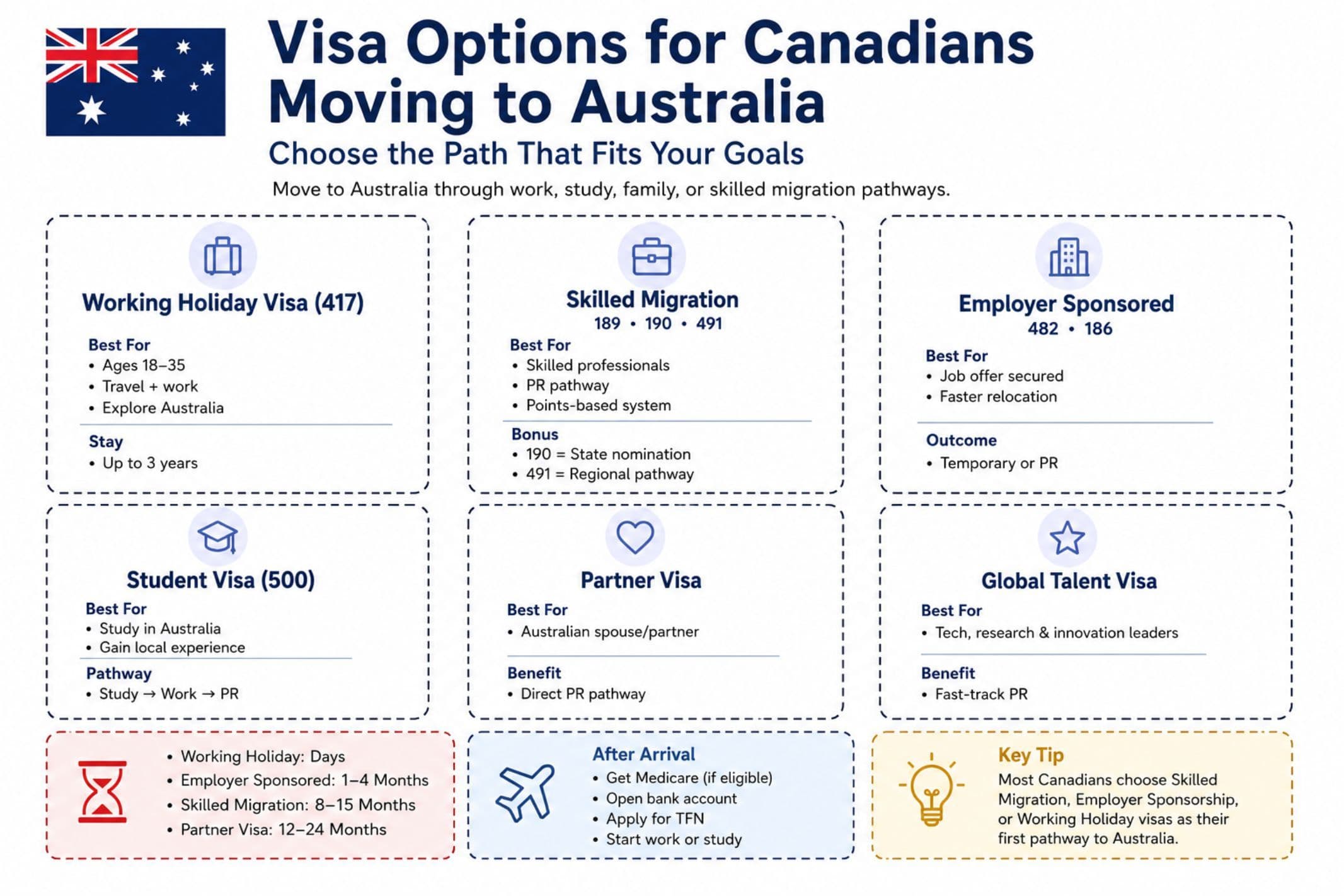
Before reading the visa details, ask yourself one question: do you need to be in Australia within the next few months, or can you wait 12 to 24 months for a stronger application? If speed matters, the Working Holiday Visa or a 482 employer sponsorship moves fastest. If long-term stability is the priority, the 189 or 190 is worth the longer process. The visa that sounds best is rarely the visa that's actually right for your situation.

Working Holiday Visa (Subclass 417)

The WHV is the fastest way into Australia most applications are decided within 24 to 48 hours online, and the fee is under AUD $700. What it doesn't give you is certainty: you're limited to six months with any single employer, which prevents you from building the deep Australian work history that speeds up a 190 application. Use it as a scouting year. Figure out which city fits, land a good employer, and use that relationship to transition to a 482 or points-based visa. One thing most people don't find out until they're already planning a second or third year: the regional work required for year two (88 days) and year three (179 days) means physically demanding labour in agriculture, construction, or disaster recovery. Know this before you factor a multi-year WHV into your plan.

Who It's For

This visa is designed for young Canadians who want flexibility. It's ideal if you want to travel, work casually, or test life in Australia before committing to permanent residency. Many professionals also use this visa to move first and then secure skilled employment.

Eligibility Requirements

To qualify, you must:

Hold a Canadian passport

Be between 18 and 35 years old

Have at least AUD $5,000 in savings

Meet health and character requirements

Not have dependent children accompanying you

The application process is simple and usually completed online, with decisions often made quickly.

How Long You Can Stay

  • First Working Holiday Visa: 12 months
  • Second Year: Available after 88 days of specified regional work
  • Third Year: Available after 179 days of additional regional work

This means Canadians can potentially stay in Australia for up to three years using this visa.

Why Canadians Choose This Visa

The biggest advantage is flexibility. You can work in different industries, move between cities, and explore opportunities without long-term commitments. Many Canadians arrive on this visa and later transition to employer sponsorship or skilled migration once they settle.

Skilled Independent Visa (Subclass 189)

The Subclass 189 is often considered the most straightforward skilled migration visa. If you receive an invitation, you get permanent residency from day one without needing employer sponsorship or state nomination. You’re also free to live and work anywhere in Australia, which gives this visa more flexibility than other skilled pathways.

The challenge is the invitation threshold. In IT and engineering, competitive rounds in 2025 often cleared at 85 to 90 points. If your score sits below 80, it’s usually more practical to treat the 189 as a longer-term goal while pursuing a 190 or 491 pathway at the same time. Waiting in the 189 pool at 70 points while also being eligible for state nomination is a common mistake that can delay applicants by 12 to 18 months.

Who This Visa Is For

The 189 visa is best suited for skilled professionals whose occupations appear on Australia’s Skilled Occupation List. Canadians working in healthcare, engineering, IT, construction, education, and trades commonly pursue this route.

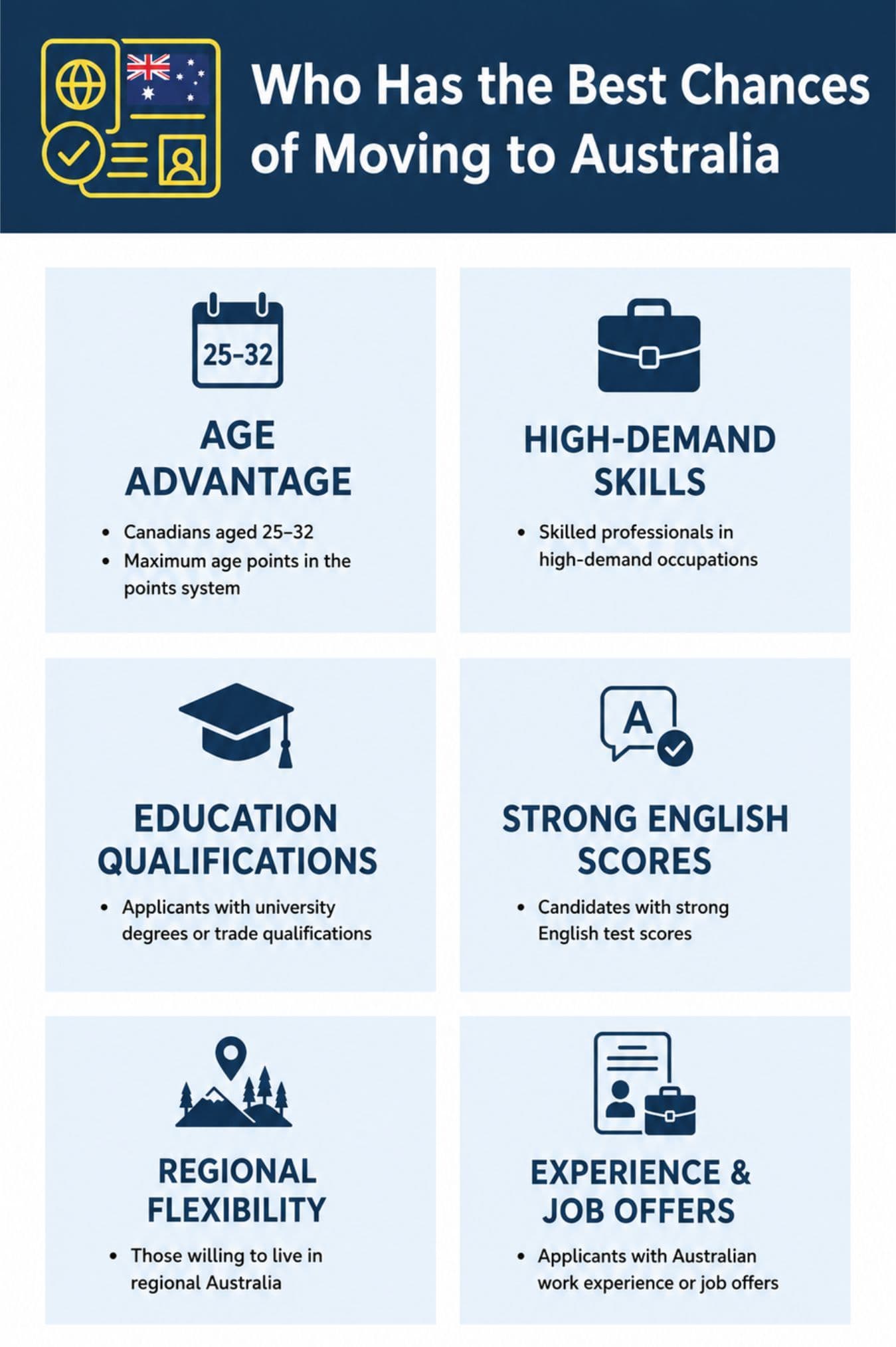
How the Points System Works

You must score at least 65 points to qualify, although competitive applicants usually need 80 points or higher. Points are awarded based on:

  • Age (highest points under 33)
  • Education level
  • Skilled work experience
  • English language ability
  • Partner skills (if applicable)
  • Australian qualifications (if applicable)

You first submit an Expression of Interest (EOI) through SkillSelect and wait for an invitation to apply.

Processing times range from 8 to 15 months after receiving an invitation, depending on demand and application volume.

Skilled Nominated Visa (Subclass 190)

The Subclass 190 leads to the same permanent residency outcome as the 189, but includes 5 extra points through state nomination, making it more achievable for many applicants. The trade-off is that you apply through a specific state or territory and are generally expected to live and work there after arrival.

State nomination requirements can change quickly. An occupation open in Victoria in January may be closed by March. For this reason, it's important to check official state migration websites directly rather than relying on third-party summaries, which are often outdated. If your occupation appears on multiple state lists, applying to more than one can significantly improve your chances.

How State Nomination Works

Each Australian state and territory runs its own migration program based on local workforce needs. If your occupation appears on a state's list and you meet the requirements, you can apply for nomination.

States may prioritise applicants with:

  • Relevant work experience
  • Strong English proficiency
  • Job offers within the state
  • Experience in high-demand industries

States that frequently nominate skilled migrants include:

  • New South Wales
  • Victoria
  • Queensland
  • Western Australia
  • South Australia
  • Tasmania
  • Australian Capital Territory
  • Northern Territory

Because each state has different requirements and priorities, your chances can vary depending on where you apply.

Living in the Nominating State

When you accept state nomination, you're generally expected to live and work in that state for at least two years. While not always strictly enforced, states nominate candidates based on local workforce needs and expect you to contribute locally.

Some Canadians find this helpful rather than restrictive. Smaller states often offer lower living costs, less competitive job markets, and a more balanced lifestyle. For applicants with slightly lower points scores, the Subclass 190 is often one of the most realistic and practical pathways to permanent residency.

Skilled Work Regional Visa (Subclass 491)

The 491 is the most accessible skilled visa for applicants in the 65 to 75 point range. The 15-point state or family sponsorship bonus changes the math entirely; a 70-point applicant with 491 nomination is suddenly at 85, competitive in most occupations. 'Regional' covers more than most people assume: Adelaide, Canberra, Gold Coast, Geelong, and Newcastle all qualify. After three years of regional living and meeting the minimum income threshold (approximately AUD $53,900), you apply for the permanent subclass 191 visa. The regional living obligation is real, but for applicants not yet attached to a specific city, it's a minor constraint for a significant benefit.

What Counts as Regional Australia

Regional Australia includes most cities and towns outside Australia's largest metropolitan areas. Many regional cities are modern, well-developed, and offer strong employment opportunities.

Popular regional cities include:

  • Adelaide
  • Perth
  • Gold Coast
  • Canberra
  • Hobart
  • Newcastle
  • Sunshine Coast
  • Geelong
  • Townsville
  • Wollongong

These locations offer strong infrastructure, good healthcare systems, and growing job markets in industries such as healthcare, construction, engineering, and technology.

Points Advantage

One of the biggest benefits of the Subclass 491 visa is the additional points. State or family sponsorship under this visa adds 15 points to your application. This can significantly improve your chances, especially if your initial points score is slightly below competitive levels.

Because of this advantage, many Canadians who may not qualify for the 189 or 190 visas often find the 491 visa more achievable.

Pathway to Permanent Residency

The Subclass 491 visa is a temporary visa but provides a clear path to permanent residency:

  • Visa valid for 5 years
  • Live and work in regional Australia
  • Meet minimum income requirements
  • Apply for permanent residency after 3 years (Subclass 191)

This structured pathway makes the visa attractive for applicants willing to settle outside major cities.

Why Canadians Are Choosing Regional Australia

  • Regional Australia offers several benefits:
  • Lower housing costs
  • Less traffic and congestion
  • Strong demand for skilled workers
  • Better work-life balance
  • Growing infrastructure and investment

Many Canadians also find regional Australian cities similar in size and lifestyle to mid-sized Canadian cities, making the transition easier.

Temporary Skill Shortage Visa (Subclass 482)

If you have a job offer, the 482 is usually faster than any points-based route standard applications process in 1 to 4 months. The trade-off is dependency: you're tied to your sponsoring employer. If the company downsizes, changes your role substantially, or closes, you have a limited window to find a new sponsor before your visa situation becomes complicated. Most people who use the 482 successfully either already have a strong employer relationship, or treat it explicitly as a 3-year stepping stone to the permanent employer nomination (subclass 186). Go in with that expectation rather than assuming you'll have full freedom once you land.

Employer Sponsorship

Employer sponsorship is the foundation of the Subclass 482 visa. An Australian company must offer you a full-time role and agree to sponsor your visa. The employer must also show that they have tried to hire locally and that your skills are needed in Australia.

This visa is common in industries where Australia faces ongoing worker shortages, including:

  • Healthcare and nursing
  • Engineering and construction
  • Information technology
  • Trades and technical roles
  • Hospitality management
  • Finance and accounting

Once sponsored, you can move to Australia and begin working for your employer almost immediately after approval.

Who Qualifies

To qualify for the Subclass 482 visa, you need:

  • A job offer from an approved Australian employer
  • At least two years of relevant work experience
  • Skills that match an occupation on the skilled list
  • English language proficiency
  • Health and character checks

This visa is particularly attractive for mid-career professionals who want to move quickly without going through the points-based system.

Processing Times

Processing times vary depending on the employer and application details. In many cases, applications are processed within:

  • 1 to 3 months for priority occupations
  • 2 to 4 months for standard applications

Because this visa is employer-driven, timelines are often faster than skilled migration visas.

Path to Permanent Residency

One of the biggest advantages of the Subclass 482 visa is the pathway to permanent residency. After working for your sponsoring employer, many applicants transition to the Employer Nomination Scheme (Subclass 186), which provides permanent residency.

This makes the 482 visa a popular stepping stone for Canadians who want to move quickly and secure long-term residency later.

Employer Nomination Scheme (Subclass 186)

The Employer Nomination Scheme (Subclass 186) is a permanent residency visa sponsored by an Australian employer. Unlike temporary visas, this option allows you to move to Australia as a permanent resident from the start.

This visa is often used by Canadians who already work in Australia on temporary visas or professionals who receive direct permanent job offers.

Direct Permanent Residency

One of the biggest advantages of the Subclass 186 visa is that it grants permanent residency immediately. This means:

  • You can live and work anywhere in Australia
  • You gain access to Medicare healthcare
  • You can sponsor eligible family members
  • You begin your pathway to Australian citizenship

This stability makes the 186 visa one of the most attractive employer-sponsored options.

Eligibility Requirements

To qualify, applicants generally need:

  • Employer sponsorship
  • Relevant qualifications and experience
  • Occupation on the skilled list
  • English language proficiency
  • Skills assessment (in many cases)

Some applicants transition to this visa after working on a Subclass 482 visa, while others apply directly from Canada.

Employer Sponsorship

Your employer must nominate you for a permanent role and demonstrate that your position is genuine and ongoing. This means employers sponsor candidates they see as long-term hires.

Processing times usually range from 6 to 12 months, depending on the application and occupation demand.

Student Visa (Subclass 500)

The Student Visa (Subclass 500) is another pathway Canadians use to move to Australia, especially those looking to change careers, gain Australian qualifications, or improve their chances of permanent residency.

This pathway is popular because Australian education can lead directly to post-study work visas and eventually permanent residency.

Study-to-PR Strategy

Many Canadians follow a study-to-permanent residency strategy:

  • Study in Australia
  • Gain local qualifications
  • Apply for a Graduate Visa (Subclass 485)
  • Gain Australian work experience
  • Apply for skilled migration or employer sponsorship

This approach is particularly helpful for applicants whose qualifications may not directly qualify for skilled migration.

Work Rights

Student visa holders are allowed to work while studying:

  • Up to 48 hours per fortnight during study periods
  • Full-time during school holidays

This allows students to support themselves financially and gain Australian work experience.

Popular Courses for PR

Some courses are more aligned with skilled migration pathways. Popular options include:

  • Nursing and healthcare
  • Engineering
  • Information technology
  • Teaching and education
  • Construction and trades
  • Accounting and finance

Choosing the right course can significantly improve your chances of transitioning to permanent residency after graduation.

Partner and Spouse Visa

The Partner and Spouse Visa is one of the most direct and reliable pathways to permanent residency in Australia. This visa is available to Canadians in a genuine relationship with an Australian citizen or permanent resident.

Unlike skilled visas, this pathway does not depend on occupation, qualifications, or points.

Eligibility

To qualify, you must demonstrate a genuine relationship. This includes:

  • Marriage or de facto relationship
  • Shared finances
  • Living together or long-term commitment
  • Evidence of a genuine ongoing relationship

Applicants must provide documentation such as joint bank accounts, leases, photos, travel history, and statements from friends or family.

Processing Times

Partner visa processing times vary but generally range between:

  • 12 to 18 months for straightforward cases
  • Up to 24 to 30 months for more complex applications

The process usually involves a temporary visa followed by permanent residency after further review.

Costs

The Partner Visa is one of the most expensive Australian visas. The application fee is approximately:

  • AUD $8,850 to $9,000 (subject to updates)

This fee covers both temporary and permanent residency stages.

Common Challenges

While the partner visa is a strong pathway, there are some challenges:

  • Extensive documentation requirements
  • Long processing times
  • High application cost
  • Need to demonstrate genuine relationship evidence

Despite these challenges, this visa remains one of the most secure pathways to permanent residency for Canadians with Australian partners.

Parent Visa Options

The standard parent visa (subclass 103) has an estimated wait time of 20 to 30 years due to annual allocation caps that is not a typo. For most families, the Contributory Parent Visa (subclass 143) is the only realistic route. It costs approximately AUD $48,000 per parent paid in stages and takes around 4 to 6 years. That is a significant financial commitment, but it provides permanent residency and stable long-term family reunification. The Sponsored Parent Temporary Visa (subclass 870) offers a faster, cheaper option for families who want time together while deciding on permanent plans up to 10 years of temporary stays.

Long Wait Times

One of the biggest challenges with Australian parent visas is processing time. Standard Parent Visas have extremely long queues due to limited places allocated each year.

Current estimated wait times:

  • Parent Visa (Subclass 103): Up to 20–30 years
  • Aged Parent Visa (Subclass 804): Often 15–25+ years

Because of these long processing times, many families choose contributory parent visas, which are significantly faster but more expensive.

Contributory Parent Visa timelines:

  • Contributory Parent Visa (Subclass 143): Around 4–6 years
  • Contributory Aged Parent Visa (Subclass 864): Similar timeframe

These faster options are more realistic for families who want to reunite within a reasonable timeframe.

Costs

Parent visas are among the most expensive Australian visas. Contributory parent visas cost:

  • Around AUD $48,000 per parent (paid in stages)
  • Additional costs for health checks, police certificates, and documentation

While expensive, these visas provide permanent residency, access to Medicare, and long-term stability for parents moving to Australia.

Many families treat this as a long-term investment in family reunification and lifestyle.

Temporary Options

For families who do not want to wait or pay for permanent parent visas immediately, temporary options are available.

The Sponsored Parent Temporary Visa (Subclass 870) allows parents to:

  • Stay in Australia for 3 or 5 years
  • Renew the visa for up to 10 years total
  • Live with family while deciding on permanent options

This visa does not provide permanent residency but offers flexibility and faster processing, making it a practical interim solution for many Canadian families.

Parent visas are best suited for Canadians whose children are already established in Australia and who are planning long-term relocation.

Global Talent Visa

The Global Talent Visa is worth pursuing if you have genuine international recognition in your field published research, senior leadership roles at a recognisable company, patents, or a profile that an Australian government nominee can credibly vouch for. The income threshold in 2026 is approximately AUD $167,500. You don't need to currently earn that, but your evidence must credibly demonstrate you can command that salary in Australia. Most applicants don't qualify and the 189 or 190 reaches the same destination on a longer timeline. Apply for GTI only if your profile genuinely fits, not as a shortcut attempt.

Who Qualifies

This visa targets professionals in high-growth industries, including:

  • Technology and digital sectors
  • Engineering and infrastructure
  • Healthcare and medical research
  • Fintech and financial services
  • Cybersecurity and artificial intelligence
  • Renewable energy and resources
  • Advanced manufacturing
  • Education and research

Applicants demonstrate:

  • International recognition in their field
  • Senior-level experience
  • Strong career achievements
  • Ability to contribute to Australia's economy

Many successful applicants include senior engineers, tech leaders, researchers, executives, and entrepreneurs.

High-Income Threshold

A key requirement for the Global Talent Visa is meeting the high-income threshold. Applicants must demonstrate they can earn at or above the Fair Work High Income Threshold.

In 2026, this threshold is approximately:

  • AUD $167,500 per year (subject to annual updates)

You do not always need to currently earn this amount, but you must demonstrate the potential to reach this level in Australia.

This requirement ensures that applicants bring high-value skills to the Australian workforce.

Fast Processing

One of the biggest advantages of the Global Talent Visa is fast processing. While standard skilled visas can take many months or longer, Global Talent Visa applications are often processed more quickly.

Typical processing timelines:

  • 3 to 6 months for strong applications
  • Sometimes faster for priority candidates

The visa also offers:

  • Direct permanent residency
  • No points test required
  • Flexibility to live anywhere in Australia
  • Pathway to citizenship
PreviousUnderstanding Australia's Immigration System
NextThe Points Test : How Australia's Skilled Migration System Works
In This Chapter
Share This Guide
Share This Guide