Not every Canadian document follows the same apostille process for Spain. Vital records go directly from the provincial registry to the authentication authority. University degrees require a notarization step first. Business documents vary depending on whether the company is federal or provincial. Medical certificates depend on the specific Spanish consulate handling your case.
This section explains each Canadian document apostille process for Spain, including what to order, what Spanish authorities require, and where delays usually happen.

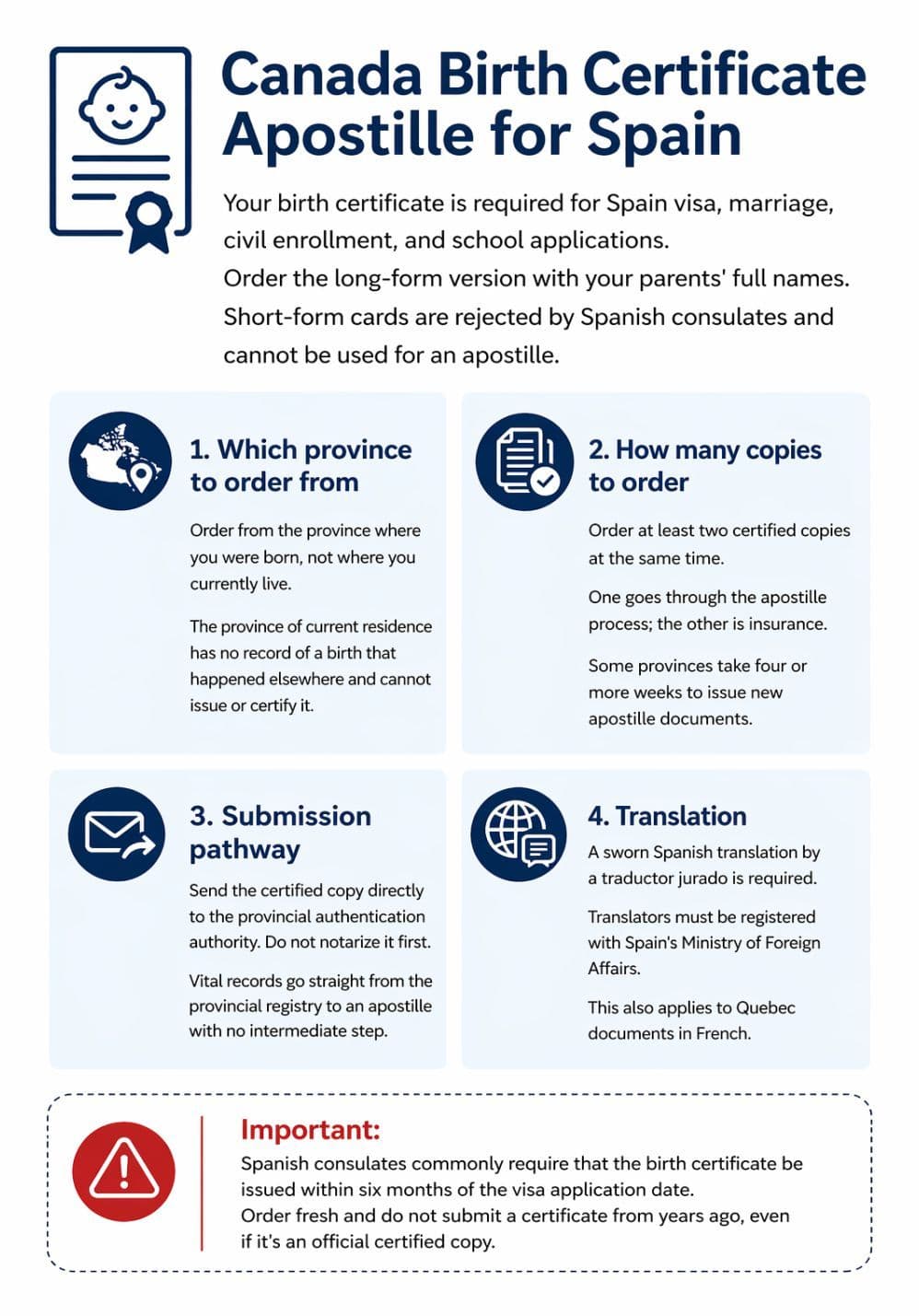
Your birth certificate comes up in more situations than almost any other document, including Spain visa applications, marriage registration in Spain, civil enrollment, and school applications. Order the long-form version specifically, the one that lists your parents' full names. The short-form card that works for Canadian government purposes is rejected by Spanish consulates and cannot be used for a birth certificate apostille for Spain.
Which province to order from
Order from the province where you were born, not where you currently live. Born in Manitoba but living in BC? That certificate comes from Manitoba Vital Statistics. The province of current residence has no record of a birth that happened elsewhere and cannot issue or certify it for a Canada apostille process.
How many copies to order
Order at least two certified copies at the same time. One goes through the apostille process; the other is insurance. If the first is lost in transit or returned with a correction request, you're set back weeks without a backup, and some provinces take four or more weeks to process a new order for apostille documents in Canada.
Submission pathway
Send the certified copy directly to the provincial authentication authority. Do not notarize it first. Private notarization of a provincial vital record is not part of the process and will cause the submission to be returned. Vital records go straight from the provincial registry to an apostille with no intermediate step in the Canada apostille process for Spain.
Translation
A sworn Spanish translation by a traductor jurado is required. Translators must be officially registered with Spain's Ministry of Foreign Affairs, not just any bilingual professional or certified translator for Canadian legal purposes. For Quebec documents in French, this applies equally to Spanish document translation requirements.
Important: Spanish consulates commonly require that the birth certificate be issued within six months of the visa application date. Order fresh and do not submit a certificate from years ago, even if it's an official certified copy for your Spain visa documentation.
Marriage certificates are required for spousal residency applications, family reunification visas, and civil registration in Spain, and they are one of the documents Spanish authorities scrutinize for name consistency during the apostille process for Spain.
The province of marriage is not the province of residence
Only the province where the marriage was registered can issue the official certificate. A certificate ordered from any other province, or a copy kept in a personal file, is not valid for apostille. Contact the registry of the province where the ceremony was registered, regardless of where you live now, to complete your marriage certificate apostille in Canada.
Name discrepancies: Address them before submission
If your name on the marriage certificate doesn't exactly match your passport, such as a missing middle name, a maiden name versus a married name, or a different hyphenation, attach a sworn statutory declaration explaining the discrepancy before submitting. Don't wait for the consulate to flag it. A discrepancy raised at the consulate stage can delay an appointment by months in your Spain visa application process.
Certificate age
Spain generally requires marriage certificates issued within six months of submission. The certificate you received on your wedding day, filed away for years, will not be accepted for Spanish immigration documents. Order a fresh certified copy.
Submission and translation
Submit directly to the provincial competent authority or Global Affairs Canada. No private notarization is added. A sworn Spanish translation by a traductor jurado is mandatory, following the same translator qualification standard as for birth certificates in the apostille process Canada to Spain.
Tip: If you are a divorced applicant remarrying in Spain, you need both the marriage certificate from the new marriage and an apostilled divorce decree from the prior one. Process them in parallel, as they often have the same six-month recency requirement for Spain legal document submission.
Death certificates come up in Canada and Spain apostille requests most often for estate and inheritance matters, not for standard visa applications. If a family member has died and held assets, property, or pension rights in Spain, the Spanish estate process requires an apostilled death certificate before proceedings can begin. If you are a visa applicant with no estate involvement, this section likely doesn't apply to you.
Who can request one
Provinces restrict access to death certificates. Immediate family members, estate executors, and legal representatives can generally obtain them, but eligibility rules vary. Confirm with the provincial registry before ordering, particularly if you are acting as an executor or a distant relative requesting a death certificate apostille in Canada.
What to order
A certified copy of the original death certificate, issued by the province where the death was registered. Photocopies and unofficial copies are not accepted. Order directly from the provincial vital statistics office for the apostille process in Canada.
Submission and translation
Submit the certified copy to the provincial competent authority or Global Affairs Canada. No notarization is added. A sworn Spanish translation by a traductor jurado is required for the Spanish estate process and Spanish legal documentation.
Important: Estate matters in Spain move on legal deadlines. Apostille processing plus translation adds 6 to 10 weeks minimum to an already complex process. Build that time in early and do not start the apostille process after you've already engaged a Spanish notary for the estate.
Spain needs official proof that a prior marriage was legally dissolved before it will register a new marital status, process certain visa types, or permit marriage on Spanish soil. A divorce decree that looks complete on its face but is missing pages or lacks the court's official seal will be turned away during the apostille process for Spain.
What 'court-certified' actually means
You need a copy issued by the court clerk with the original court seal and the clerk's original signature, not a photocopy of your personal copy, not a printout from an online court portal, and not a lawyer's file copy. Every page of the decree must be included. Incomplete decrees are the leading cause of rejection for this type of divorce decree apostille in Canada.
Submission pathway
Certified court copies go to the provincial competent authority or Global Affairs Canada. No additional notarization is required because the court certification itself is sufficient. A sworn Spanish translation is required for the submission of a Spanish legal document.
Older decrees
Courts processing requests for older cases can take several weeks, particularly if the records are archived offsite. Contact the court registry directly for a realistic timeline before assuming standard turnaround for your Canada apostille process.
Tip: If you are remarrying in Spain and were previously divorced, Spanish civil authorities will want the apostilled divorce decree alongside your new marriage documentation and your single status affidavit. Prepare all three in the same processing window for smooth Spain marriage documentation approval.

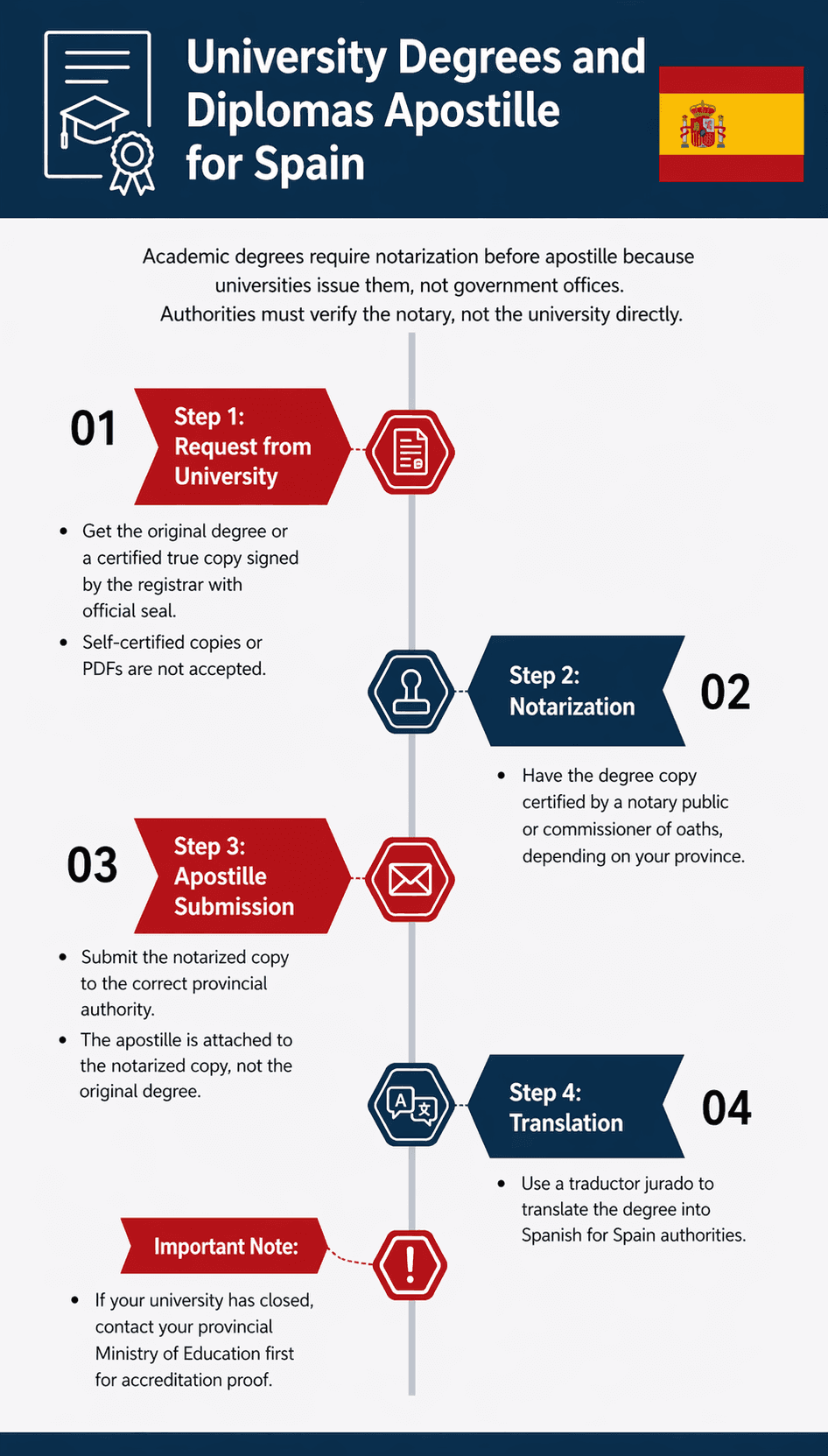
Academic credentials are the only major document category where notarization is built into the standard apostille process in Canada and Spain for everyone, not just in specific provinces or for specific visa types. This is because degrees are issued by institutions, not governments, so the apostille authority has no way to verify the original directly.
Step 1: What to request from the university
Ask the registrar for either the original degree or a certified true copy bearing the registrar's signature and the institution's official seal. A photocopy you certified yourself or a scanned PDF is not sufficient for a degree apostille in Canada.
Step 2: Notarization
Take the document to a notary public in BC and Quebec or a commissioner of oaths in other provinces to certify a true copy. This notarization is the bridge between your institution-issued document and the government authority that will issue the apostille. The apostille verifies the notary's credentials and confirms that the notary who certified the copy is legitimate, which, by extension, authenticates the degree for Spain education document verification.
Step 3: Apostille submission
Submit the notarized copy to the appropriate provincial competent authority. The apostille is placed on the notarized copy and not on the original degree certificate itself as part of the Canada apostille process for Spain.
Step 4: Translation
Have a traductor jurado translate the degree content into Spanish. This translation is attached to the apostilled document before submission to Spanish authorities for Spain document translation requirements.
Note: If your university has closed since you graduated, contact your province's Ministry of Education before attempting anything. Some provinces maintain records of dissolved institutions, while others require a letter from the ministry itself confirming the institution's accreditation history. Without this step, the notary has nothing verifiable to certify against for the apostille documents Canada process.
The apostille pathway for business documents depends entirely on how the company was incorporated. Federal and provincial corporations follow different routes, and private business documents such as contracts, agreements, and authorizations require notarization before they go anywhere near an authentication office for a business document apostille Canada.
Federal corporations
Certificates of incorporation, good standing, and existence for federally incorporated companies go to Global Affairs Canada and not to any provincial authority. This applies regardless of which province the business operates in for a corporate apostille in Canada.
Provincial corporations
Provincially incorporated businesses use the authentication authority of the province in which they are registered. An Alberta-incorporated company's certificate of good standing goes through Service Alberta and not through any federal channel for the apostille process in Canada.
Private documents, contracts, agreements, and authorizations
Shareholder agreements, power of attorney documents, and commercial contracts are not government-issued. They must be notarized first and then submitted to the provincial authority for an apostille. The notarization certifies the signatures and the apostille, then validates the notary for the legalization.
Important: Certificates of good standing have a short shelf life. Spanish authorities commonly require them to be dated within three months of submission. Do not order these early and time the request to your actual submission window for the Spain company registration documents.
Canada does not apostille passports. The original document is never submitted for authentication. When Spanish authorities ask for an apostilled passport, which happens occasionally for specific property or financial transactions and not for standard visa applications, what they actually need is a notarized copy of the passport with an apostille on the notarization for a passport copy apostille for Spain.
Take your passport to a notary public or commissioner of oaths, who will certify a true copy. That notarized copy is what goes to the provincial authentication authority. Translation is usually not required unless specifically requested for the Spain document submission.
Tip: Before going through this process, confirm it is actually necessary. Many Spanish authorities that initially list an apostilled passport copy in their requirements will accept a plain notarized copy or simply a photocopy once asked directly. The apostille adds weeks and cost, so verify before starting your apostille process from Canada to Spain.
Apostilling a driving licence is rare. It comes up occasionally for identity verification in residency-related processes and not for actually driving in Spain, where an International Driving Permit issued by CAA is the standard solution.
If an apostille is specifically requested, notarize a photocopy of your licence with a notary public or commissioner of oaths, and then submit the notarized copy to the provincial competent authority for authentication. The original licence is not submitted for the driving licence apostille in Canada.
Tip: If the underlying purpose is driving in Spain, get an International Driving Permit from CAA before you leave Canada. It is faster, costs around $25, and is recognized throughout Spain and the EU. The apostille route is for administrative identity purposes only.
Enrollment confirmations, student status letters, and academic verification documents are issued by educational institutions, which means they follow the same notarization first pathway as university degrees and not the direct submission pathway of vital records for the academic document apostille Canada.
The document must carry an original signature and the institution's official seal. A printout from a student portal or an unsigned template letter is not sufficient. Take the original signed letter to a notary or commissioner of oaths for certification, and then submit the notarized copy to the provincial authentication authority.
A sworn Spanish translation by a traductor jurado is required before submission to Spanish authorities for Spain academic document verification.
Note: Universities issue these letters routinely, but not all will include the specific language Spanish authorities expect, particularly around enrollment status, program name, and expected completion date. Ask the registrar whether there is a standard international enrollment confirmation format before accepting the default letter.
The Non-Lucrative Visa requires a medical certificate signed by a licensed Canadian physician in original wet ink. Printed or digital signatures are rejected. The certificate must confirm that you have no contagious or communicable diseases. Spanish consulates are specific about the wording required. A certificate that uses different phrasing, even if the underlying medical content is identical, may be sent back for correction during the medical certificate apostille Canada process.
Whether the medical certificate also needs to be apostilled depends on the consulate. Some require it while others accept a notarized copy. This is not standardized across Spanish consulates in Canada.
Important: Check with your specific consulate and not the general Spain visa guidance online before having the medical certificate notarized or apostilled. Applying the wrong authentication step wastes time and money, and recency requirements mean you may need to get the medical exam redone if too much time passes during the correction process.
Standard bank statements for most Spain visa applications do not require an apostille. A signed and stamped statement from a bank officer is generally accepted as is. Apostille on bank statements comes up primarily in financial verification for property transactions or specific residency processes, and not for Non-Lucrative or Digital Nomad visa applications, which have their own financial documentation standards.
If an apostille is requested, the bank must sign and stamp the statement, a notary certifies it, and the notarized copy goes to the provincial authentication authority. This is the same pattern as any private financial document and follows the bank statement apostille Canada process.
Tip: If you are applying for the Non-Lucrative Visa, confirm what financial documentation your specific consulate requires before assuming an apostille is needed. Most consulates specify bank statements, investment account summaries, or pension letters with specific balance thresholds, and an apostille is rarely part of that list.
If you plan to marry in Spain, Spanish civil authorities require proof that you are legally free to marry and that you have no existing marriage in Canada. A single status affidavit, also called a Certificate of No Impediment, is a sworn declaration that provides this confirmation for the single status affidavit apostille Canada.
How it is created
The affidavit must be executed before a notary public or commissioner of oaths. It becomes legally valid only when signed in their presence under oath. A self-drafted and signed document, or one signed outside a notary's presence, is not valid. The notary's certification of the oath is what gets apostilled and not the content of the affidavit itself.
Submission and translation
Submit the notarized affidavit to the provincial competent authority for apostille. A sworn Spanish translation by a traductor jurado is required for Spain marriage legal documents.
Important: If you are divorced, a single status affidavit alone is not sufficient. Spanish civil authorities want the apostilled divorce decree alongside it. This serves as proof that the prior marriage ended, and not just a sworn statement that you are currently single. Prepare both documents in the same processing window since they often have matching recency requirements.